Laboratory of Genetic Diagnostics, Medical University of Lublin, 20-093 Lublin, Poland.
Student Scientific Society, Laboratory of Genetic Diagnostics, Medical University of Lublin, 20-093 Lublin, Poland.
Int J Mol Sci. 2022 Mar 2;23(5):2755. doi: 10.3390/ijms23052755.
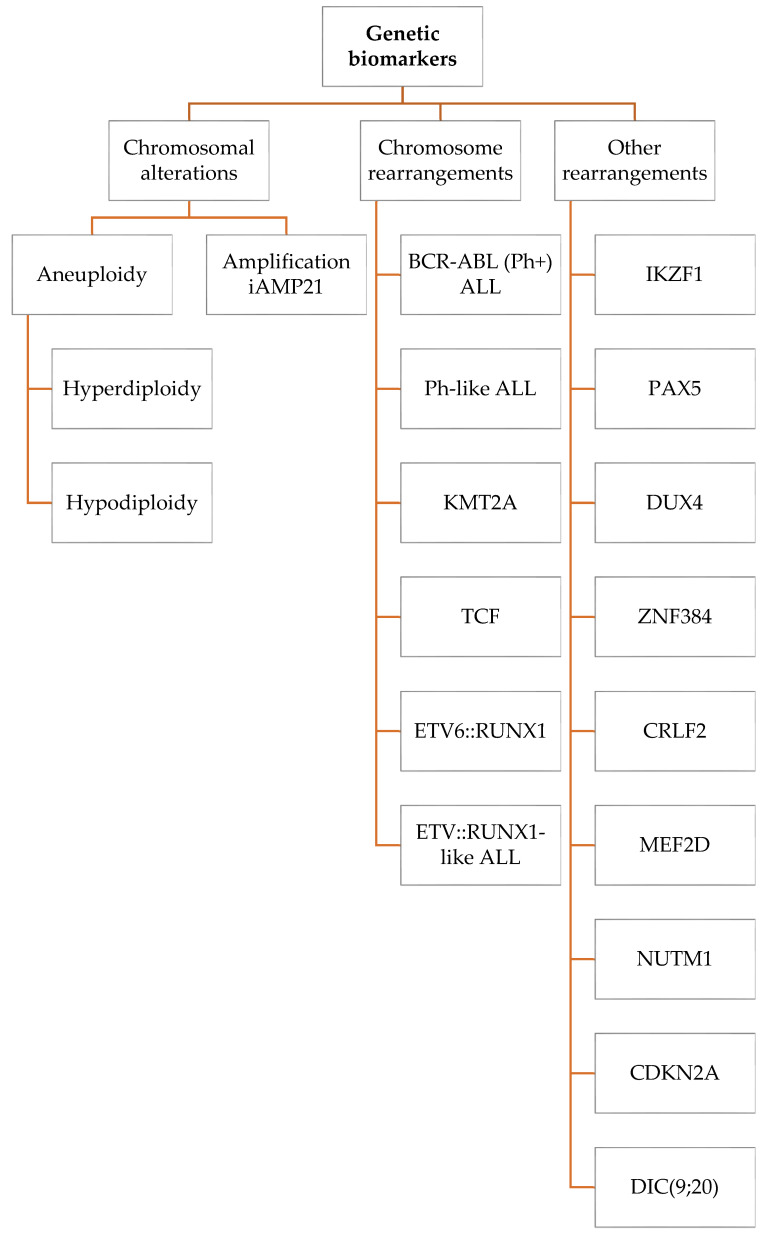
Acute lymphoblastic leukemia (ALL) is a heterogeneous group of hematologic malignancies characterized by abnormal proliferation of immature lymphoid cells. It is the most commonly diagnosed childhood cancer with an almost 80% cure rate. Despite favorable survival rates in the pediatric population, a significant number of patients develop resistance to therapy, resulting in poor prognosis. ALL is a heterogeneous disease at the genetic level, but the intensive development of sequencing in the last decade has made it possible to broaden the study of genomic changes. New technologies allow us to detect molecular changes such as point mutations or to characterize epigenetic or proteomic profiles. This process made it possible to identify new subtypes of this disease characterized by constellations of genetic alterations, including chromosome changes, sequence mutations, and DNA copy number alterations. These genetic abnormalities are used as diagnostic, prognostic and predictive biomarkers that play an important role in earlier disease detection, more accurate risk stratification, and treatment. Identification of new ALL biomarkers, and thus a greater understanding of their molecular basis, will lead to better monitoring of the course of the disease. In this article, we provide an overview of the latest information on genomic alterations found in childhood ALL and discuss their impact on patients' clinical outcomes.
急性淋巴细胞白血病(ALL)是一组异质性血液恶性肿瘤,其特征为不成熟淋巴细胞的异常增殖。它是最常见的儿童期癌症,治愈率接近 80%。尽管儿科人群的生存率良好,但仍有相当数量的患者对治疗产生耐药性,导致预后不良。ALL 在遗传水平上是一种异质性疾病,但在过去十年中测序技术的飞速发展使得研究基因组变化成为可能。新技术使我们能够检测点突变等分子变化,或表征表观遗传或蛋白质组学特征。这一过程使得能够识别这种疾病的新亚型,其特征是遗传改变的星座,包括染色体改变、序列突变和 DNA 拷贝数改变。这些遗传异常可用作诊断、预后和预测生物标志物,在早期疾病检测、更准确的风险分层和治疗中发挥重要作用。鉴定新的 ALL 生物标志物,从而更好地了解其分子基础,将有助于更好地监测疾病的进程。本文综述了儿童 ALL 中发现的最新基因组改变信息,并讨论了它们对患者临床结局的影响。