Department of Periodontology, School of Dentistry, Faculty of Health, Witten/Herdecke University, Alfred-Herrhausen Str. 45, 58455, Witten, Germany.
Institute of Pharmacology and Toxicology, Center for Biomedical Education and Research (ZBAF), Faculty of Health, Witten/Herdecke University, Stockumer Straße 10, 58453, Witten, Germany.
Clin Oral Investig. 2021 Dec;25(12):6707-6715. doi: 10.1007/s00784-021-03957-x. Epub 2021 May 3.
The aim of the study was to compare the performance of narrow diameter implants in patients with uncontrolled diabetes mellitus type 2 (T2DM) and normo-glycemic individuals during the first 12 months after implant loading.
In 16 T2DM patients with HbA1C > 6.5% (test group) and 16 normo-glycemic patients (HbA1C < 6.0%; control group), one to two narrow diameter tissue level implants were placed in the posterior maxilla or mandible. After 3-month lasting integration period, implants were loaded by fixed dentures. The clinical parameters probing depth (PD), bleeding on probing (BOP), attachment loss (CAL), recession and papilla bleeding index (PBI) were assessed manually at loading and after 12 months of function. The paired digital periapical radiographs were analyzed with regard to the change in marginal bone level (MBL) from baseline to 12 months' control. The mean values calculated for both patient groups were statistically analyzed. The technical complications were recorded.
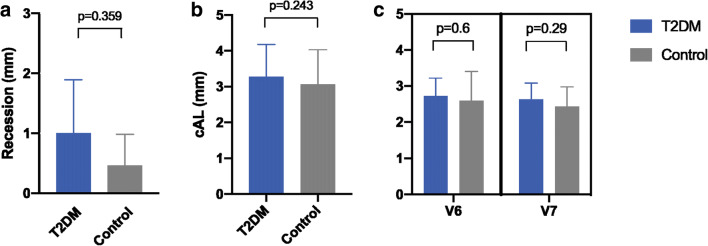
The T2DM group accounted 13 patients due to 3 dropouts. The overall implant survival rate after 12 months was 100%. The differences in means for the clinical parameters and the MBL were statistically non-significant between the T2DM and normo-glycemic patients for the short period of loaded function reported here. No technical complications were recorded.
The study demonstrated an encouraging clinical outcome with narrow diameter implants in patients with uncontrolled T2DM compared to non-diabetics after 12 months post loading. For the short observation period, no biological and technical complications were reported regardless the glycemic status.
Patients with HbA1C > 6.5% may benefit from the treatment with narrow diameter implants by avoiding complex surgical interventions with augmentation procedures.
Clinicaltrials.gov : NCT04630691.
本研究旨在比较糖尿病 2 型(T2DM)未控制患者和血糖正常个体在种植体负荷后 12 个月内,窄直径种植体的性能。
在 16 名糖化血红蛋白(HbA1C)>6.5%的 T2DM 患者(试验组)和 16 名血糖正常患者(HbA1C<6.0%;对照组)中,在后颌牙槽嵴放置 1 至 2 个窄直径的组织水平种植体。经过 3 个月的整合期后,通过固定义齿负荷种植体。在负荷和功能 12 个月时,手动评估探诊深度(PD)、探诊出血(BOP)、附着丧失(CAL)、退缩和龈乳头出血指数(PBI)等临床参数。使用数字根尖片分析从基线到 12 个月的边缘骨水平(MBL)的变化。对两组患者的平均值进行了统计学分析。记录了技术并发症。
由于 3 名患者脱落,T2DM 组患者数为 13 名。12 个月后,总体种植体存活率为 100%。在报告的短期负荷功能期间,T2DM 患者和血糖正常患者的临床参数和 MBL 的平均值差异无统计学意义。未记录到技术并发症。
与非糖尿病患者相比,未经控制的 T2DM 患者在负荷后 12 个月内使用窄直径种植体可获得令人鼓舞的临床效果。在观察期较短的情况下,无论血糖状况如何,均未报告生物学和技术并发症。
糖化血红蛋白(HbA1C)>6.5%的患者可以通过避免复杂的手术干预和增强手术来受益于使用窄直径种植体的治疗。
Clinicaltrials.gov:NCT04630691。