Division of Cardiology, Yokohama City University Medical Center, Yokohama, Japan.
Department of Medical Science and Cardiorenal Medicine, Yokohama City University Graduate School of Medicine, Yokohama, Japan.
J Cachexia Sarcopenia Muscle. 2021 Jun;12(3):568-576. doi: 10.1002/jcsm.12702. Epub 2021 May 3.
Cachexia, characterized by loss of muscle with or without loss of fat mass, is a poor prognostic factor in patients with heart failure (HF). However, there is limited investigation on the prognostic impact of muscle and fat mass separately in HF. We hypothesized that muscle and fat mass have different effects on the prognosis of HF.
This was an observational cohort study of 418 patients (59% were men) admitted with a diagnosis of HF (71 ± 13 years [mean ± standard deviation]), with left ventricular ejection fraction (LVEF) of 39 ± 16%, including 31.3%, 14.8%, and 53.8% of patients with preserved LVEF (LVEF ≥ 50%), mid-range LVEF (40-50%), and reduced (<40%) LVEF, respectively. Dual-energy X-ray absorptiometry was performed with the patients in the stable state after decongestion therapy.
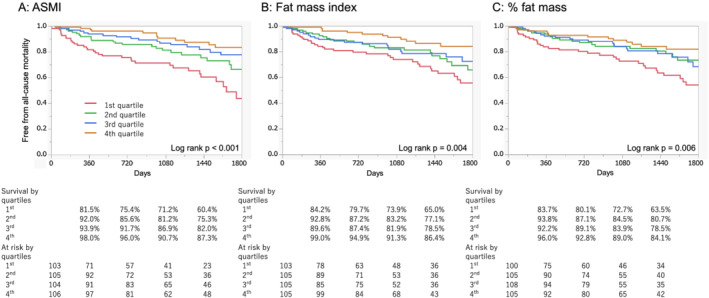
The mean body mass index of patients was 22.1 ± 4.6 kg/m , and the mean appendicular skeletal mass (ASM) index was 6.88 ± 1.23 kg/m in men and 5.59 ± 0.92 in women; 54.1% of the patients showed reduced muscle mass defined by the international cut-off value (7.0 kg/m for men and 5.4 for women). The mean fat mass was 20.4 ± 7.2% in men and 27.2 ± 8.6% in women. During a median follow-up of 37 months, 92 (22.0%) of 418 patients with HF died (1 and 3 year mortality: 8.4% and 17.3%, respectively). Lower values of both skeletal muscle and fat mass were independently associated with increased risk of mortality adjusted for age, sex, haemoglobin, New York Heart Association functional class, and height squared (hazard ratio with 95% confidence interval of 0.825 [0.747-0.908] per 1 kg increase of ASM, P < 0.001, and 0.954 [0.916-0.993] per 1 kg increase of fat mass, P = 0.018, respectively).
More than half of the patients with HF showed reduced muscle mass. Lower values of both muscle and fat mass were associated with higher mortality in HF.
恶病质是一种以肌肉减少伴或不伴脂肪减少为特征的疾病,是心力衰竭(HF)患者预后不良的一个危险因素。然而,目前对于 HF 患者中肌肉和脂肪质量的预后影响的研究还很有限。我们假设肌肉和脂肪质量对 HF 的预后有不同的影响。
这是一项对 418 名(59%为男性)因 HF 住院的患者进行的观察性队列研究(诊断时年龄 71±13 岁[均值±标准差]),左心室射血分数(LVEF)为 39±16%,包括 31.3%、14.8%和 53.8%的患者为射血分数保留型 HF(LVEF≥50%)、中间范围 LVEF(40-50%)和射血分数降低型 HF(<40%)。在充血治疗后稳定状态下对患者进行双能 X 线吸收法测量。
患者的平均体重指数为 22.1±4.6kg/m ,男性的平均四肢骨骼肌质量指数为 6.88±1.23kg/m ,女性为 5.59±0.92kg/m ;54.1%的患者肌肉质量低于国际截断值(男性 7.0kg/m ,女性 5.4kg/m )。男性的平均脂肪量为 20.4±7.2%,女性为 27.2±8.6%。在中位随访 37 个月期间,418 例 HF 患者中有 92 例(22.0%)死亡(1 年和 3 年死亡率分别为 8.4%和 17.3%)。在调整年龄、性别、血红蛋白、纽约心脏协会功能分级和身高平方后,骨骼肌和脂肪质量较低与死亡率增加独立相关(每增加 1kg 四肢骨骼肌质量,风险比[HR]为 0.825[0.747-0.908],P<0.001,每增加 1kg 脂肪质量,HR 为 0.954[0.916-0.993],P=0.018)。
超过一半的 HF 患者存在肌肉减少。肌肉和脂肪质量降低与 HF 患者的高死亡率相关。