Department of Obstetrics and Gynecology, Baylor College of Medicine, Houston, Texas.
Department of Obstetrics and Gynecology, University Hospital Zurich, Zurich, Switzerland.
Am J Perinatol. 2023 Mar;40(4):400-406. doi: 10.1055/s-0041-1728828. Epub 2021 May 3.
Obesity in pregnancy bears unique maternal and fetal risks. Obesity has also been associated with chronic inflammation, including elevated serum levels of interleukin-6 (IL-6) and tumor necrosis factor-α (TNF-α). Higher serum lipopolysaccharide (LPS) levels have been implicated in driving this inflammation, a phenomenon called metabolic endotoxemia (ME). GLP-2, a proglucagon-derived peptide, is believed to be integral in maintaining the integrity of the intestine in the face of LPS-mediated endotoxemia. We hypothesized that obesity and/or excess weight gain in pregnancy would be associated with an increase in maternal and neonatal markers of ME, as well as GLP-2.
Paired maternal and neonatal (cord blood) serum samples ( = 159) were obtained from our pregnancy biobank repository. Serum levels of LPS, endotoxin core antibody-immunoglobulin M (EndoCAb-IgM), and GLP-2 were measured by ELISA. IL-6 and TNF-α were measured using a Milliplex assay. Results were stratified by maternal body mass index (BMI), maternal diabetes, and gestational weight gain (GWG).
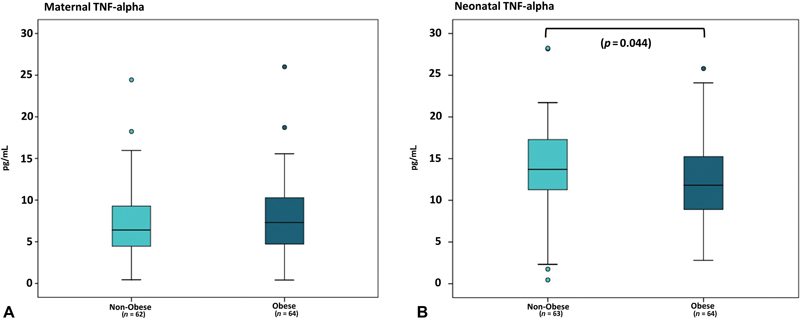
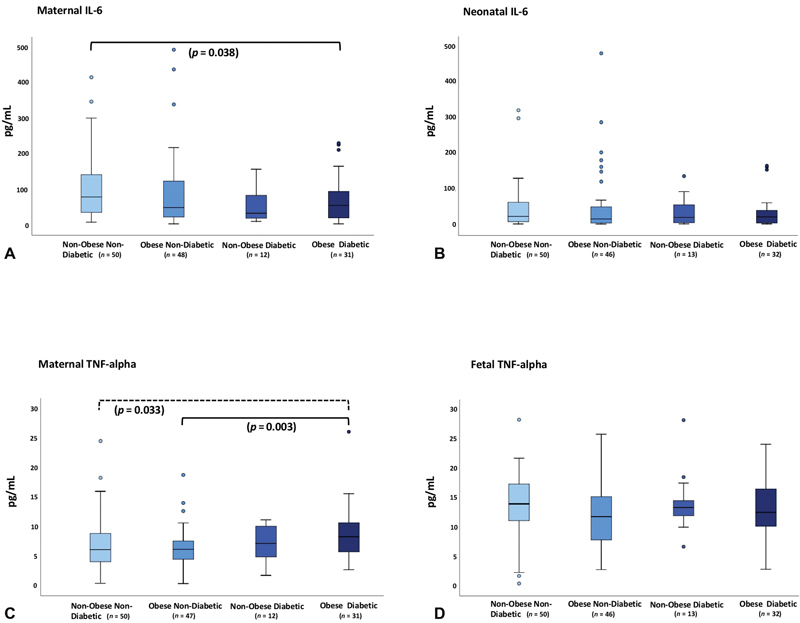
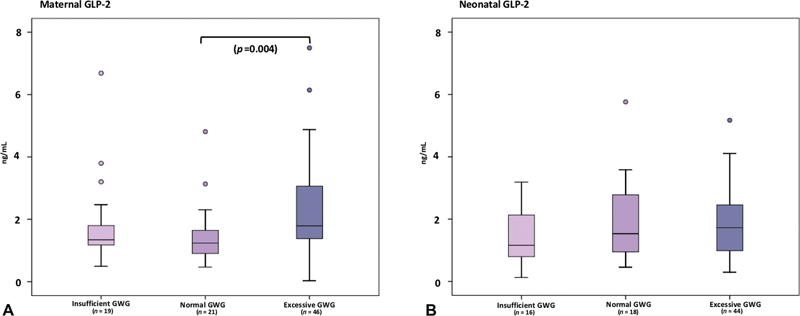
Maternal IL-6 is significantly decreased in the obese, diabetic cohort compared with the nonobese, nondiabetic cohorts (95.28 vs. 99.48 pg/mL, = 0.047), whereas GLP-2 is significantly increased (1.92 vs. 2.89 ng/mL, = 0.026). Neonatal TNF-α is significantly decreased in the obese cohort compared with the nonobese cohort (12.43 vs. 13.93 pg/mL, = 0.044). Maternal GLP-2 is significantly increased in women with excess GWG compared with those with normal GWG (2.27 vs. 1.48 ng/mL, = 0.014). We further found that neonatal IL-6 and TNF-α are negatively correlated with maternal BMI (-0.186, = 0.036 and -0.179, = 0.044, respectively) and that maternal and neonatal IL-6 showed a positive correlation (0.348, < 0.001).
Although we observed altered levels of markers of inflammation (IL-6 and TNF-α) with maternal obesity and diabetes, no changes in LPS or endoCAb-IgM were observed. We hypothesize that the increased GLP-2 levels in maternal serum in association with excess GWG may protect against ME in pregnancy.
· Maternal serum levels of GLP-2, a proglucagon-derived peptide, are increased in obese, diabetic gravidae.. · Maternal serum GLP-2 levels are also increased in association with excess gestational weight gain compared with normal gestational weight gain.. · GLP-2 may be increased in association with obesity and weight gain to protect against metabolic endotoxemia in pregnancy..
妊娠肥胖对母婴均存在独特的风险。肥胖还与慢性炎症有关,包括白细胞介素-6(IL-6)和肿瘤坏死因子-α(TNF-α)的血清水平升高。脂多糖(LPS)水平升高与这种炎症有关,这种现象称为代谢性内毒素血症(ME)。胰高血糖素原衍生肽 GLP-2 被认为是在 LPS 介导的内毒素血症中维持肠道完整性的重要因素。我们假设肥胖和/或妊娠期间体重过度增加与母婴 ME 以及 GLP-2 的标志物增加有关。
从我们的妊娠生物库库中获得了 159 对配对的产妇和新生儿(脐血)血清样本。通过 ELISA 测量 LPS、内毒素核心抗体免疫球蛋白 M(EndoCAb-IgM)和 GLP-2 的血清水平。使用 Milliplex 测定法测量 IL-6 和 TNF-α。结果根据母体体重指数(BMI)、母体糖尿病和妊娠体重增加(GWG)进行分层。
与非肥胖、非糖尿病组相比,肥胖、糖尿病组的母体 IL-6 明显降低(95.28 与 99.48 pg/mL, = 0.047),而 GLP-2 明显升高(1.92 与 2.89 ng/mL, = 0.026)。与非肥胖组相比,肥胖组新生儿 TNF-α明显降低(12.43 与 13.93 pg/mL, = 0.044)。与 GWG 正常的妇女相比,GWG 过多的妇女的母体 GLP-2 明显升高(2.27 与 1.48 ng/mL, = 0.014)。我们进一步发现,新生儿 IL-6 和 TNF-α与母体 BMI 呈负相关(-0.186, = 0.036 和-0.179, = 0.044),并且母体和新生儿 IL-6 呈正相关(0.348, < 0.001)。
尽管我们观察到母体肥胖和糖尿病时炎症标志物(IL-6 和 TNF-α)水平发生了变化,但 LPS 或 EndoCAb-IgM 没有变化。我们假设与 GWG 过多相关的母体血清中 GLP-2 水平升高可能会预防妊娠期间的 ME。
· 肥胖、糖尿病孕妇的血清 GLP-2 水平升高,一种胰高血糖素原衍生肽。
· 与正常妊娠体重增加相比,妊娠体重过度增加的孕妇血清 GLP-2 水平也升高。
· GLP-2 可能会因肥胖和体重增加而增加,以防止妊娠期间发生代谢性内毒素血症。