Li Kun, Han Jinxiang, Wang Ziqiang
Department of Nuclear Medicine, The First Affiliated Hospital of Shandong First Medical University & Shandong Provincial Qianfoshan Hospital, 250014, Jinan, China.
Biomedical Sciences College & Shandong Medicinal Biotechnology Centre, Shandong First Medical University & Shandong Academy of Medical Sciences, 250062, Jinan, China.
Cell Death Discov. 2021 May 3;7(1):91. doi: 10.1038/s41420-021-00472-6.
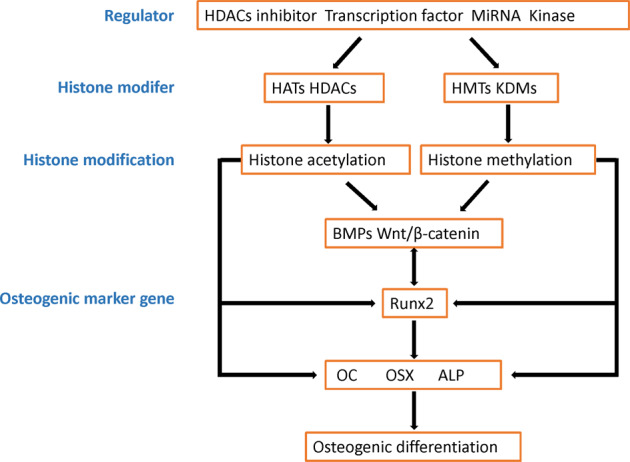
Histone modification critically contributes to the epigenetic control of gene expression by changing the configuration of chromatin and modifying the access of transcription factors to gene promoters. Recently, we observed that histone acetylation and crotonylation mediated the expression of endocytosis-related genes and tumor-related immune checkpoint genes by regulating the enrichment of signal transducer and activator of transcription 3 on these gene promoters in Alzheimer's disease and tumorigenesis, suggesting that histone modification plays an important role in disease development. Furthermore, studies performed in the past decade revealed that histone modifications affect osteogenic differentiation by regulating the expression of osteogenic marker genes. In this review, we summarize and discuss the histone modification-centric regulation of osteogenic gene expression. This review improves the understanding of the role of histone modifications in osteogenic differentiation and describes its potential as a therapeutic target for osteogenic differentiation-related diseases.
组蛋白修饰通过改变染色质的构型以及修饰转录因子与基因启动子的结合,对基因表达的表观遗传调控起着关键作用。最近,我们观察到在阿尔茨海默病和肿瘤发生过程中,组蛋白乙酰化和巴豆酰化通过调节信号转导和转录激活因子3在这些基因启动子上的富集,介导了内吞作用相关基因和肿瘤相关免疫检查点基因的表达,这表明组蛋白修饰在疾病发展中起重要作用。此外,过去十年进行的研究表明,组蛋白修饰通过调节成骨标记基因的表达影响成骨分化。在这篇综述中,我们总结并讨论了以组蛋白修饰为中心的成骨基因表达调控。这篇综述增进了我们对组蛋白修饰在成骨分化中作用的理解,并描述了其作为成骨分化相关疾病治疗靶点的潜力。