Muza Olivia, Debnath Ramit
African Centre of Excellence in Energy for Sustainable Development, College of Sciences and Technology, University of Rwanda, Kigali, Rwanda.
Energy Policy Research Group, Judge Business School, University of Cambridge, Cambridge, United Kingdom.
Renew Energy. 2021 May;168:896-912. doi: 10.1016/j.renene.2020.12.091.
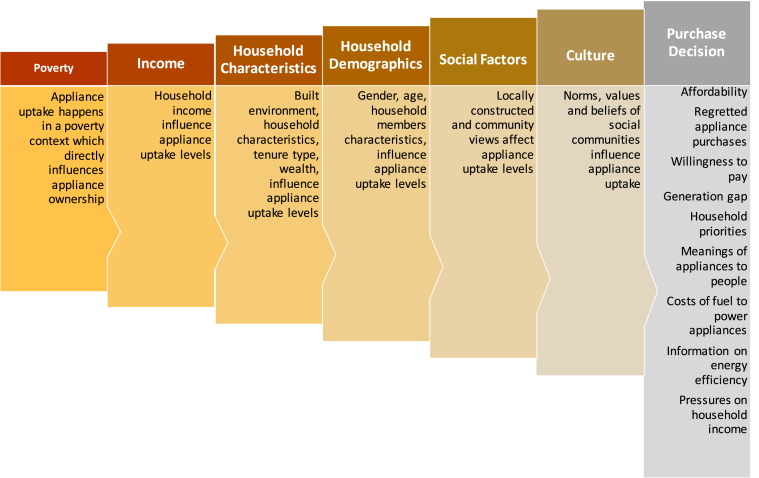
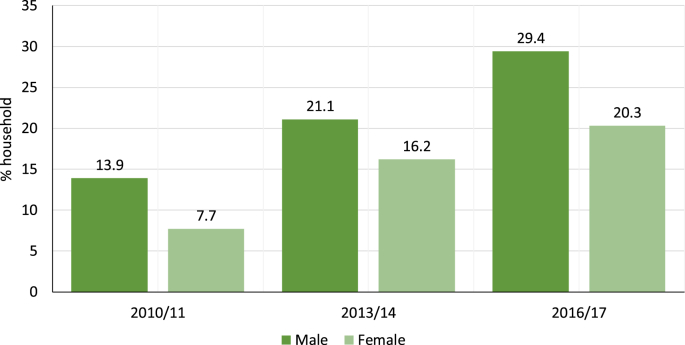
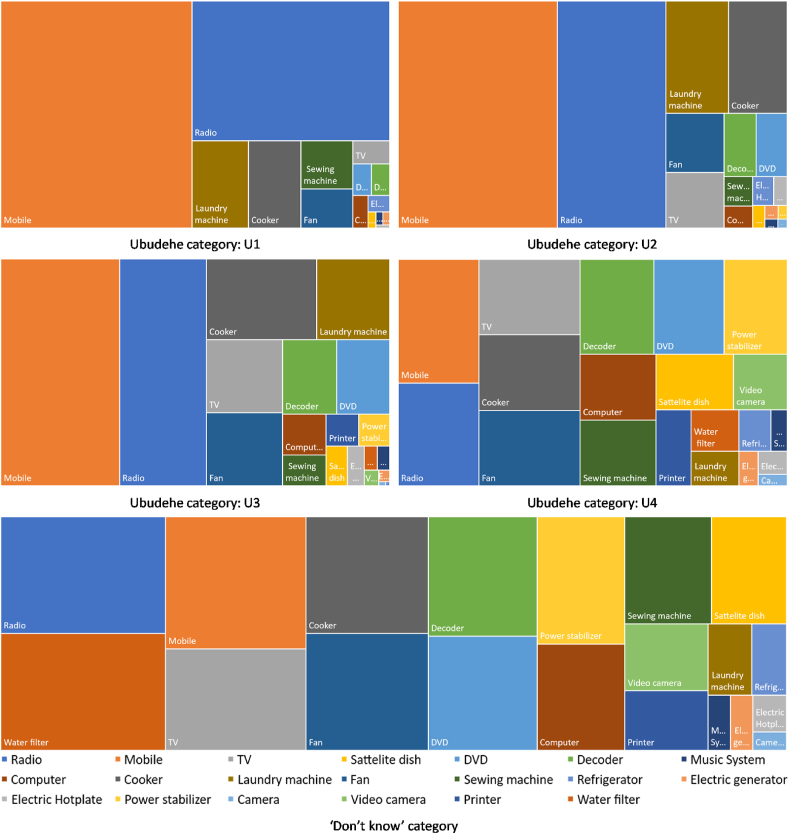
Rural off-grid renewable energy solutions often fail due to uncertainties in household energy demand, insufficient community engagement, inappropriate financial models and policy inconsistency. Social shaping of technology (SST) of household appliances provides a critical lens of understanding the involved socio-technical drivers behind these constraints. This study employs an SST lens to investigate appliance uptake drivers in 14,580 households in Rwanda, such that these drivers can aid in policy design for green growth at the grassroots level. The methodology includes an epistemological review of non-income drivers of appliance uptake. Empirical analysis using a binary logistic regression, based on which disruptive innovation pathways were derived for fostering green growth. Results showed that appliance uptake was highly gendered and skewed across the Ubudehe (social welfare) categories. ICT-devices like mobile phones and radios had a higher likelihood of ownership than welfare appliances like refrigerator and laundry machines. Fans and cookers also demonstrated a greater probability of ownership. Disruptive innovation pathways were derived from leveraging the ICT-driven wave of appliance ownership, creation of service sectors through off-grid renewable solutions and promoting cleaner fuel-switching of cooking energy at the household level. Further policy implications were drawn to support the creation of consumption identities for green growth.
农村离网可再生能源解决方案常常因家庭能源需求的不确定性、社区参与不足、金融模式不当以及政策不一致而失败。家用电器的技术社会塑造(SST)为理解这些制约因素背后所涉及的社会技术驱动因素提供了一个关键视角。本研究运用SST视角调查了卢旺达14580户家庭中电器采用的驱动因素,以便这些驱动因素能够有助于基层层面绿色增长的政策设计。该方法包括对电器采用的非收入驱动因素进行认识论审查。使用二元逻辑回归进行实证分析,并据此得出促进绿色增长的颠覆性创新路径。结果表明,电器采用在性别上差异很大,并且在乌布德赫(社会福利)类别中分布不均。像手机和收音机这样的信息通信技术设备的拥有可能性高于冰箱和洗衣机等福利电器。风扇和炊具的拥有概率也更高。颠覆性创新路径源自利用信息通信技术驱动的电器拥有浪潮、通过离网可再生能源解决方案创建服务部门以及在家庭层面推广烹饪能源的清洁燃料转换。还得出了进一步的政策含义,以支持为绿色增长创造消费身份。