Department of Anesthesiology and Pain Management, Maastricht University Medical Centre (MUMC+), Maastricht, The Netherlands.
School for Mental Health and Neuroscience (MHeNS), Faculty of Health, Medicine and Life Sciences, Maastricht University, Maastricht, The Netherlands.
Neuromodulation. 2021 Jun;24(4):639-645. doi: 10.1111/ner.13398. Epub 2021 May 4.
The sensory cell somata in the DRG contain all equipment necessary for extensive GABAergic signaling and are able to release GABA upon depolarization. With this study, we hypothesize that pain relief induced by conventional dorsal root ganglion stimulation (Con-DRGS) in animals with experimental painful diabetic peripheral neuropathy is related to the release of GABA from DRG neurons. With use of quantitative immunocytochemistry, we hypothesize DRGS to result in a decreased intensity of intracellular GABA-immunostaining in DRG somata.
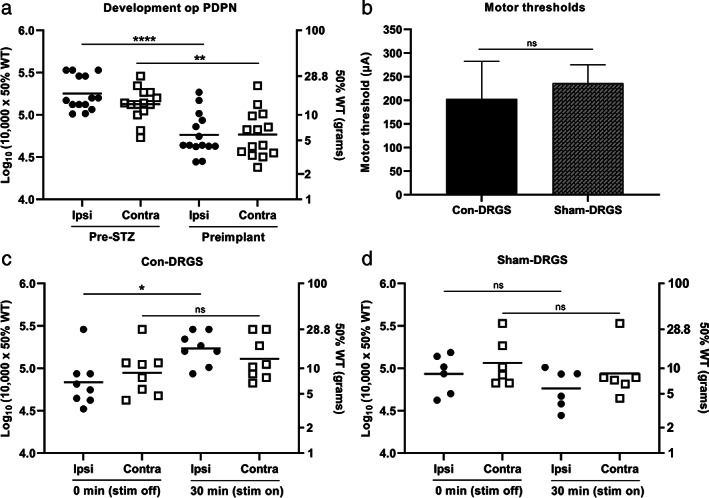
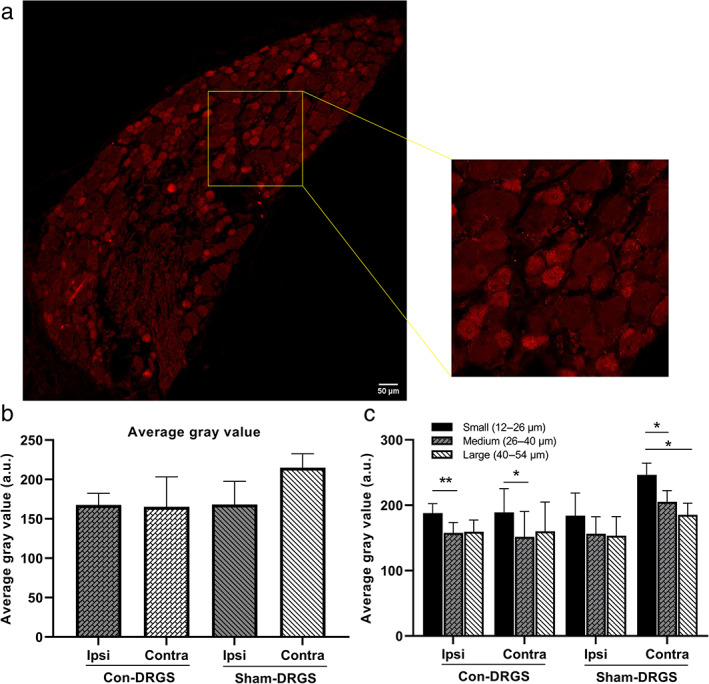
Female Sprague-Dawley rats (n = 31) were injected with streptozotocin (STZ) in order to induce Diabetes Mellitus. Animals that developed neuropathic pain after four weeks (Von Frey) were implanted with a unilateral DRGS device at L4 (n = 14). Animals were then stimulated for 30 min with Con-DRGS (20 Hz, pulse width = 0.2 msec, amplitude = 67% of motor threshold, n = 8) or Sham-DRGS (n = 6), while pain behavior (von Frey) was measured. DRGs were then collected and immunostained for GABA, and a relation to size of sensory cell soma diameter (small: 12-26 μm, assumed to be C-fiber related sensory neurons; medium: 26-40 μm, assumed to be Aδ related sensory neurons; and large: 40-54 μm, assumed to be Aβ related sensory neurons) was made.
DRGS treated animals showed significant reductions in STZ-induced mechanical hypersensitivity. No significant differences in GABA immunostaining intensity per sensory neuron cell soma type (small-, medium-, or large-sized) were noted in DRGs of stimulated (Con-DRGS) animals versus Sham animals. No differences in GABA immunostaining intensity per sensory cell soma type in ipsi- as compared to contralateral DRGs were observed.
Con-DRGS does not affect the average intracellular GABA immunofluorescence staining intensity in DRG sensory neurons of those animals which showed significant pain reduction. Similarly, no soma size related changes in intracellular GABA immunofluorescence were observed following Con-DRGS.
背根神经节(DRG)中的感觉细胞体包含广泛 GABA 信号所必需的所有设备,并能在去极化时释放 GABA。本研究假设,在患有实验性痛性糖尿病周围神经病的动物中,传统的背根神经节刺激(Con-DRGS)引起的疼痛缓解与 DRG 神经元释放 GABA 有关。通过使用定量免疫细胞化学,我们假设 DRGS 会导致 DRG 细胞体中细胞内 GABA 免疫染色强度降低。
雌性 Sprague-Dawley 大鼠(n = 31)注射链脲佐菌素(STZ)以诱导糖尿病。四周后出现神经性疼痛的动物(Von Frey)在 L4 植入单侧 DRGS 装置(n = 14)。然后,用 Con-DRGS(20 Hz,脉冲宽度 = 0.2 毫秒,幅度 = 运动阈值的 67%,n = 8)或 Sham-DRGS(n = 6)刺激 30 分钟,同时测量疼痛行为(von Frey)。然后收集 DRGs 并进行 GABA 免疫染色,并与感觉细胞体直径的大小(小:12-26 μm,假定与 C 纤维相关的感觉神经元;中:26-40 μm,假定与 Aδ 相关的感觉神经元;大:40-54 μm,假定与 Aβ 相关的感觉神经元)相关。
DRGS 治疗的动物表现出 STZ 诱导的机械性超敏反应的显著减轻。刺激(Con-DRGS)动物与 Sham 动物的 DRG 中,各感觉神经元细胞体类型(小、中、大)的 GABA 免疫染色强度无显著差异。同侧与对侧 DRG 中各感觉细胞体类型的 GABA 免疫染色强度无差异。
Con-DRGS 不会影响表现出显著疼痛减轻的动物的 DRG 感觉神经元中细胞内 GABA 免疫荧光染色强度的平均值。同样,Con-DRGS 后也未观察到细胞内 GABA 免疫荧光强度与细胞体大小相关的变化。