Department of Psychology, Centre for Comparative and Evolutionary Psychology, University of Portsmouth, Portsmouth, United Kingdom.
The Donkey Sanctuary, Sidmouth, Devon, United Kingdom.
PLoS One. 2021 May 4;16(5):e0251002. doi: 10.1371/journal.pone.0251002. eCollection 2021.
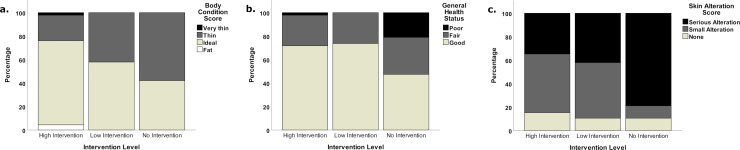
Working equids play an essential role in supporting livelihoods, providing resilience and income security to people around the world, yet their welfare is often poor. Consequently, animal welfare focussed NGOs employ a range of initiatives aimed at improving standards of working equid welfare. However, there is debate surrounding the efficacy of welfare initiatives utilised and long term monitoring and evaluation of initiatives is rarely undertaken. This study compares equid welfare and the social transmission of welfare information across Mexican communities that had previously received differing intervention histories (veterinary treatment plus educational initiatives, veterinary treatment only and control communities) in order to assess their efficacy. Indicators of equid welfare were assessed using the Equid Assessment Research and Scoping tool and included body condition score, skin alterations, lameness, general health status and reaction to observer approach. Owners were interviewed about their involvement in previous welfare initiatives, beliefs regarding equid emotions and pain, and the social transmission of welfare knowledge, including whether they ask advice about their equid or discuss its health with others and whether there is a specific individual that they consider to be 'good with equids' in their community. In total 266 owners were interviewed from 25 communities across three states. Better welfare (specifically body condition and skin alteration scores) was seen in communities where a history of combined free veterinary treatment and educational initiatives had taken place compared to those that had only received veterinary treatment or control communities. The social transfer of welfare knowledge was also higher in these communities, suggesting that the discussion and transfer of equid welfare advice within communities can act as a mechanism to disseminate good welfare practices more widely. Our results suggest that using a combined approach may enhance the success of welfare initiatives, a finding that may impact future NGO programming.
役用动物在支持生计方面发挥着至关重要的作用,为世界各地的人们提供韧性和收入保障,但它们的福利往往很差。因此,关注动物福利的非政府组织采用了一系列旨在提高役用动物福利标准的举措。然而,人们对所采用的福利举措的效果存在争议,而且很少对这些举措进行长期监测和评估。本研究比较了墨西哥不同社区的役用动物福利和福利信息的社会传播情况,这些社区以前接受过不同的干预历史(兽医治疗加教育举措、仅兽医治疗和对照组社区),以评估它们的效果。役用动物福利的指标使用 Equid Assessment Research and Scoping 工具进行评估,包括身体状况评分、皮肤变化、跛行、一般健康状况和对观察者接近的反应。对所有者进行了采访,询问他们以前参与福利举措的情况、对役用动物情绪和疼痛的看法,以及福利知识的社会传播情况,包括他们是否向他人咨询有关役用动物的问题或与他人讨论其健康状况,以及他们所在社区是否有特定的人被认为是“擅长处理役用动物”的。总共对来自三个州的 25 个社区的 266 名所有者进行了采访。与仅接受兽医治疗或对照组社区相比,那些接受过免费兽医治疗和教育举措的历史的社区的福利状况更好(特别是身体状况和皮肤变化评分)。这些社区的福利知识的社会传播也更高,这表明社区内有关役用动物福利的讨论和信息传递可以作为一种机制,更广泛地传播良好的福利实践。我们的研究结果表明,采用综合方法可能会提高福利举措的成功率,这一发现可能会影响未来非政府组织的规划。