Epidemiology Cell, Public Health England National Infection Service, London, UK.
Epidemiology Cell, Public Health England National Infection Service, London, UK.
Public Health. 2021 May;194:163-166. doi: 10.1016/j.puhe.2021.03.012. Epub 2021 Apr 1.
The aim of the study was to evaluate completeness and timeliness of the rapidly developed surveillance of severe acute respiratory syndrome coronavirus 2 (SARS-CoV-2) infection in England using patient-level data.
This is an observational study wherein public health surveillance systems are evaluated.
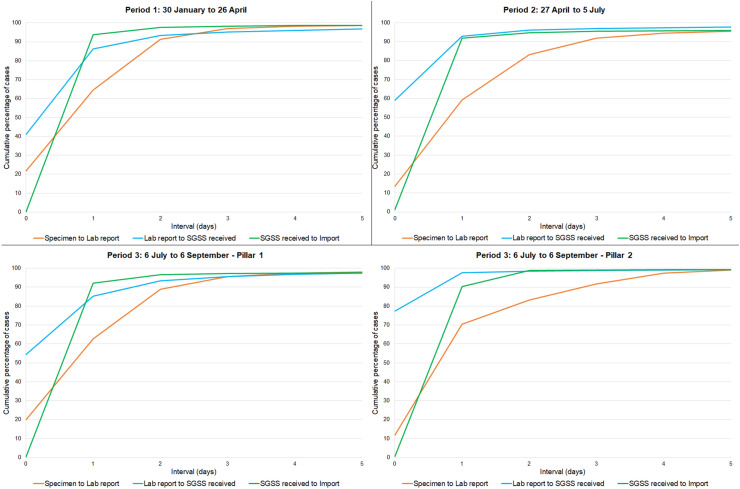
Data were collected in the Public Health England's Second-Generation Surveillance System through routine laboratory reporting processes, as well as via enhanced testing in collaboration with commercial partners. Three periods were chosen to present developments in disease surveillance around the first pandemic wave in England. Completeness of valid entries for key demographic and epidemiological fields was summarised. Timeliness was assessed using recorded date intervals: from sample collection to the laboratory reporting a positive result, the positive result being received by the national surveillance system and the data being available for epidemiological analysis.
In each period, demographic variables were more than 95% complete and enhanced ethnicity more than 85%, allowing a rich understanding of the general characteristics of COVID-19 cases in England. The proportion of cases completing all reporting stages of the national system within 3 days of when the specimen was taken increased from 69.1% in period 1 to 76.6% in period 3. In period 3, the median number of days to complete all reporting stages decreased to 2, from 3 in previous periods. Analysis of each reporting stage offers suggestive evidence that timeliness of the system has improved as reporting has become established over time.
Timely processing of data for epidemiological use was consistent and rapid once received by the national system. Delays in timeliness were most likely to occur in the first stage of the reporting process, before laboratory input to the surveillance platform. Existing national surveillance mechanisms enhanced during the response have succeeded in providing rapid collection and reporting of case data to facilitate epidemiological monitoring and analysis and guide public health policy and strategy.
本研究旨在使用患者层面的数据评估英国针对严重急性呼吸综合征冠状病毒 2(SARS-CoV-2)感染快速发展的监测的完整性和及时性。
这是一项观察性研究,评估公共卫生监测系统。
通过常规实验室报告流程以及与商业合作伙伴合作进行的强化检测,从英格兰公共卫生部第二代监测系统中收集数据。选择三个时期来展示英格兰首次大流行浪潮前后疾病监测的发展情况。总结关键人口统计学和流行病学字段有效条目记录的完整性。使用记录的时间间隔评估及时性:从样本采集到实验室报告阳性结果,阳性结果被国家监测系统接收以及数据可用于流行病学分析的时间。
在每个时期,人口统计学变量的完整性都超过 95%,强化族裔群体的完整性超过 85%,从而可以深入了解英格兰 COVID-19 病例的一般特征。在采集标本后 3 天内完成国家系统所有报告阶段的病例比例从第 1 期的 69.1%增加到第 3 期的 76.6%。在第 3 期,完成所有报告阶段的中位数天数从之前各期的 3 天减少到 2 天。对每个报告阶段的分析提供了提示性证据,表明随着报告的建立,该系统的及时性得到了改善。
一旦国家系统接收到数据,用于流行病学使用的数据处理就会及时且迅速。及时性延迟最有可能发生在报告过程的第一阶段,即在实验室向监测平台输入之前。在应对过程中增强的现有国家监测机制成功地快速收集和报告病例数据,以促进流行病学监测和分析,并指导公共卫生政策和策略。