Department of Geography, Florida State University, Tallahassee, FL 32306, USA.
Department of Environmental and Occupational Health Sciences, University of Washington, Seattle, WA 98195, USA.
Int J Environ Res Public Health. 2021 Apr 30;18(9):4801. doi: 10.3390/ijerph18094801.
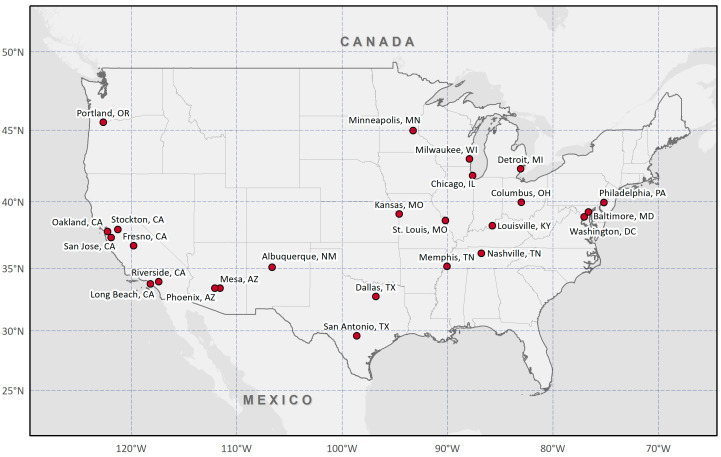
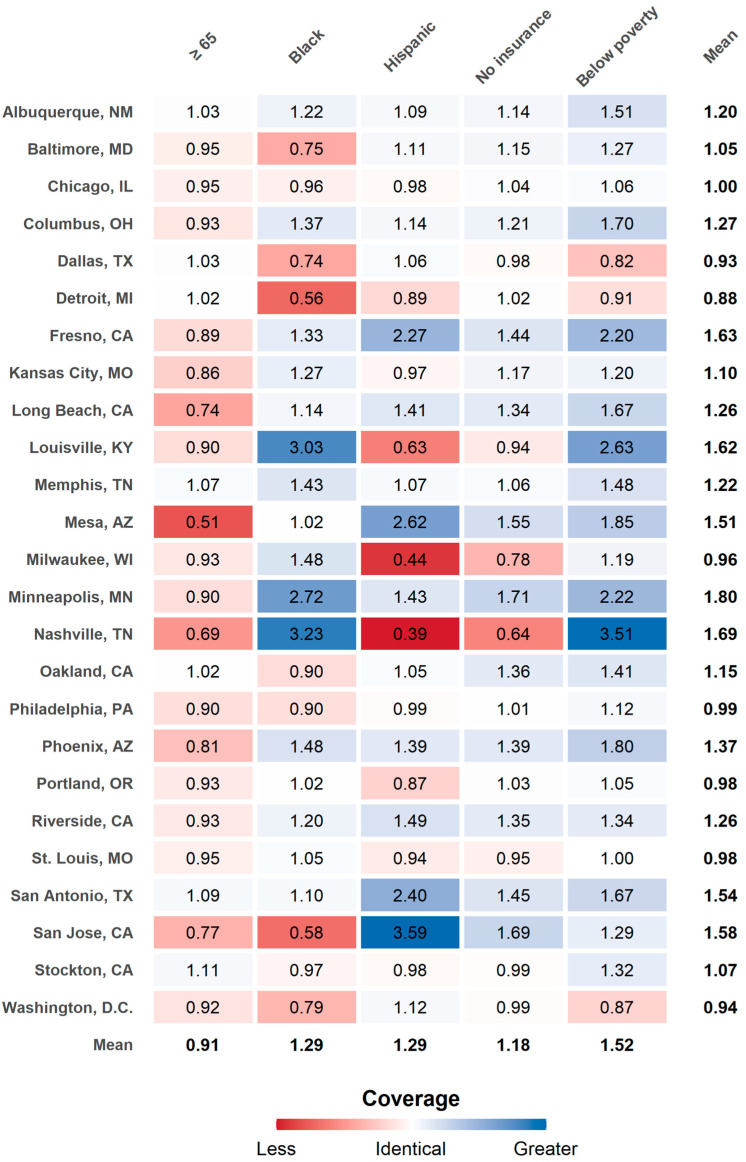
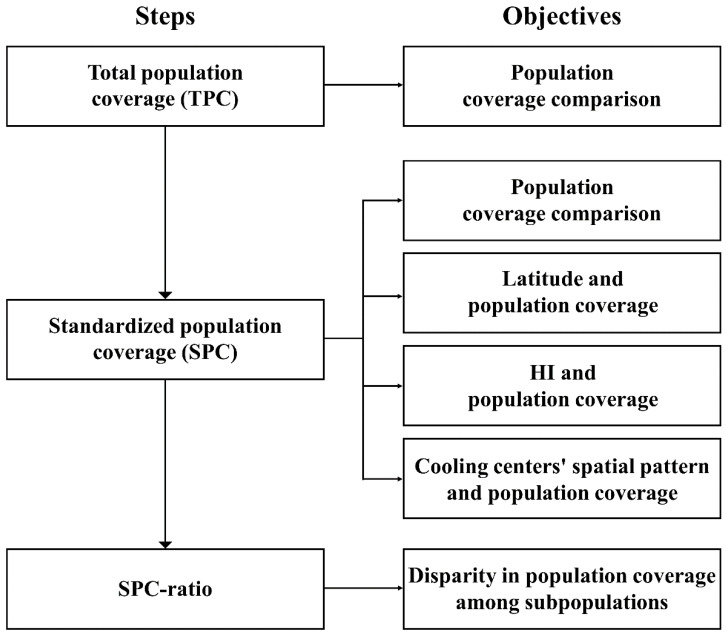
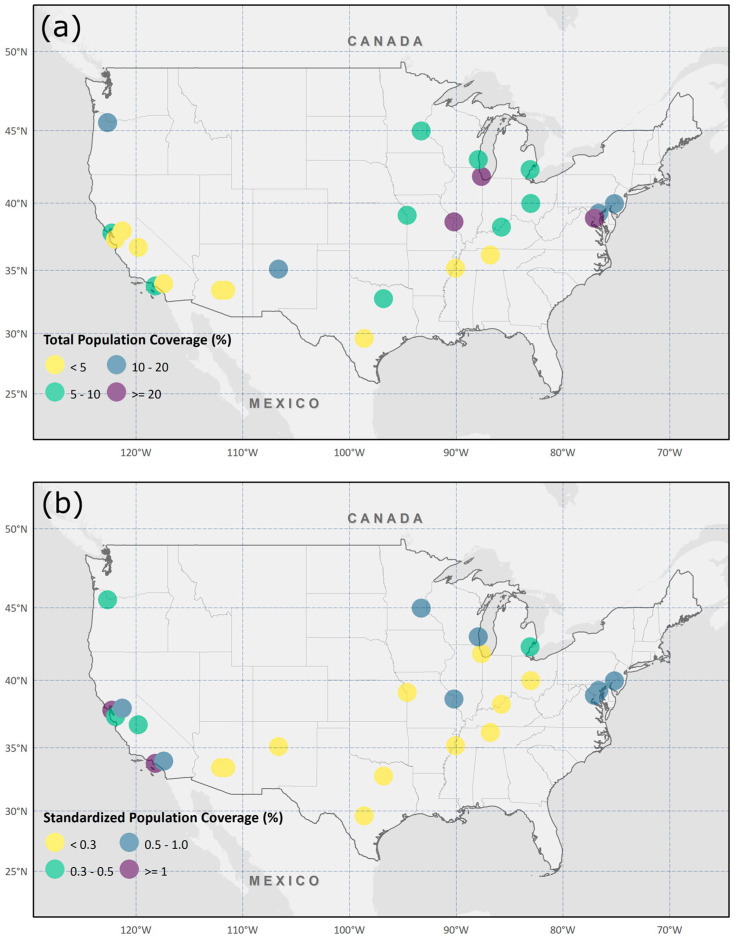
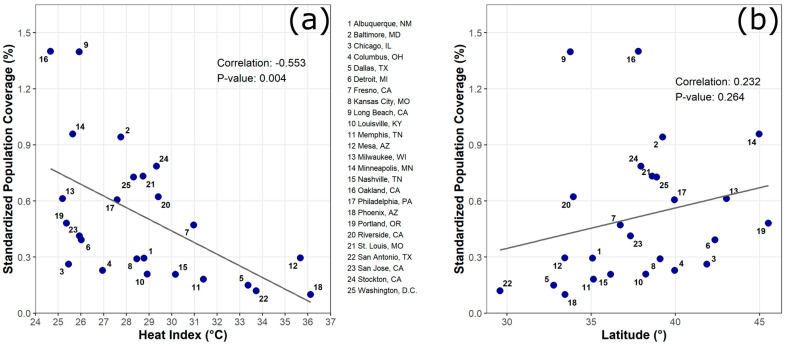
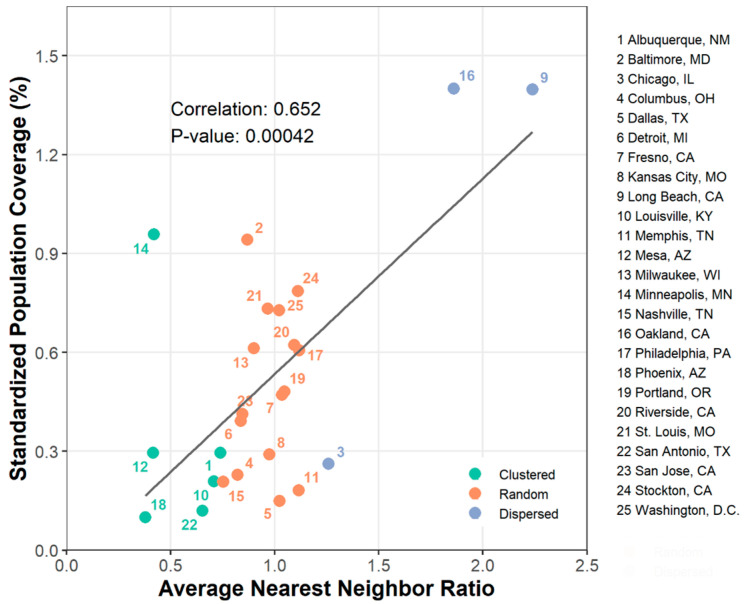
Cooling centers have played a significant role in reducing the risks of adverse health impacts of extreme heat exposure. However, there have been no comparative studies investigating cooling center preparedness in terms of population coverage, location efficiency, and population coverage disparities among different subpopulation groups. Using a catchment area method with a 0.8 km walking distance, we compared three aspects of cooling center preparedness across twenty-five cities in the U.S. We first calculated the percentage of the population covered by a single cooling center for each city. Then, the extracted values were separately compared to the city's heat indexes, latitudes, and spatial patterns of cooling centers. Finally, we investigated population coverage disparities among multiple demographics (age, race/ethnicity) and socioeconomic (insurance, poverty) subpopulation groups by comparing the percentage of population coverage between selected subpopulation groups and reference subpopulation groups. Our results showed that cooler cities, higher latitude cities, and cities with dispersed cooling centers tend to be more prepared than warmer cities, lower latitude cities, and cities with clustered cooling centers across the U.S. Moreover, older people (≥65) had 9% lower population coverage than younger people (≤64). Our results suggest that the placement of future cooling centers should consider both the location of other nearby cooling centers and the spatial distribution of subpopulations to maximize population coverage and reduce access disparities among several subpopulations.
降温中心在降低高温暴露对健康的不利影响方面发挥了重要作用。然而,目前还没有比较研究调查降温中心在人口覆盖范围、位置效率以及不同亚人群之间的人口覆盖差距方面的准备情况。我们使用具有 0.8 公里步行距离的集水区方法,比较了美国 25 个城市的三个方面的降温中心准备情况。我们首先计算了每个城市单个降温中心所覆盖的人口比例。然后,将提取的值分别与城市的热指数、纬度和降温中心的空间模式进行比较。最后,我们通过比较选定亚人群与参考亚人群之间的人口覆盖比例,调查了多个人口统计学(年龄、种族/民族)和社会经济(保险、贫困)亚人群之间的人口覆盖差距。结果表明,美国较凉爽的城市、纬度较高的城市和降温中心分布较分散的城市比较温暖的城市、纬度较低的城市和降温中心集中的城市准备得更充分。此外,老年人(≥65 岁)的人口覆盖比例比年轻人(≤64 岁)低 9%。我们的研究结果表明,未来降温中心的选址应同时考虑其他附近降温中心的位置和亚人群的空间分布,以最大限度地提高人口覆盖范围,并减少多个亚人群之间的可达性差距。