Aprile Irene, Guardati Giulia, Cipollini Valeria, Papadopoulou Dionysia, Monteleone Serena, Redolfi Alessandra, Garattini Romina, Sacella Gianluigi, Noro Fulvia, Galeri Silvia, Carrozza Maria Chiara, Germanotta Marco
IRCCS Fondazione Don Carlo Gnocchi ONLUS, 50143 Florence, Italy.
IRCCS Fondazione Don Carlo Gnocchi ONLUS, 20121 Milan, Italy.
Brain Sci. 2021 Apr 30;11(5):587. doi: 10.3390/brainsci11050587.
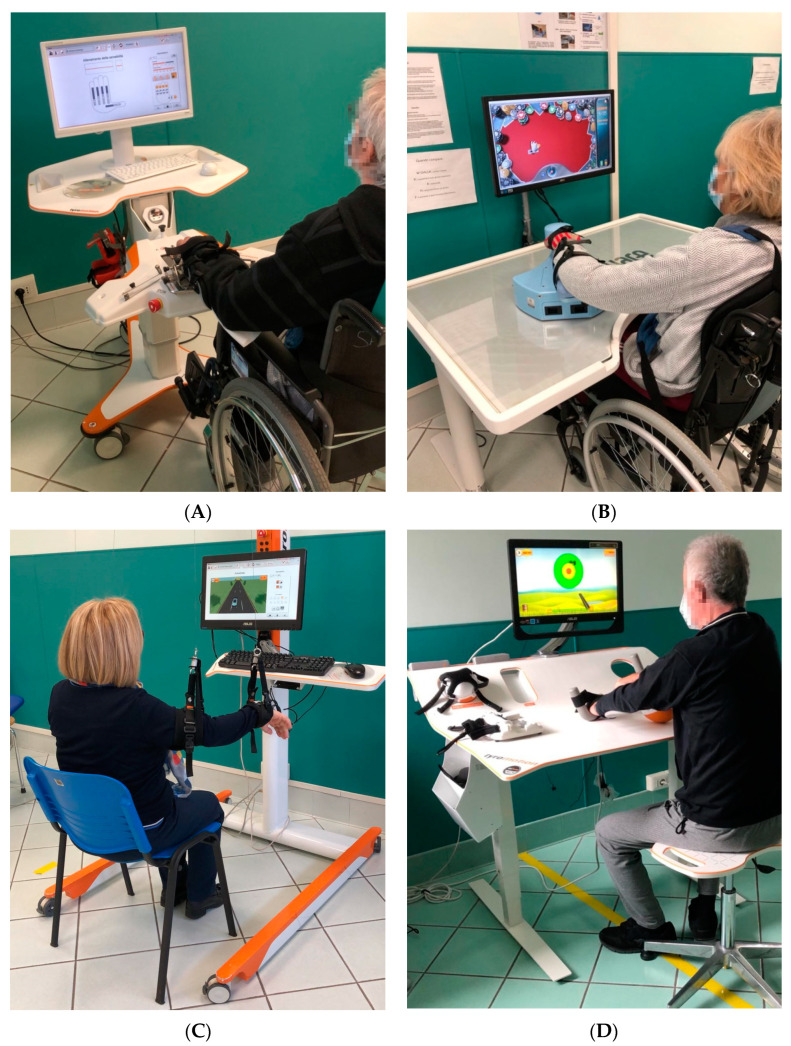
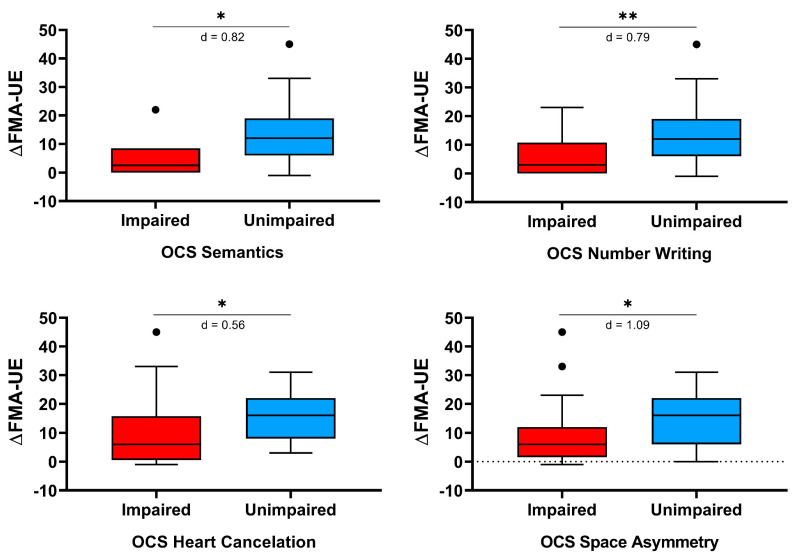
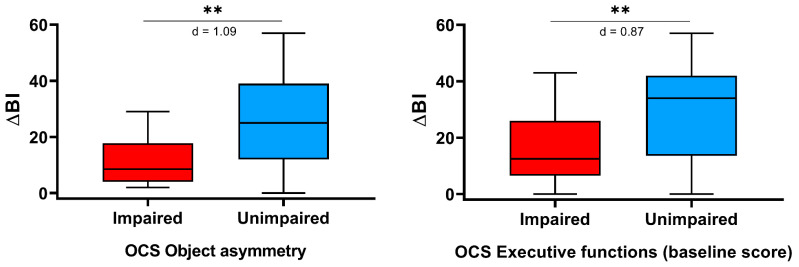
Cognitive decline is often present in stroke survivors, with a significant impact on motor recovery. However, how specific cognitive domains could impact motor recovery after robotic rehabilitation in patients with stroke is still not well understood. In this study, we analyzed the relationship between cognitive impairment and the outcome of a robot-mediated upper limb rehabilitation intervention in a sample of 51 subacute stroke patients. Participants were enrolled and treated with a set of robotic and sensor-based devices. Before the intervention, patients underwent a cognitive assessment by means of the Oxford Cognitive Screen. To assess the effect of the 30-session rehabilitation intervention, patients were assessed twice with the following outcome measures: the Fugl-Meyer Assessment for Upper Extremity (FMA-UE), to evaluate motor function; the Upper limb Motricity Index (MI), to evaluate upper limb muscle strength; the Modified Barthel Index (mBI), to evaluate activities of daily living and mobility. We found that deficits in spatial attention and executive functions impacted the mBI improvement, while language, number processing, and spatial attention deficits reduced the gains in the FMA-UE. These results suggest the importance to evaluate the cognitive functions using an adequate tool in patients with stroke undergoing a robotic rehabilitation intervention.
认知功能衰退在中风幸存者中很常见,对运动恢复有重大影响。然而,在中风患者接受机器人康复治疗后,特定认知领域如何影响运动恢复仍未得到充分理解。在本研究中,我们分析了51例亚急性中风患者样本中认知障碍与机器人介导的上肢康复干预结果之间的关系。参与者登记入组并使用一套基于机器人和传感器的设备进行治疗。干预前,患者通过牛津认知筛查进行认知评估。为评估30节康复干预课程的效果,使用以下结果指标对患者进行了两次评估:用于评估运动功能的上肢Fugl-Meyer评估量表(FMA-UE);用于评估上肢肌肉力量的上肢运动能力指数(MI);用于评估日常生活活动能力和移动能力的改良Barthel指数(mBI)。我们发现,空间注意力和执行功能缺陷影响了mBI的改善,而语言、数字处理和空间注意力缺陷则降低了FMA-UE的改善程度。这些结果表明,在接受机器人康复干预的中风患者中,使用适当工具评估认知功能具有重要意义。