School of Law, Psychology and Social Work, Örebro University, SE-701 82 Örebro, Sweden.
Int J Environ Res Public Health. 2021 Apr 29;18(9):4727. doi: 10.3390/ijerph18094727.
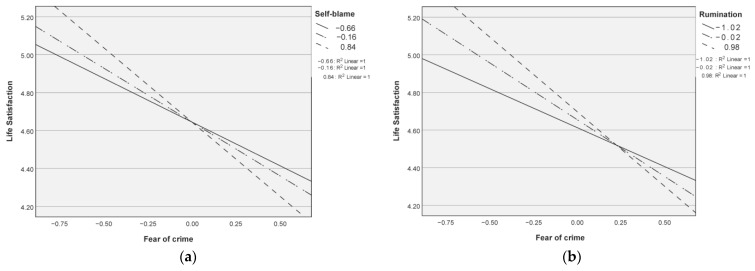
Fear of crime is a substantial problem for older adults and is associated with reduced subjective well-being. However, less is known about factors that could moderate the associations between fear of crime and mental health problems and well-being in advanced age. Cognitive emotion regulation could serve as a potentially buffering factor for adverse health outcomes related to fear of crime due to its potential importance in managing feelings when facing threatening situations. The current study investigated the associations between affective fear of crime with depressive feelings and life satisfaction and examined whether adaptive and maladaptive cognitive emotion regulation strategies moderated these associations in a sample of older adults (age 64-106) in Sweden (N = 622). The results showed that affective fear of crime was associated with more depressive feelings, less life satisfaction, and more frequent use of such maladaptive cognitive emotion regulation strategies as rumination, catastrophizing, and blaming others. Moreover, rumination and self-blame moderated the associations between affective fear of crime and life satisfaction. Adaptive emotion regulation strategies were not associated with affective fear of crime and did not decrease the strength of its association with depressive feelings and with life satisfaction. These findings allow us to conclude that maladaptive emotion regulation could be considered a vulnerability factor in the association of fear of crime with life satisfaction.
对老年人来说,犯罪恐惧是一个严重的问题,它与主观幸福感降低有关。然而,对于能够缓和犯罪恐惧与心理健康问题和老年幸福感之间关联的因素知之甚少。由于认知情绪调节在面对威胁性情境时管理情绪的潜在重要性,它可能是与犯罪恐惧相关的不良健康结果的潜在缓冲因素。本研究在瑞典的一个老年人样本(年龄 64-106 岁,N=622)中,调查了情感性犯罪恐惧与抑郁情绪和生活满意度之间的关联,并检验了适应性和不良认知情绪调节策略是否调节了这些关联。结果表明,情感性犯罪恐惧与更多的抑郁情绪、更少的生活满意度以及更频繁地使用沉思、灾难化和责备他人等不良认知情绪调节策略有关。此外,沉思和自责调节了情感性犯罪恐惧与生活满意度之间的关联。适应性情绪调节策略与情感性犯罪恐惧无关,也没有降低其与抑郁情绪和生活满意度之间关联的强度。这些发现使我们得出结论,不良的情绪调节可能是犯罪恐惧与生活满意度之间关联的一个脆弱因素。