Radiation Oncology Department, Institut Claudius Regaud, Institut Universitaire du Cancer de Toulouse, CEDEX 09, 31059 Toulouse, France.
Pathology Department, Centre Hospitalo-Universitaire de Toulouse, Institut Universitaire du Cancer de Toulouse, CEDEX 09, 31059 Toulouse, France.
Curr Oncol. 2021 Apr 29;28(3):1673-1680. doi: 10.3390/curroncol28030156.
Recent modifications in the epidemiology of oropharyngeal squamous cell carcinoma (OSCC) have led to the increase of Human papillomavirus (HPV) related metastatic head and neck cancer patients with high life expectancy even at advanced stage, low comorbidity and still restricted systemic therapy opportunities. In the recent era of ablative therapies' development, oligometastatic HPV OSCC patients are indubitably good candidates for intensified treatment. However, data related to outcomes after optimised management of metastatic sites are dramatically missing.
In our cohort of 186 unselected consecutive OSCC patients treated with curative intent at our institution between 2009 and 2013, we analysed the incidence, treatment and outcomes of distant metastatic (DM) failure according to p16 status.
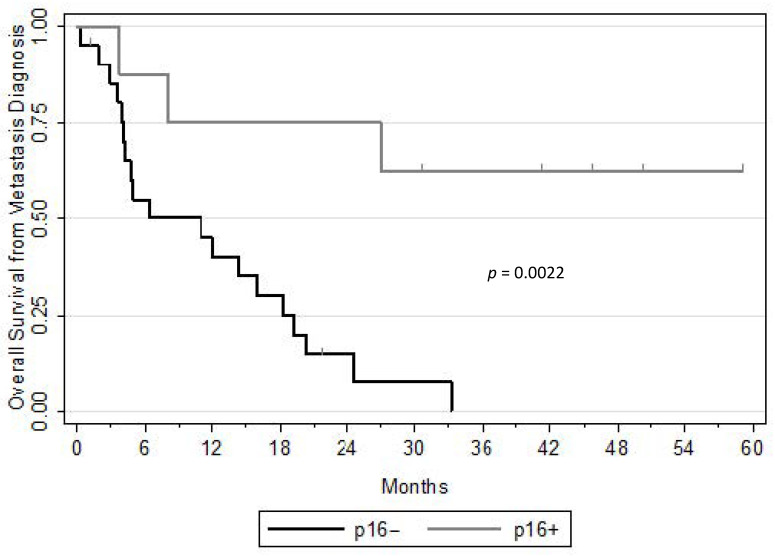
After a median follow-up of 4.2 years (95% CI: 3.8-4.4) from primary diagnosis of OSCC, 21/95 p16- patients (22.1%) vs. 8/91 (8.8%) p16+ patients presented DM failure with a median interval of 11 (range 0-46) and 28 months (range 0-71), respectively ( = 0.10). Overall survival (OS) after DM failure was significantly higher in p16+ patients with a two-year OS rate of 75% and 15% for p16+ and p16-, respectively ( = 0.002). In eight HPV-related metastatic patients, three underwent ablative lung metastasis treatment and are still complete responders four to five years later.
This study highlights distinct outcomes of metastatic HPV-related OSCC patients emphasised by three long-term complete responders after lung ablative treatment. In patients with high life expectancy and limited tumour burden, the question of ablative treatment such as metastasectomy or stereotactic ablative radiotherapy (SBRT) should be addressed.
口咽鳞状细胞癌(OSCC)的流行病学最近发生了变化,导致具有高预期寿命的 HPV 相关转移性头颈部癌症患者数量增加,即使在晚期、合并症少且系统治疗机会仍然有限的情况下也是如此。在消融治疗发展的新时代,寡转移性 HPV OSCC 患者无疑是强化治疗的良好候选者。然而,关于转移性疾病最佳治疗后结果的数据严重缺失。
在我们的队列中,186 名未经选择的连续 OSCC 患者在 2009 年至 2013 年期间在我们的机构接受根治性治疗,我们根据 p16 状态分析了远处转移(DM)失败的发生率、治疗和结果。
在 OSCC 原发性诊断后中位随访 4.2 年(95%CI:3.8-4.4)后,21/95 p16-患者(22.1%)与 8/91(8.8%)p16+患者出现 DM 失败,中位数间隔分别为 11(范围 0-46)和 28 个月(范围 0-71)(=0.10)。p16+患者 DM 失败后的总生存率(OS)明显更高,两年 OS 率分别为 75%和 15%(=0.002)。在 8 例 HPV 相关转移性患者中,3 例接受了消融性肺转移治疗,四到五年后仍为完全缓解者。
这项研究突出了 HPV 相关转移性 OSCC 患者的不同结果,强调了 3 例接受肺消融治疗后的长期完全缓解者。对于具有高预期寿命和有限肿瘤负担的患者,应考虑消融治疗,如转移切除术或立体定向消融放疗(SBRT)。