Department of Radiation Oncology, University Hospital of Zurich, University of Zurich, Raemistrasse 100, 8091, Zurich, Germany.
Radiat Oncol. 2021 May 4;16(1):84. doi: 10.1186/s13014-021-01813-6.
To assess the effects of daily adaptive MR-guided replanning in stereotactic body radiation therapy (SBRT) of liver metastases based on a patient individual longitudinal dosimetric analysis.
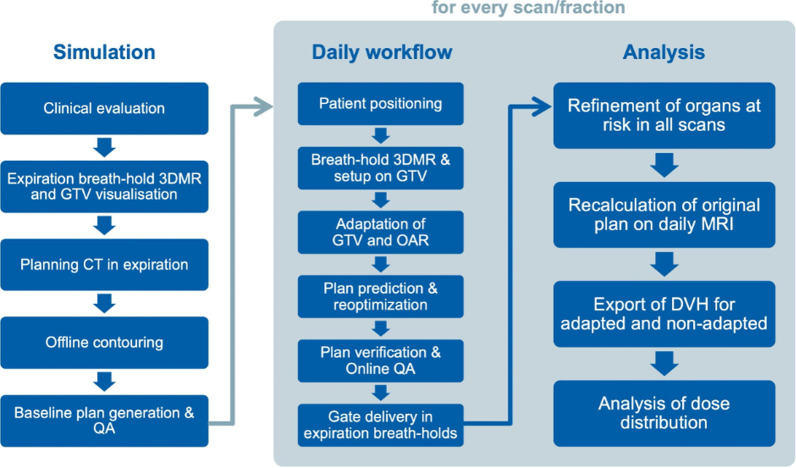
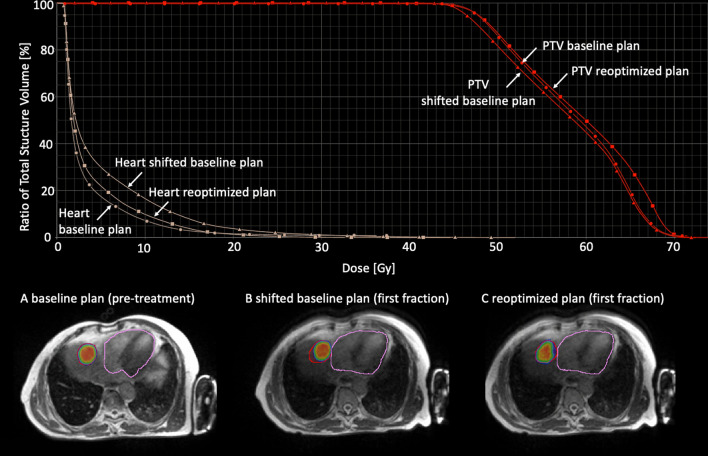
Fifteen patients assigned to SBRT for oligometastatic liver metastases underwent daily MR-guided target localization and on-table treatment plan re-optimization. Gross tumor volume (GTV) and organs at risk (OARs) were adapted to the anatomy-of-the-day. A reoptimized plan (RP) and a rigidly shifted baseline plan (sBP) without re-optimization were generated for each fraction. After extraction of DVH parameters for GTV, planning target volume (PTV), and OARs (stomach, duodenum, bowel, liver, heart) plans were compared on a per-patient basis.
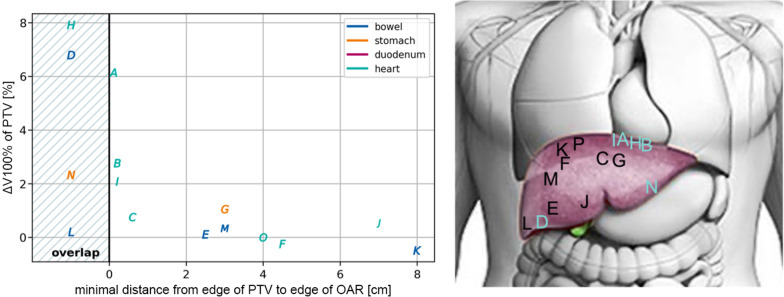
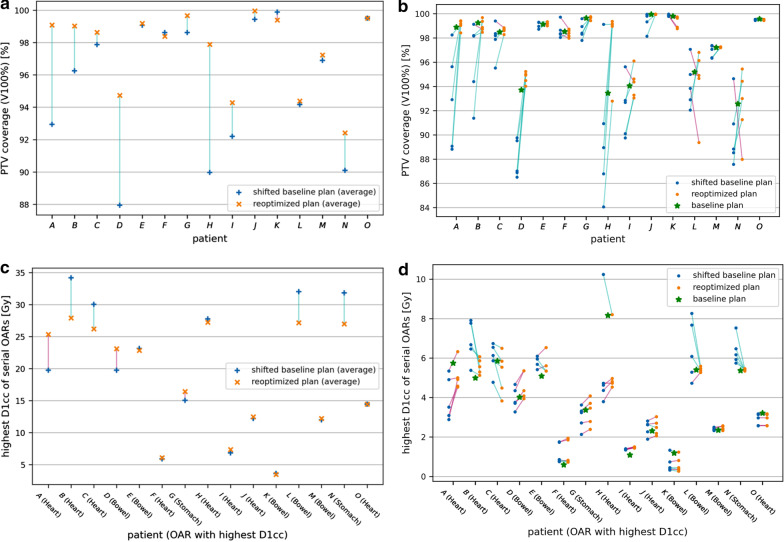
Median pre-treatment GTV and PTV were 14.9 cc (interquartile range (IQR): 7.7-32.9) and 62.7 cc (IQR: 42.4-105.5) respectively. SBRT with RP improved PTV coverage (V100%) for 47/75 of the fractions and reduced doses to the most proximal OARs (D1cc, Dmean) in 33/75 fractions compared to sBP. RP significantly improved PTV coverage (V100%) for metastases within close proximity to an OAR by 4.0% (≤ 0.2 cm distance from the edge of the PTV to the edge of the OAR; n = 7; p = 0.01), but only by 0.2% for metastases farther away from OAR (> 2 cm distance; n = 7; p = 0.37). No acute grade 3 treatment-related toxicities were observed.
MR-guided online replanning SBRT improved target coverage and OAR sparing for liver metastases with a distance from the edge of the PTV to the nearest luminal OAR < 2 cm. Only marginal improvements in target coverage were observed for target distant to critical OARs, indicating that these patients do not benefit from daily adaptive replanning.
基于患者个体纵向剂量学分析,评估肝转移立体定向体部放射治疗(SBRT)中每日自适应磁共振(MR)引导重计划的效果。
15 例寡转移肝转移患者接受 SBRT 治疗,行每日 MR 引导靶区定位和治疗计划在线重优化。大体肿瘤体积(GTV)和危及器官(OARs)根据当天的解剖结构进行调整。为每个分次生成重优化计划(RP)和未重优化的刚性移位基准计划(sBP)。从 GTV、计划靶区(PTV)和 OARs(胃、十二指肠、肠、肝、心)的计划中提取剂量体积直方图(DVH)参数后,在个体患者的基础上进行计划比较。
中位治疗前 GTV 和 PTV 分别为 14.9 cc(四分位距(IQR):7.7-32.9)和 62.7 cc(IQR:42.4-105.5)。与 sBP 相比,RP 可改善 47/75 分次的 PTV 覆盖(V100%),并降低 33/75 分次最接近 OAR 的剂量(D1cc、Dmean)。RP 可显著改善紧邻 OAR 的转移灶的 PTV 覆盖(V100%),改善程度为 4.0%(PTV 边缘至 OAR 边缘的距离≤0.2 cm;n=7;p=0.01),而距离 OAR 较远的转移灶(>2 cm 距离;n=7;p=0.37)仅改善 0.2%。未观察到急性 3 级与治疗相关的毒性。
MR 引导在线重计划 SBRT 可改善距离 PTV 边缘最近腔 OAR<2 cm 的肝转移灶的靶区覆盖和 OAR 保护。对于距离关键 OAR 较远的靶区,靶区覆盖的改善程度仅略有改善,表明这些患者不能从每日自适应重计划中获益。