Department of Surgery, Oncology and Gastroenterology, University of Padova, Padova, Italy.
Pathological Anatomy Unit, Padova University Hospital, Padova, Italy.
J Exp Clin Cancer Res. 2021 May 4;40(1):154. doi: 10.1186/s13046-021-01947-1.
Uveal melanoma (UM) represents the most common primary intra-ocular malignancy in adults. Up to 50% of the patients develop distant metastases within 10 years from diagnosis, with the liver as the most common site. Upon metastatization, life expectancy strongly reduces and immune checkpoint inhibitors that prove effective in cutaneous melanoma do not modify clinical outcome. To date, few studies have focused on deciphering the immunomodulatory features of metastatic UM microenvironment, and there are no prognostic models for clinical use. This highlights the urgent need to understand the delicate interplay between tumor and immune cells acting at the site of metastasis.
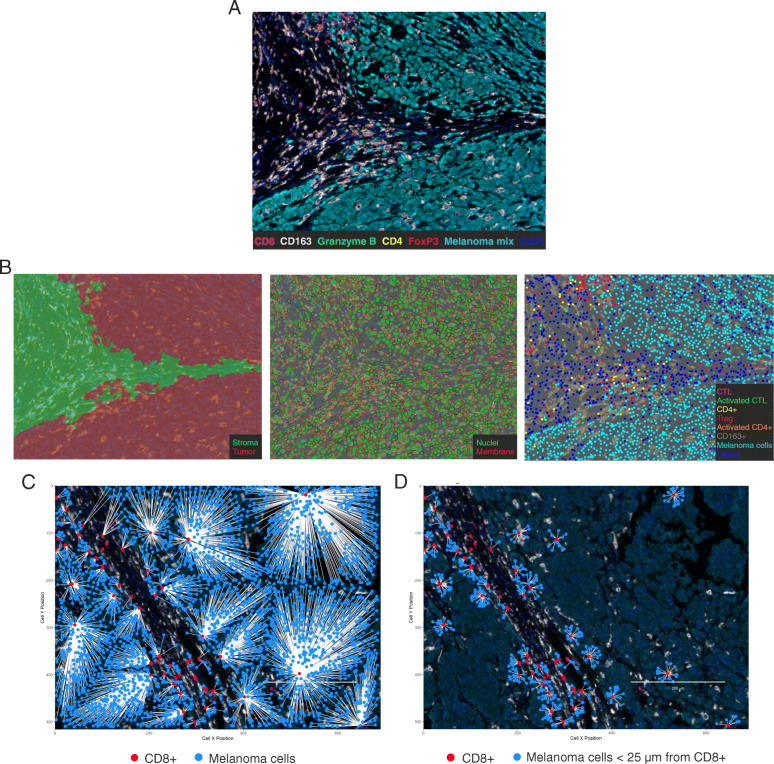
We collected a patient cohort comprising 21 metastatic UM patients. Hepatic and extra-hepatic UM metastasis samples were studied by multiplex immunofluorescence to assess the tumor immune cell composition. Quantitative analyses were performed to correlate immune cell densities with treatment response, metastasis site and patient survival.
Compared to patients with progressive disease, those with controlled disease had a higher intra-tumoral/peritumoral ratio of CD8 + Granzyme B+ cells, higher density of intra-tumoral CD8+ cytotoxic T lymphocytes (CTL) and an increased percentage of UM cells in close proximity to T lymphocytes, reflecting a role of tumor-killing T cells in the disease. In liver metastases (LM), the intra-tumoral densities of CD163+ tumor-associated macrophages (TAM) and of total CD8+ T cells were higher than in extra-hepatic UM metastases, but the percentage of Granzyme B+ CTL was lower. Moreover, LM displayed more UM cells adjacent to both CTL and TAM, and also more T cells in proximity to TAM, all signs of an impaired immune response. The percentage of activated CTL within the tumor represented a prognostic indicator, as patients with a higher intra-tumoral percentage of CD8 + Granzyme B+ cells had the better outcome. A temptative Immunoscore was generated and proved capable to stratify patients with improved survival. Finally, CD4 + FoxP3+ T cells appeared a crucial population for response to immunotherapy.
The results of this study underly the clinical relevance and functional importance of composition and localization of antitumor effector cells for the progression of UM metastasis.
葡萄膜黑色素瘤(UM)是成年人中最常见的原发性眼内恶性肿瘤。多达 50%的患者在诊断后 10 年内会发生远处转移,肝脏是最常见的转移部位。转移后,预期寿命明显缩短,在皮肤黑色素瘤中有效的免疫检查点抑制剂并不能改变临床结果。迄今为止,很少有研究集中在破译转移性 UM 微环境的免疫调节特征上,也没有用于临床的预后模型。这突出表明迫切需要了解肿瘤和免疫细胞在转移部位相互作用的微妙关系。
我们收集了一个包含 21 名转移性 UM 患者的患者队列。通过多重免疫荧光法研究肝内和肝外 UM 转移样本,以评估肿瘤免疫细胞组成。进行定量分析,以将免疫细胞密度与治疗反应、转移部位和患者生存相关联。
与疾病进展的患者相比,疾病得到控制的患者具有更高的肿瘤内/肿瘤周 CD8+Granzyme B+细胞比、更高的肿瘤内 CD8+细胞毒性 T 淋巴细胞(CTL)密度和更接近 T 淋巴细胞的 UM 细胞百分比,反映了杀伤肿瘤 T 细胞在疾病中的作用。在肝转移(LM)中,肿瘤内 CD163+肿瘤相关巨噬细胞(TAM)和总 CD8+T 细胞的密度高于肝外 UM 转移,而 Granzyme B+CTL 的百分比较低。此外,LM 显示更多的 UM 细胞与 CTL 和 TAM 相邻,并且更多的 T 细胞与 TAM 相邻,所有这些都是免疫反应受损的迹象。肿瘤内激活 CTL 的百分比是一个预后指标,因为肿瘤内 CD8+Granzyme B+细胞百分比较高的患者预后更好。尝试生成免疫评分并证明能够对患者进行分层,提高生存。最后,CD4+FoxP3+T 细胞似乎是对免疫治疗有反应的关键群体。
这项研究的结果强调了抗肿瘤效应细胞的组成和定位对 UM 转移进展的临床相关性和功能重要性。