Immunology and Molecular Oncology Diagnostics, Veneto Institute of Oncology IOV-IRCCS, Via Gattamelata 64, 35128, Padova, Italy.
Department of Surgery, Oncology and Gastroenterology, University of Padova, Via Gattamelata 64, 35128, Padova, Italy.
J Exp Clin Cancer Res. 2024 Apr 10;43(1):109. doi: 10.1186/s13046-024-03028-5.
The intravesical instillation of the paclitaxel-hyaluronan conjugate ONCOFID-P-B™ in patients with bacillus Calmette-Guérin (BCG)-unresponsive bladder carcinoma in situ (CIS; NCT04798703 phase I study), induced 75 and 40% of complete response (CR) after 12 weeks of intensive phase and 12 months of maintenance phase, respectively. The aim of this study was to provide a detailed description of the tumor microenvironment (TME) of ONCOFID-P-B™-treated BCG-unresponsive bladder CIS patients enrolled in the NCT04798703 phase I study, in order to identify predictive biomarkers of response.
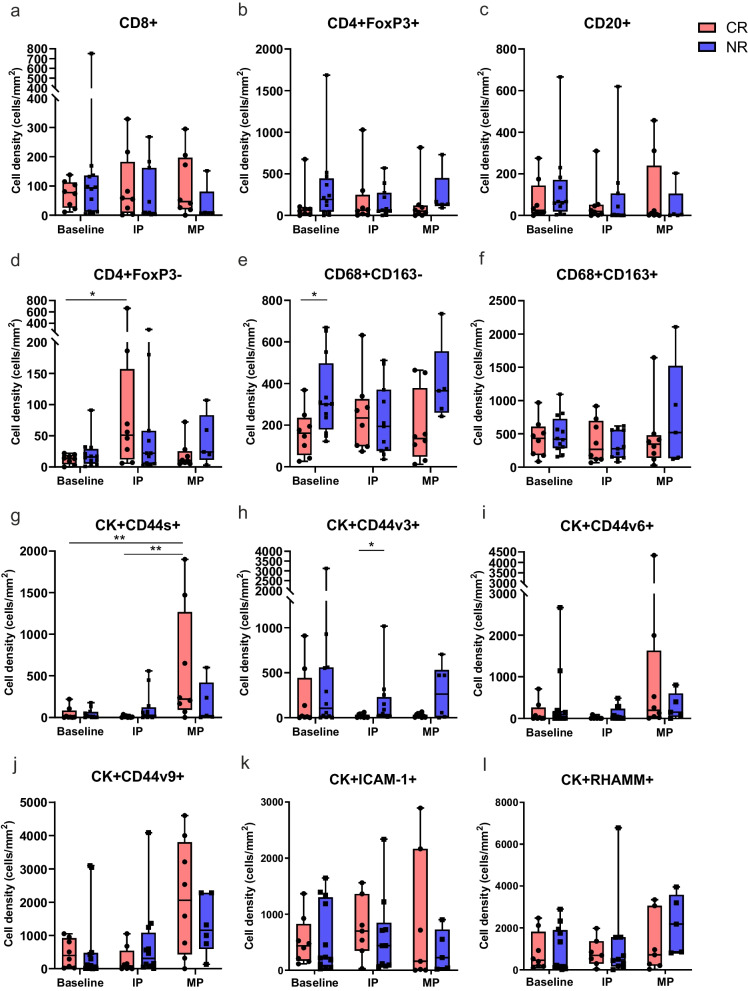
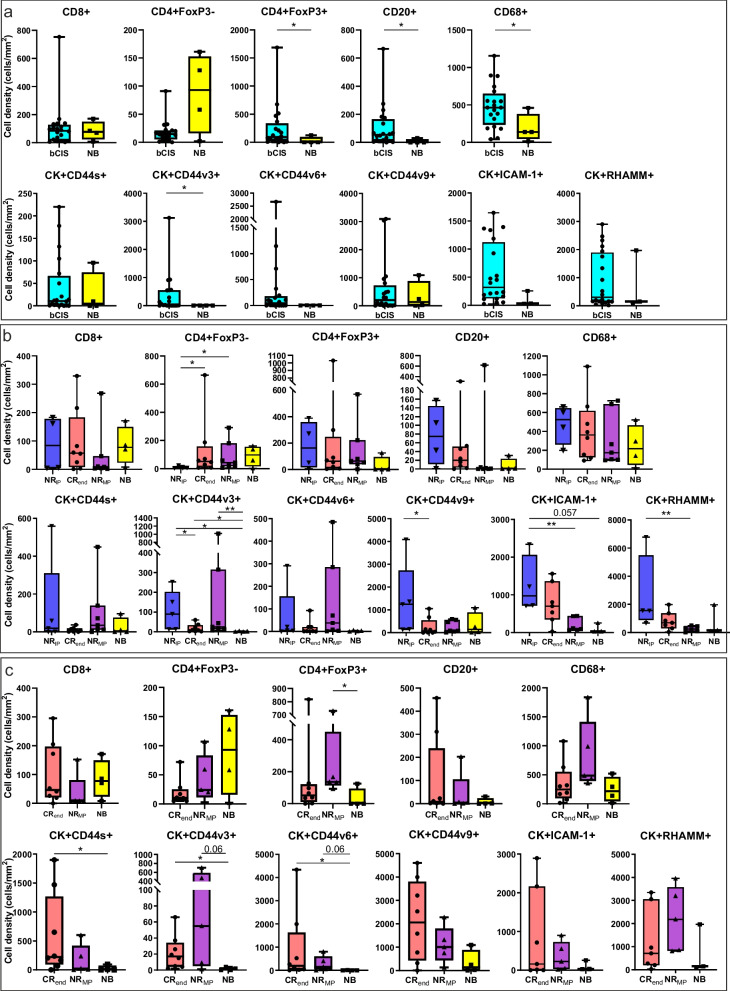
The composition and spatial interactions of tumor-infiltrating immune cells and the expression of the most relevant hyaluronic acid (HA) receptors on cancer cells, were analyzed in biopsies from the 20 patients enrolled in the NCT04798703 phase I study collected before starting ONCOFID-P-B™ therapy (baseline), and after the intensive and the maintenance phases. Clinical data were correlated with cell densities, cell distribution and cell interactions. Associations between immune populations or HA receptors expression and outcome were analyzed using univariate Cox regression and log-rank analysis.
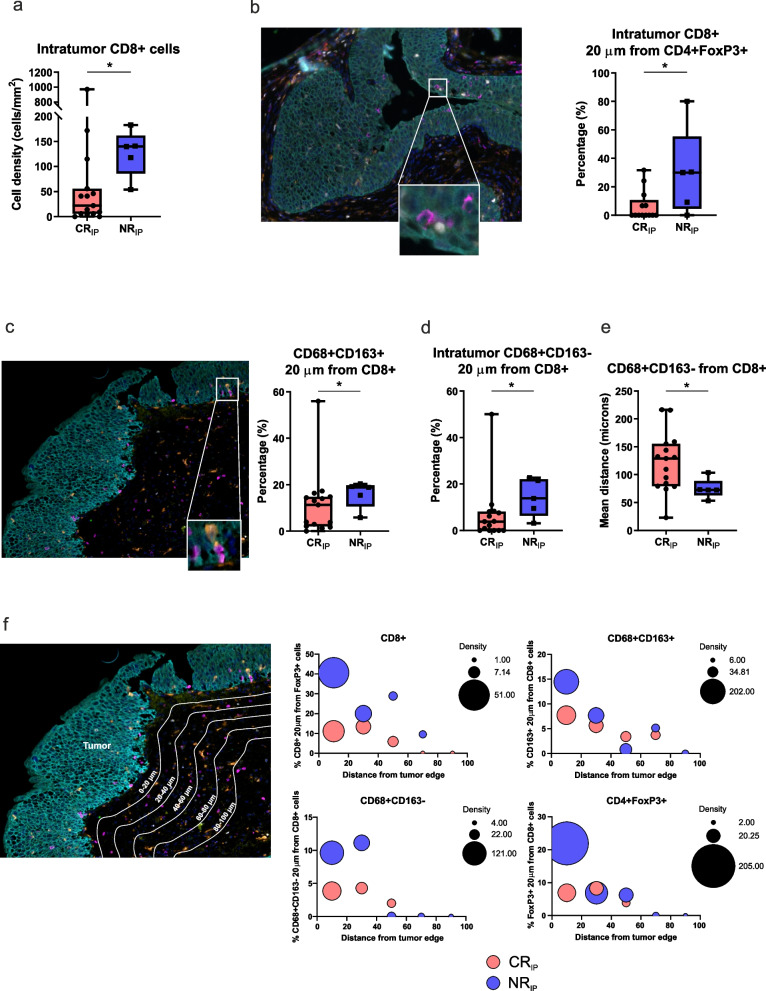
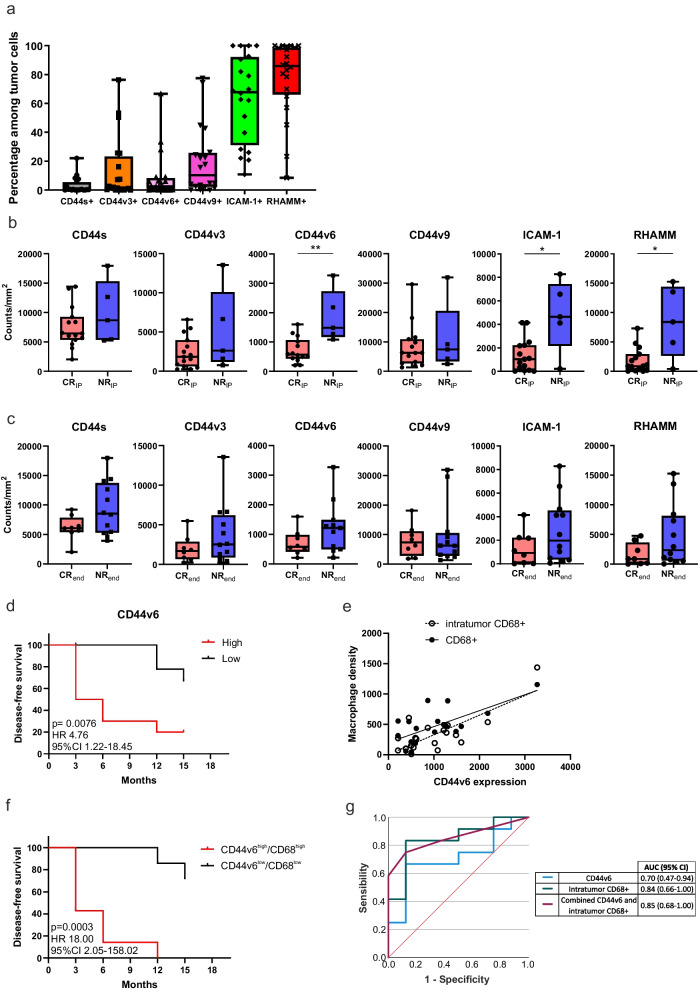
In baseline biopsies, patients achieving CR after the intensive phase had a lower density of intra-tumoral CD8+ cytotoxic T lymphocytes (CTL), but also fewer interactions between CTL and macrophages or T-regulatory cells, as compared to non-responders (NR). NR expressed higher levels of the HA receptors CD44v6, ICAM-1 and RHAMM. The intra-tumoral macrophage density was positively correlated with the expression of the pro-metastatic and aggressive variant CD44v6, and the combined score of intra-tumoral macrophage density and CD44v6 expression had an AUC of 0.85 (95% CI 0.68-1.00) for patient response prediction.
The clinical response to ONCOFID-P-B™ in bladder CIS likely relies on several components of the TME, and the combined evaluation of intra-tumoral macrophages density and CD44v6 expression is a potentially new predictive biomarker for patient response. Overall, our data allow to advance a potential rationale for combinatorial treatments targeting the immune infiltrate such as immune checkpoint inhibitors, to make bladder CIS more responsive to ONCOFID-P-B™ treatment.
在卡介苗(BCG)无反应性膀胱癌原位(CIS;NCT04798703 期 I 研究)患者中,腔内灌注紫杉醇-透明质酸缀合物 ONCOFID-P-B™,在强化期 12 周和维持期 12 个月后,分别有 75%和 40%的患者获得完全缓解(CR)。本研究的目的是详细描述接受 NCT04798703 期 I 研究的 BCG 无反应性膀胱癌 CIS 患者的肿瘤微环境(TME),以确定反应的预测生物标志物。
分析了 20 名接受 NCT04798703 期 I 研究治疗的患者的活检组织中肿瘤浸润免疫细胞的组成和空间相互作用,以及癌细胞上最相关的透明质酸(HA)受体的表达。这些患者在开始 ONCOFID-P-B™治疗前(基线)、强化期和维持期后采集了活检组织。将临床数据与细胞密度、细胞分布和细胞相互作用进行了关联。使用单变量 Cox 回归和对数秩分析分析了免疫群体或 HA 受体表达与结局之间的关系。
在基线活检中,与非应答者(NR)相比,在强化期后获得 CR 的患者肿瘤内 CD8+细胞毒性 T 淋巴细胞(CTL)密度较低,但 CTL 与巨噬细胞或 T 调节细胞的相互作用也较少。NR 表达较高水平的 HA 受体 CD44v6、ICAM-1 和 RHAMM。肿瘤内巨噬细胞密度与促转移和侵袭性变体 CD44v6 的表达呈正相关,肿瘤内巨噬细胞密度和 CD44v6 表达的联合评分对患者反应预测的 AUC 为 0.85(95%CI 0.68-1.00)。
膀胱癌 CIS 对 ONCOFID-P-B™的临床反应可能依赖于 TME 的几个组成部分,肿瘤内巨噬细胞密度和 CD44v6 表达的联合评估可能是预测患者反应的新生物标志物。总的来说,我们的数据为针对免疫浸润的联合治疗提供了一个潜在的合理方案,例如免疫检查点抑制剂,以使膀胱癌 CIS 对 ONCOFID-P-B™治疗更敏感。