Laboratory of Drosophila Research, The Chinese University of Hong Kong, Hong Kong, China.
School of Life Sciences, The Chinese University of Hong Kong, Hong Kong, China.
Proc Natl Acad Sci U S A. 2021 May 11;118(19). doi: 10.1073/pnas.2022940118.
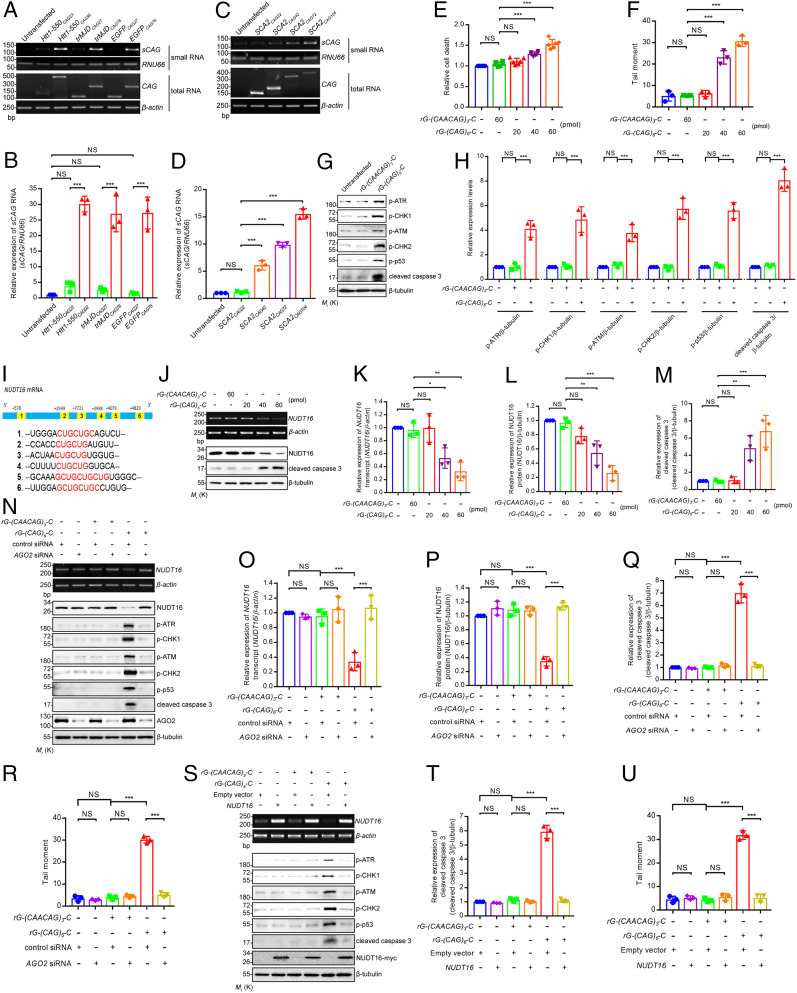
DNA damage plays a central role in the cellular pathogenesis of polyglutamine (polyQ) diseases, including Huntington's disease (HD). In this study, we showed that the expression of untranslatable expanded CAG RNA per se induced the cellular DNA damage response pathway. By means of RNA sequencing (RNA-seq), we found that expression of the () gene was down-regulated in mutant CAG RNA-expressing cells. The loss of NUDT16 function results in a misincorporation of damaging nucleotides into DNAs and leads to DNA damage. We showed that small CAG (sCAG) RNAs, species generated from expanded CAG transcripts, hybridize with CUG-containing mRNA and form a CAG-CUG RNA heteroduplex, resulting in gene silencing of and leading to the DNA damage and cellular apoptosis. These results were further validated using expanded CAG RNA-expressing mouse primary neurons and in vivo R6/2 HD transgenic mice. Moreover, we identified a bisamidinium compound, DB213, that interacts specifically with the major groove of the CAG RNA homoduplex and disfavors the CAG-CUG heteroduplex formation. This action subsequently mitigated RNA-induced silencing complex (RISC)-dependent silencing in both in vitro cell and in vivo mouse disease models. After DB213 treatment, DNA damage, apoptosis, and locomotor defects were rescued in HD mice. This work establishes NUDT16 deficiency by CAG repeat RNAs as a pathogenic mechanism of polyQ diseases and as a potential therapeutic direction for HD and other polyQ diseases.
DNA 损伤在包括亨廷顿病(HD)在内的多聚谷氨酰胺(polyQ)疾病的细胞发病机制中起着核心作用。在这项研究中,我们表明,未翻译的扩增 CAG RNA 的表达本身就会诱导细胞 DNA 损伤反应途径。通过 RNA 测序(RNA-seq),我们发现在表达突变 CAG RNA 的细胞中,基因的表达被下调。NUDT16 功能的丧失导致有害核苷酸错误掺入 DNA 中,从而导致 DNA 损伤。我们表明,小 CAG(sCAG)RNA,即从扩增 CAG 转录本中产生的物种,与含有 CUG 的 mRNA 杂交,并形成 CAG-CUG RNA 异源双链体,导致基因沉默,并导致 DNA 损伤和细胞凋亡。这些结果在使用表达扩增 CAG RNA 的小鼠原代神经元和体内 R6/2 HD 转基因小鼠进一步得到了验证。此外,我们鉴定了一种双脒化合物 DB213,它特异性地与 CAG RNA 同源双链体的大沟相互作用,并不利于 CAG-CUG 异源双链体的形成。这种作用随后减轻了体外细胞和体内小鼠疾病模型中 RNA 诱导的沉默复合物(RISC)依赖性沉默。在 DB213 治疗后,HD 小鼠的 DNA 损伤、凋亡和运动缺陷得到了挽救。这项工作确立了 CAG 重复 RNA 导致的 NUDT16 缺陷是 polyQ 疾病的发病机制,并为 HD 和其他 polyQ 疾病提供了潜在的治疗方向。