Poetker David M, Friedland David R, Adams Jazzmyne A, Tong Ling, Osinski Kristen, Luo Jake
Department of Otolaryngology and Communication Sciences, Medical College of Wisconsin, Milwaukee, Wisconsin, USA.
Zablocki VA Medical Center, Milwaukee, Wisconsin, USA.
OTO Open. 2021 Apr 16;5(2):2473974X211009830. doi: 10.1177/2473974X211009830. eCollection 2021 Apr-Jun.
The objective of this study was to determine the impact of patient demographics and socioeconomic factors on the utilization of tertiary rhinology care services in an upper Midwestern academic medical center.
Retrospective review of electronic health records.
Academic medical center.
The electronic health record of our academic center was interrogated for the demographics and diagnosis of chronic rhinosinusitis (CRS) among adult patients seen by fellowship-trained rhinologists from 2000 to 2019. Patient characteristics (age, sex, race, insurance status) and population-level data (median income and education level) were compared with utilization of tertiary rhinology services for CRS. Utilization rates were calculated for each regional zip code and correlated with census data for median income and education. The association between determinants of health and tertiary rhinology utilization was assessed by multivariate regression analyses.
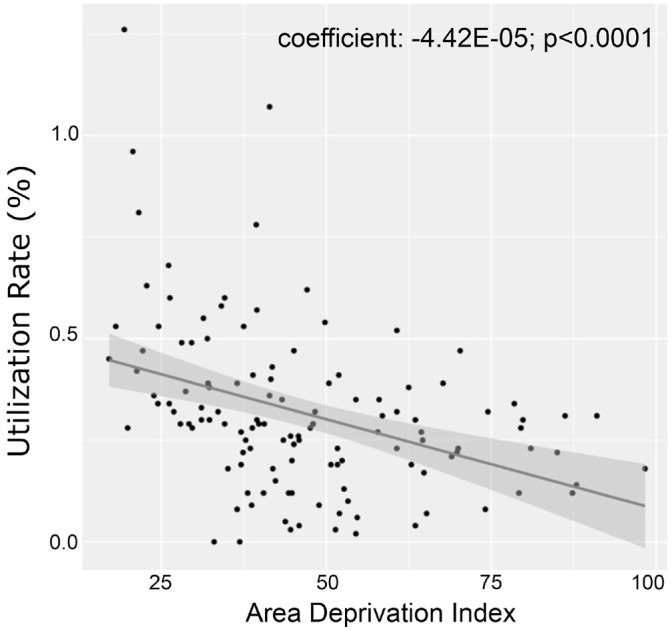
A total of 8325 patients diagnosed with CRS used tertiary rhinology services. Patients were older (median, 58.9 years) and more likely to be female (57.6%), White (85%), and privately insured (60%) when compared with patients seen across our hospital system ( < .001). Adjusted analyses showed median income, education level, and White race to be independently correlated with tertiary care utilization. Private insurance alone was not an independent contributing factor to access.
Utilization of tertiary rhinology services correlated with income, race, and education level. Private insurance was not an independent factor. These results highlight social differences in determinants of access to tertiary otolaryngologic care.
本研究的目的是确定患者人口统计学和社会经济因素对美国中西部一所学术医疗中心三级鼻科护理服务利用情况的影响。
对电子健康记录进行回顾性研究。
学术医疗中心。
查询了我们学术中心2000年至2019年由接受过专科培训的鼻科医生诊治的成年慢性鼻窦炎(CRS)患者的电子健康记录中的人口统计学和诊断信息。将患者特征(年龄、性别、种族、保险状况)和人群水平数据(收入中位数和教育水平)与CRS三级鼻科服务的利用情况进行比较。计算每个地区邮政编码区域的利用率,并将其与收入中位数和教育水平的人口普查数据相关联。通过多因素回归分析评估健康决定因素与三级鼻科服务利用之间的关联。
共有8325名被诊断为CRS的患者使用了三级鼻科服务。与我们医院系统诊治的患者相比,这些患者年龄更大(中位数为58.9岁),女性比例更高(57.6%),白人比例更高(85%),有私人保险的比例更高(60%)(P<0.001)。校正分析显示,收入中位数、教育水平和白人种族与三级医疗服务利用独立相关。仅私人保险不是获得服务的独立影响因素。
三级鼻科服务的利用与收入、种族和教育水平相关。私人保险不是独立因素。这些结果凸显了获得三级耳鼻喉科护理服务决定因素中的社会差异。