Department of Obstetrics and Gynaecology, The Chinese University of Hong Kong, Hong Kong.
Center for Reproductive Medicine, Henan Key Laboratory of Reproduction and Genetics, The First Affiliated Hospital of Zhengzhou University, Zhengzhou.
Med Res Rev. 2021 Jul;41(4):2489-2564. doi: 10.1002/med.21802. Epub 2021 May 5.
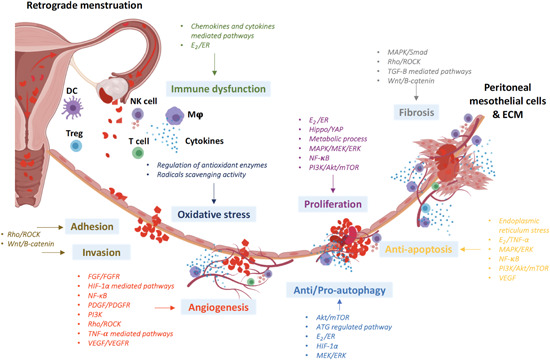
Endometriosis (EM) is defined as endometrial tissues found outside the uterus. Growth and development of endometriotic cells in ectopic sites can be promoted via multiple pathways, including MAPK/MEK/ERK, PI3K/Akt/mTOR, NF-κB, Rho/ROCK, reactive oxidative stress, tumor necrosis factor, transforming growth factor-β, Wnt/β-catenin, vascular endothelial growth factor, estrogen, and cytokines. The underlying pathophysiological mechanisms include proliferation, apoptosis, autophagy, migration, invasion, fibrosis, angiogenesis, oxidative stress, inflammation, and immune escape. Current medical treatments for EM are mainly hormonal and symptomatic, and thus the development of new, effective, and safe pharmaceuticals targeting specific molecular and signaling pathways is needed. Here, we systematically reviewed the literature focused on pharmaceuticals that specifically target the molecular and signaling pathways involved in the pathophysiology of EM. Potential drug targets, their upstream and downstream molecules with key aberrant signaling, and the regulatory mechanisms promoting the growth and development of endometriotic cells and tissues were discussed. Hormonal pharmaceuticals, including melatonin, exerts proapoptotic via regulating matrix metallopeptidase activity while nonhormonal pharmaceutical sorafenib exerts antiproliferative effect via MAPK/ERK pathway and antiangiogenesis activity via VEGF/VEGFR pathway. N-acetyl cysteine, curcumin, and ginsenoside exert antioxidant and anti-inflammatory effects via radical scavenging activity. Natural products have high efficacy with minimal side effects; for example, resveratrol and epigallocatechin gallate have multiple targets and provide synergistic efficacy to resolve the complexity of the pathophysiology of EM, showing promising efficacy in treating EM. Although new medical treatments are currently being developed, more detailed pharmacological studies and large sample size clinical trials are needed to confirm the efficacy and safety of these treatments in the near future.
子宫内膜异位症 (EM) 被定义为在子宫外发现的子宫内膜组织。异位部位的内异症细胞的生长和发育可以通过多种途径促进,包括 MAPK/MEK/ERK、PI3K/Akt/mTOR、NF-κB、Rho/ROCK、活性氧化应激、肿瘤坏死因子、转化生长因子-β、Wnt/β-catenin、血管内皮生长因子、雌激素和细胞因子。其潜在的病理生理机制包括增殖、凋亡、自噬、迁移、侵袭、纤维化、血管生成、氧化应激、炎症和免疫逃避。目前 EM 的医学治疗主要是激素和对症治疗,因此需要开发针对特定分子和信号通路的新的、有效和安全的药物。在这里,我们系统地回顾了专注于特定靶向 EM 病理生理学涉及的分子和信号通路的药物的文献。讨论了潜在的药物靶点、它们具有关键异常信号的上下游分子,以及促进内异症细胞和组织生长和发育的调节机制。激素药物,如褪黑素,通过调节基质金属蛋白酶活性发挥促凋亡作用,而非激素药物索拉非尼通过 MAPK/ERK 通路发挥抗增殖作用,通过 VEGF/VEGFR 通路发挥抗血管生成作用。N-乙酰半胱氨酸、姜黄素和人参皂苷通过清除自由基发挥抗氧化和抗炎作用。天然产物具有高效低副作用的特点;例如,白藜芦醇和表没食子儿茶素没食子酸酯具有多个靶点,提供协同疗效,以解决 EM 病理生理学的复杂性,在治疗 EM 方面显示出有希望的疗效。尽管目前正在开发新的医疗方法,但在不久的将来还需要更详细的药理学研究和更大样本量的临床试验来确认这些治疗方法的疗效和安全性。