Earth to Ocean Research Group, Simon Fraser University, Burnaby, B.C. V5A 1S6, Canada.
Biological Sciences, Simon Fraser University, Burnaby, B.C. V5A 1S6, Canada.
Sci Adv. 2021 May 5;7(19). doi: 10.1126/sciadv.abe5163. Print 2021 May.
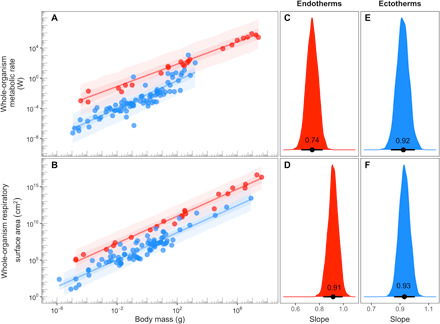
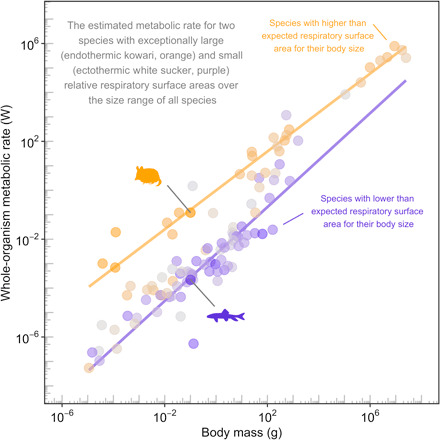
Metabolic rate underlies a wide range of phenomena from cellular dynamics to ecosystem structure and function. Models seeking to statistically explain variation in metabolic rate across vertebrates are largely based on body size and temperature. Unexpectedly, these models overlook variation in the size of gills and lungs that acquire the oxygen needed to fuel aerobic processes. Here, we assess the importance of respiratory surface area in explaining patterns of metabolic rate across the vertebrate tree of life using a novel phylogenetic Bayesian multilevel modeling framework coupled with a species-paired dataset of metabolic rate and respiratory surface area. We reveal that respiratory surface area explains twice as much variation in metabolic rate, compared to temperature, across the vertebrate tree of life. Understanding the combination of oxygen acquisition and transport provides opportunity to understand the evolutionary history of metabolic rate and improve models that quantify the impacts of climate change.
代谢率是从细胞动态到生态系统结构和功能的广泛现象的基础。试图从统计学上解释脊椎动物代谢率变化的模型主要基于体型和温度。出乎意料的是,这些模型忽略了获取有氧过程所需氧气的鳃和肺的大小的变化。在这里,我们使用新颖的系统发育贝叶斯多层次建模框架以及代谢率和呼吸表面积的物种配对数据集,评估呼吸表面积在解释整个脊椎动物生命树的代谢率模式中的重要性。我们揭示了在整个脊椎动物生命树中,呼吸表面积比温度对代谢率的变化解释程度高出一倍。了解氧气获取和运输的结合为理解代谢率的进化历史和改进量化气候变化影响的模型提供了机会。