• 文献检索
  • 文档翻译
  • 深度研究
  • 学术资讯
  • Suppr Zotero 插件Zotero 插件
  • 邀请有礼
  • 套餐&价格
  • 历史记录
应用&插件
Suppr Zotero 插件Zotero 插件浏览器插件Mac 客户端Windows 客户端微信小程序
定价
高级版会员购买积分包购买API积分包
服务
文献检索文档翻译深度研究API 文档MCP 服务
关于我们
关于 Suppr公司介绍联系我们用户协议隐私条款
关注我们

Suppr 超能文献

核心技术专利:CN118964589B侵权必究
粤ICP备2023148730 号-1Suppr @ 2026

文献检索

告别复杂PubMed语法,用中文像聊天一样搜索,搜遍4000万医学文献。AI智能推荐,让科研检索更轻松。

立即免费搜索

文件翻译

保留排版,准确专业,支持PDF/Word/PPT等文件格式,支持 12+语言互译。

免费翻译文档

深度研究

AI帮你快速写综述,25分钟生成高质量综述,智能提取关键信息,辅助科研写作。

立即免费体验

用于在统一度量空间中同时对 GPCR 蛋白进行建模的深度层次嵌入。

Deep hierarchical embedding for simultaneous modeling of GPCR proteins in a unified metric space.

机构信息

Looxid Labs, Seoul, 06628, Republic of Korea.

BK21 FOUR Intelligence Computing, Seoul National University, Seoul, 08826, Republic of Korea.

出版信息

Sci Rep. 2021 May 5;11(1):9543. doi: 10.1038/s41598-021-88623-8.

DOI:10.1038/s41598-021-88623-8
PMID:33953216
原文链接:https://pmc.ncbi.nlm.nih.gov/articles/PMC8100104/
Abstract

GPCR proteins belong to diverse families of proteins that are defined at multiple hierarchical levels. Inspecting relationships between GPCR proteins on the hierarchical structure is important, since characteristics of the protein can be inferred from proteins in similar hierarchical information. However, modeling of GPCR families has been performed separately for each of the family, subfamily, and sub-subfamily level. Relationships between GPCR proteins are ignored in these approaches as they process the information in the proteins with several disconnected models. In this study, we propose DeepHier, a deep learning model to simultaneously learn representations of GPCR family hierarchy from the protein sequences with a unified single model. Novel loss term based on metric learning is introduced to incorporate hierarchical relations between proteins. We tested our approach using a public GPCR sequence dataset. Metric distances in the deep feature space corresponded to the hierarchical family relation between GPCR proteins. Furthermore, we demonstrated that further downstream tasks, like phylogenetic reconstruction and motif discovery, are feasible in the constructed embedding space. These results show that hierarchical relations between sequences were successfully captured in both of technical and biological aspects.

摘要

G 蛋白偶联受体(GPCR)蛋白属于多种蛋白质家族,这些家族在多个层次上进行定义。检查 GPCR 蛋白在层次结构上的关系很重要,因为可以从具有相似层次信息的蛋白质中推断出蛋白质的特性。然而,GPCR 家族的建模分别针对每个家族、亚家族和亚亚家族进行。在这些方法中,忽略了 GPCR 蛋白之间的关系,因为它们使用几个不相关的模型处理蛋白质中的信息。在这项研究中,我们提出了 DeepHier,这是一种深度学习模型,可以从蛋白质序列中使用统一的单个模型同时学习 GPCR 家族层次结构的表示。引入了基于度量学习的新损失项,以在蛋白质之间纳入层次关系。我们使用公共的 GPCR 序列数据集测试了我们的方法。在深度特征空间中的度量距离与 GPCR 蛋白之间的层次家族关系相对应。此外,我们证明,在构建的嵌入空间中,进一步的下游任务,如系统发育重建和模体发现,是可行的。这些结果表明,在技术和生物学方面都成功地捕获了序列之间的层次关系。
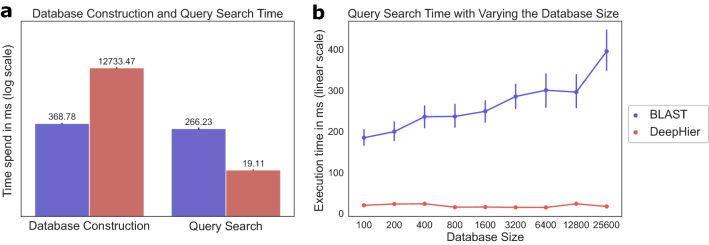
https://cdn.ncbi.nlm.nih.gov/pmc/blobs/e818/8100104/eef4a981c487/41598_2021_88623_Fig5_HTML.jpg
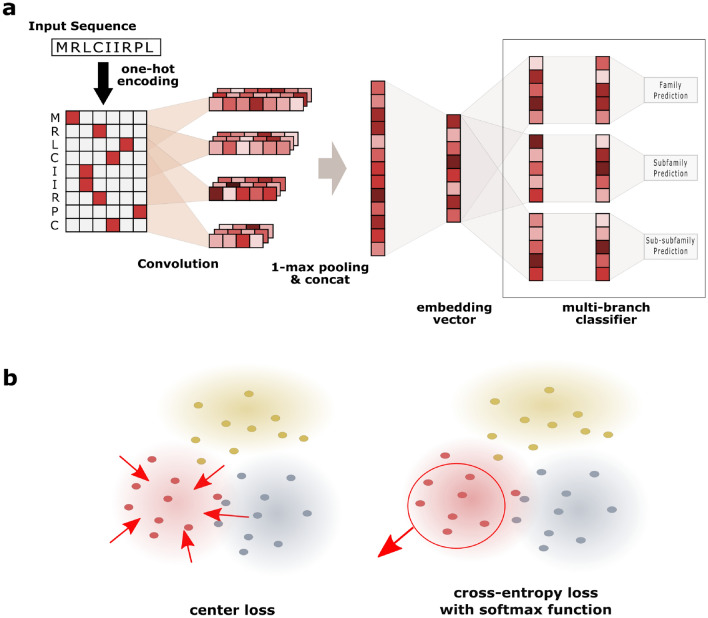
https://cdn.ncbi.nlm.nih.gov/pmc/blobs/e818/8100104/130693f65d93/41598_2021_88623_Fig1_HTML.jpg
https://cdn.ncbi.nlm.nih.gov/pmc/blobs/e818/8100104/c5332580fe26/41598_2021_88623_Fig2_HTML.jpg
https://cdn.ncbi.nlm.nih.gov/pmc/blobs/e818/8100104/90088d917754/41598_2021_88623_Fig3_HTML.jpg
https://cdn.ncbi.nlm.nih.gov/pmc/blobs/e818/8100104/07927ec18188/41598_2021_88623_Fig4_HTML.jpg
https://cdn.ncbi.nlm.nih.gov/pmc/blobs/e818/8100104/eef4a981c487/41598_2021_88623_Fig5_HTML.jpg
https://cdn.ncbi.nlm.nih.gov/pmc/blobs/e818/8100104/130693f65d93/41598_2021_88623_Fig1_HTML.jpg
https://cdn.ncbi.nlm.nih.gov/pmc/blobs/e818/8100104/c5332580fe26/41598_2021_88623_Fig2_HTML.jpg
https://cdn.ncbi.nlm.nih.gov/pmc/blobs/e818/8100104/90088d917754/41598_2021_88623_Fig3_HTML.jpg
https://cdn.ncbi.nlm.nih.gov/pmc/blobs/e818/8100104/07927ec18188/41598_2021_88623_Fig4_HTML.jpg
https://cdn.ncbi.nlm.nih.gov/pmc/blobs/e818/8100104/eef4a981c487/41598_2021_88623_Fig5_HTML.jpg

相似文献

1
Deep hierarchical embedding for simultaneous modeling of GPCR proteins in a unified metric space.用于在统一度量空间中同时对 GPCR 蛋白进行建模的深度层次嵌入。
Sci Rep. 2021 May 5;11(1):9543. doi: 10.1038/s41598-021-88623-8.
2
GPCR-MPredictor: multi-level prediction of G protein-coupled receptors using genetic ensemble.GPCR-MPredictor:基于遗传集成的 G 蛋白偶联受体多层次预测
Amino Acids. 2012 May;42(5):1809-23. doi: 10.1007/s00726-011-0902-6. Epub 2011 Apr 20.
3
Structure-Based Sequence Alignment of the Transmembrane Domains of All Human GPCRs: Phylogenetic, Structural and Functional Implications.所有人类G蛋白偶联受体跨膜结构域基于结构的序列比对:系统发育、结构和功能意义
PLoS Comput Biol. 2016 Mar 30;12(3):e1004805. doi: 10.1371/journal.pcbi.1004805. eCollection 2016 Mar.
4
An improved classification of G-protein-coupled receptors using sequence-derived features.基于序列衍生特征的 G 蛋白偶联受体的改进分类。
BMC Bioinformatics. 2010 Aug 9;11:420. doi: 10.1186/1471-2105-11-420.
5
On the hierarchical classification of G protein-coupled receptors.关于G蛋白偶联受体的层次分类
Bioinformatics. 2007 Dec 1;23(23):3113-8. doi: 10.1093/bioinformatics/btm506. Epub 2007 Oct 22.
6
Reduced alphabet motif methodology for GPCR annotation.用于G蛋白偶联受体注释的简化字母基序方法。
J Biomol Struct Dyn. 2007 Dec;25(3):299-310. doi: 10.1080/07391102.2007.10507178.
7
Present perspectives on the automated classification of the G-protein coupled receptors (GPCRs) at the protein sequence level.目前在蛋白质序列水平上对 G 蛋白偶联受体(GPCRs)进行自动分类的观点。
Curr Top Med Chem. 2011;11(15):1994-2009. doi: 10.2174/156802611796391221.
8
Bioinformatics tools for predicting GPCR gene functions.用于预测 GPCR 基因功能的生物信息学工具。
Adv Exp Med Biol. 2014;796:205-24. doi: 10.1007/978-94-007-7423-0_10.
9
Structure modeling of all identified G protein-coupled receptors in the human genome.人类基因组中所有已鉴定的G蛋白偶联受体的结构建模。
PLoS Comput Biol. 2006 Feb;2(2):e13. doi: 10.1371/journal.pcbi.0020013. Epub 2006 Feb 17.
10
Identification of G protein-coupled receptor signaling pathway proteins in marine diatoms using comparative genomics.利用比较基因组学鉴定海洋硅藻中的 G 蛋白偶联受体信号通路蛋白。
BMC Genomics. 2013 Jul 24;14:503. doi: 10.1186/1471-2164-14-503.

引用本文的文献

1
Tree visualizations of protein sequence embedding space enable improved functional clustering of diverse protein superfamilies.蛋白质序列嵌入空间的树状图可视化可提高不同蛋白质超家族功能聚类的效果。
Brief Bioinform. 2023 Jan 19;24(1). doi: 10.1093/bib/bbac619.

本文引用的文献

1
DeepNOG: fast and accurate protein orthologous group assignment.DeepNOG:快速准确的蛋白质直系同源组分配
Bioinformatics. 2021 Apr 1;36(22-23):5304-5312. doi: 10.1093/bioinformatics/btaa1051.
2
SENSE: Siamese neural network for sequence embedding and alignment-free comparison.感知:用于序列嵌入和无比对的暹罗神经网络。
Bioinformatics. 2019 Jun 1;35(11):1820-1828. doi: 10.1093/bioinformatics/bty887.
3
Prediction of RNA-protein sequence and structure binding preferences using deep convolutional and recurrent neural networks.
使用深度卷积和递归神经网络预测 RNA-蛋白质序列和结构的结合偏好。
BMC Genomics. 2018 Jul 3;19(1):511. doi: 10.1186/s12864-018-4889-1.
4
DeepFam: deep learning based alignment-free method for protein family modeling and prediction.DeepFam:基于深度学习的蛋白质家族建模和预测的无对齐方法。
Bioinformatics. 2018 Jul 1;34(13):i254-i262. doi: 10.1093/bioinformatics/bty275.
5
Pharmacogenomics of GPCR Drug Targets.GPCR 药物靶点的药物基因组学。
Cell. 2018 Jan 11;172(1-2):41-54.e19. doi: 10.1016/j.cell.2017.11.033. Epub 2017 Dec 14.
6
DeepSF: deep convolutional neural network for mapping protein sequences to folds.DeepSF:一种将蛋白质序列映射到折叠结构的深度卷积神经网络。
Bioinformatics. 2018 Apr 15;34(8):1295-1303. doi: 10.1093/bioinformatics/btx780.
7
Visualizing the GPCR Network: Classification and Evolution.可视化GPCR网络:分类与进化
Sci Rep. 2017 Nov 14;7(1):15495. doi: 10.1038/s41598-017-15707-9.
8
Trends in GPCR drug discovery: new agents, targets and indications.G蛋白偶联受体(GPCR)药物研发趋势:新药物、靶点与适应症
Nat Rev Drug Discov. 2017 Dec;16(12):829-842. doi: 10.1038/nrd.2017.178. Epub 2017 Oct 27.
9
Alignment-free sequence comparison: benefits, applications, and tools.无比对信息的序列比对:优势、应用和工具。
Genome Biol. 2017 Oct 3;18(1):186. doi: 10.1186/s13059-017-1319-7.
10
DanQ: a hybrid convolutional and recurrent deep neural network for quantifying the function of DNA sequences.DanQ:一种用于量化DNA序列功能的卷积与循环相结合的深度神经网络。
Nucleic Acids Res. 2016 Jun 20;44(11):e107. doi: 10.1093/nar/gkw226. Epub 2016 Apr 15.