Kabeya Kenji, Satoh Hiroki, Hori Satoko, Sawada Yasufumi
Faculty of Pharmaceutical Sciences, The University of Tokyo, Tokyo, 113-0033, Japan.
Laboratory of Drug Lifetime Management, Graduate School of Pharmaceutical Sciences, The University of Tokyo, Tokyo, 113-0033, Japan.
Patient Prefer Adherence. 2021 Apr 28;15:863-870. doi: 10.2147/PPA.S306582. eCollection 2021.
Tablets and capsules are the most common dosage forms. However, ease of use and/or swallowing influences patients' compliance.
To identify patients' preferences regarding the three-dimensional size of medical tablets/capsules.
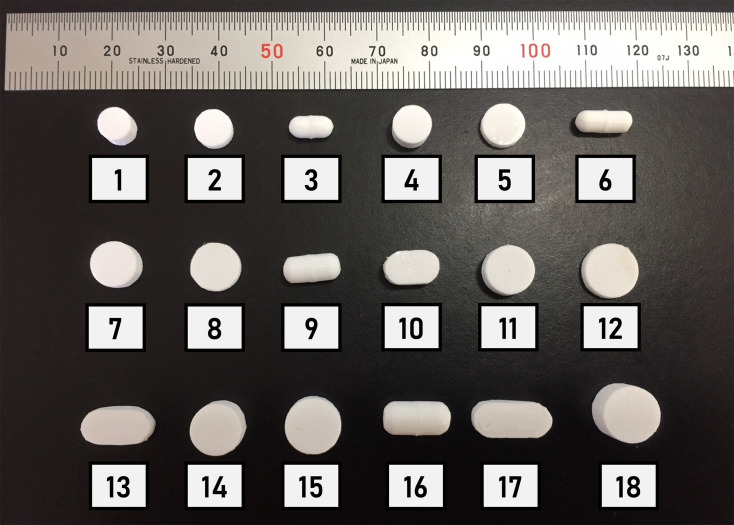
Eighteen cylindrical-, oblong-, and oval-shaped model formulations having different sizes were prepared by three-dimensional printing using polylactic acid. Participants (40 patients visiting a pharmacy in Japan) evaluated the difficulty of picking up and swallowing these model formulations by touching/observing them, and completed a questionnaire. The visual analogue scale (VAS) was used to evaluate each sample, and the relationship of VAS scores to the major axis, thickness, I (the sum of major/minor axes) and I (the sum of major/minor axes and thickness) of the model formulations was evaluated by ANOVA followed by Tukey's test.
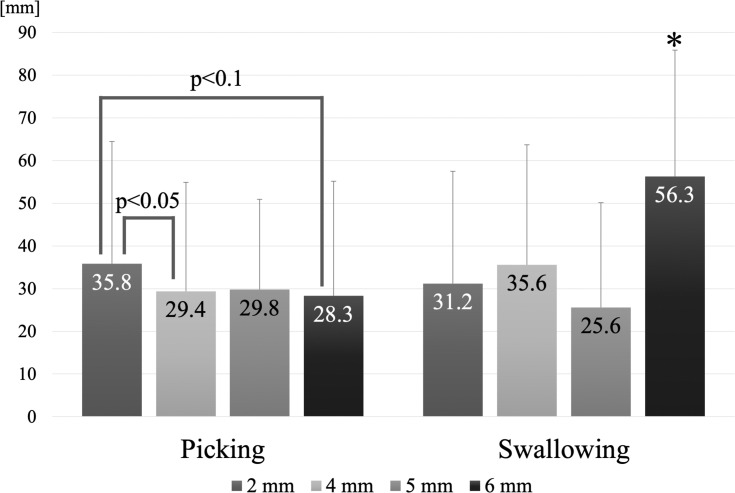
Female participants showed lower VAS scores (less difficult) for picking difficulty compared with male participants, and those taking many drugs showed higher VAS scores (more difficult) for swallowing difficulty compared with those taking fewer drugs. Otherwise, age, gender, disease status, number of drugs usually taken, and ingestion problems did not greatly influence the evaluation. Overall, larger model formulations showed less picking difficulty, but greater swallowing difficulty. Model formulations 2 mm thick or less were harder to pick up, whereas those 6 mm thick or more were harder to swallow. I values greater than 20-22 mm were associated with a negative evaluation by participants.
Participants in this study preferred model formulations with an I value below 22 mm and a thickness of 2-6 mm.
片剂和胶囊是最常见的剂型。然而,使用和/或吞咽的难易程度会影响患者的依从性。
确定患者对医用片剂/胶囊三维尺寸的偏好。
使用聚乳酸通过三维打印制备18种具有不同尺寸的圆柱形、长方形和椭圆形模型制剂。参与者(40名访问日本一家药店的患者)通过触摸/观察评估拿起和吞咽这些模型制剂的难度,并完成一份问卷。使用视觉模拟量表(VAS)对每个样本进行评估,并通过方差分析(ANOVA)和随后的Tukey检验评估VAS评分与模型制剂的长轴、厚度、I(长轴/短轴之和)和I(长轴/短轴与厚度之和)之间的关系。
与男性参与者相比,女性参与者在拿起难度方面的VAS评分较低(难度较小),与服用药物较少的参与者相比,服用多种药物的参与者在吞咽难度方面的VAS评分较高(难度较大)。此外,年龄、性别、疾病状态、通常服用的药物数量和摄入问题对评估影响不大。总体而言,较大的模型制剂拿起难度较小,但吞咽难度较大。厚度为2毫米或更小的模型制剂更难拿起,而厚度为6毫米或更大的模型制剂更难吞咽。I值大于20 - 22毫米与参与者的负面评价相关。
本研究中的参与者更喜欢I值低于22毫米且厚度为2 - 6毫米的模型制剂。