Northwell Health, Great Neck, NY, USA.
NIHR Manchester Biomedical Research Centre, Manchester University Hospitals NHS Trust.
Rheumatology (Oxford). 2021 Nov 3;60(11):5397-5407. doi: 10.1093/rheumatology/keab381.
To evaluate the dose-response, efficacy and safety of dapirolizumab pegol (DZP) in patients with SLE.
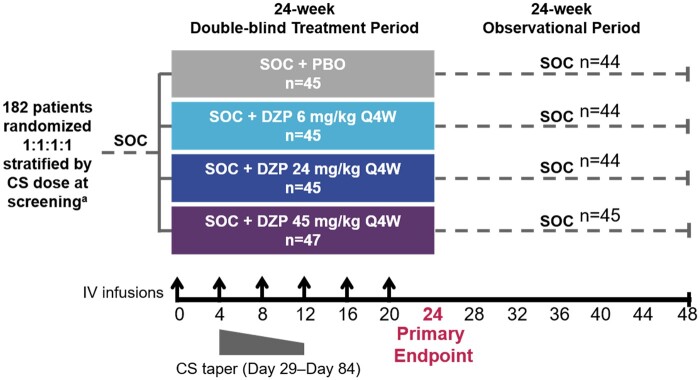
Adults with moderately to severely active SLE (SLEDAI-2K score ≥6 and ≥1 BILAG A or ≥2 BILAG B domain scores), receiving stable CS (≤40 mg/day prednisone-equivalent), antimalarial or immunosuppressant drugs were included. Patients with stable LN (proteinuria ≤2 g/day) not receiving high-dose CS or CYC were permitted entry. Randomized patients received placebo or i.v. DZP (6/24/45 mg/kg) and standard-of-care (SOC) treatment every 4 weeks to week 24, after which patients received only SOC to week 48. The primary objective was to establish a dose-response relationship based on week 24 BILAG-Based Composite Lupus Assessment (BICLA) responder rates.
All DZP groups exhibited improvements in clinical and immunological outcomes vs placebo at week 24; however, BICLA responder rates did not fit pre-specified dose-response models [best-fitting model (Emax): P = 0.07]. Incidences of serious treatment-emergent adverse events across DZP groups were low and similar to placebo. Following DZP withdrawal, SLEDAI-2K, physician's global assessment (PGA), BILAG, and Cutaneous Lupus Erythematosus Disease Area and Severity Index (CLASI) scores stabilized; BICLA and SLE Responder Index (SRI-4) responder rates declined (likely due to interventions with disallowed escape medications), BILAG flares increased, and immunologic parameters returned towards baseline.
Although the primary objective was not met, DZP appeared to be well tolerated, and patients exhibited improvements across multiple clinical and immunological measures of disease activity after 24 weeks relative to placebo. The potential clinical benefit of DZP warrants further investigation.
评估 dapiroizumab pegol(DZP)在系统性红斑狼疮(SLE)患者中的剂量反应、疗效和安全性。
纳入了中度至重度活动期 SLE(SLEDAI-2K 评分≥6 且≥1 BILAG A 或≥2 BILAG B 域评分)、接受稳定 CS(≤40mg/天泼尼松等效物)、抗疟药或免疫抑制剂治疗的成年人。允许有稳定 LN(蛋白尿≤2g/天)且未接受高剂量 CS 或 CYC 的患者入组。随机分组的患者接受安慰剂或静脉注射 DZP(6/24/45mg/kg)和标准治疗(SOC),每 4 周治疗至第 24 周,此后患者仅接受 SOC 治疗至第 48 周。主要目的是基于第 24 周 BILAG 为基础的复合狼疮评估(BICLA)应答率建立剂量反应关系。
与安慰剂相比,所有 DZP 组在第 24 周时均显示出临床和免疫学结局的改善;然而,BICLA 应答率不符合预先指定的剂量反应模型[最佳拟合模型(Emax):P=0.07]。DZP 组的严重治疗相关不良事件发生率较低,与安慰剂相似。在停用 DZP 后,SLEDAI-2K、医生整体评估(PGA)、BILAG、皮肤狼疮红斑疾病面积和严重度指数(CLASI)评分稳定;BICLA 和 SLE 应答指数(SRI-4)应答率下降(可能是由于使用了不允许的逃逸药物干预),BILAG 发作增加,免疫参数恢复到基线。
尽管主要目标未达到,但 DZP 似乎具有良好的耐受性,与安慰剂相比,患者在第 24 周后在多个临床和免疫性疾病活动指标上均有改善。DZP 的潜在临床获益值得进一步研究。