Carotenuto Antonio, Costabile Teresa, Moccia Marcello, Falco Fabrizia, Petracca Maria, Satelliti Barbara, Russo Cinzia Valeria, Saccà Francesco, Lanzillo Roberta, Brescia Morra Vincenzo
Department of Neurosciences, Reproductive and Odontostomatological Sciences, 'Federico II' University, Naples, Italy.
Int Neurourol J. 2021 Dec;25(4):310-318. doi: 10.5213/inj.2040346.173. Epub 2021 May 6.
The aim of this study was to evaluate the prevalence of bowel/bladder dysfunction in multiple sclerosis (MS) and its associations with cognitive impairment.
We prospectively enrolled 150 MS patients. Patients were administered the Symbol Digit Modality Test (SDMT), the Neurogenic Bowel Dysfunction Score (NBDS), and the Actionable Bladder Symptom Screening Tool (ABSST). The associations between bowel/bladder dysfunction and cognitive function were assessed through hierarchical regression models using the SDMT and clinicodemographic features as independent variables and NBDS and ABSST scores as dependent variables.
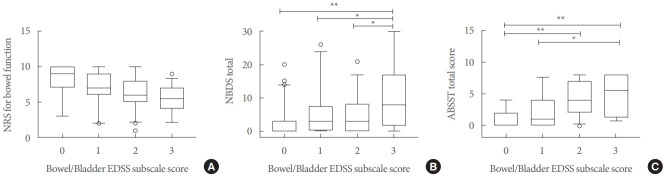
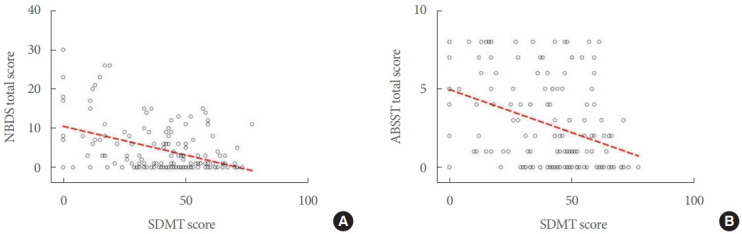
The prevalence of bowel/bladder deficits was 44.7%, with 26 patients (17.3%) suffering from bowel deficits and 60 patients (40%) from bladder deficits. The total NBDS and ABSST scores were correlated with the SDMT (β=-0.10, P<0.001 and β=-0.03, P=0.04, respectively) after correction for demographic features and physical disability.
Bowel/bladder disorders are common in MS and are associated with both physical and cognitive disability burdens. As SDMT is embedded into routine clinical assessments, a lower score may warrant investigating bowel/bladder dysfunction due to the strong interplay of these factors.
本研究旨在评估多发性硬化症(MS)患者肠道/膀胱功能障碍的患病率及其与认知障碍的关联。
我们前瞻性招募了150例MS患者。对患者进行符号数字模态测验(SDMT)、神经源性肠道功能障碍评分(NBDS)和可操作性膀胱症状筛查工具(ABSST)测试。以SDMT和临床人口统计学特征作为自变量,NBDS和ABSST评分作为因变量,通过分层回归模型评估肠道/膀胱功能障碍与认知功能之间的关联。
肠道/膀胱功能缺陷的患病率为44.7%,其中26例患者(17.3%)存在肠道功能缺陷,60例患者(40%)存在膀胱功能缺陷。在校正人口统计学特征和身体残疾因素后,NBDS和ABSST总分与SDMT相关(β分别为-0.10,P<0.001和β为-0.03,P=0.04)。
肠道/膀胱功能障碍在MS患者中很常见,且与身体和认知残疾负担均相关。由于这些因素之间存在强烈的相互作用,鉴于SDMT已纳入常规临床评估,较低的分数可能需要对肠道/膀胱功能障碍进行调查。