Marancik David P, Perrault Justin R, Komoroske Lisa M, Stoll Jamie A, Kelley Kristina N, Manire Charles A
Department of Pathobiology, School of Veterinary Medicine, St. George's University, True Blue, Grenada, West Indies.
Loggerhead Marinelife Center, 14200 US Highway One, Juno Beach, FL 33408, USA.
Conserv Physiol. 2021 Apr 28;9(1):coab018. doi: 10.1093/conphys/coab018. eCollection 2021.
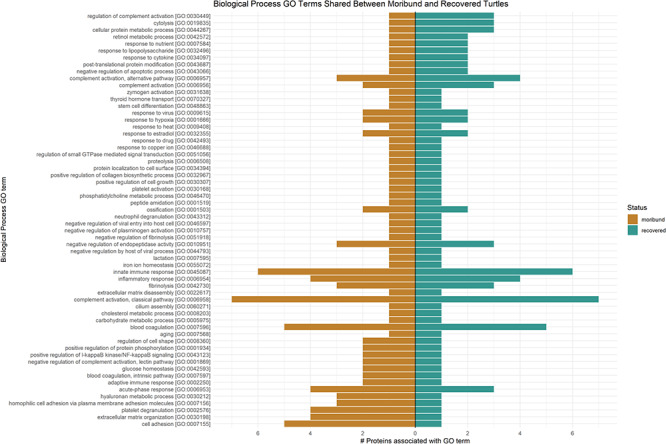
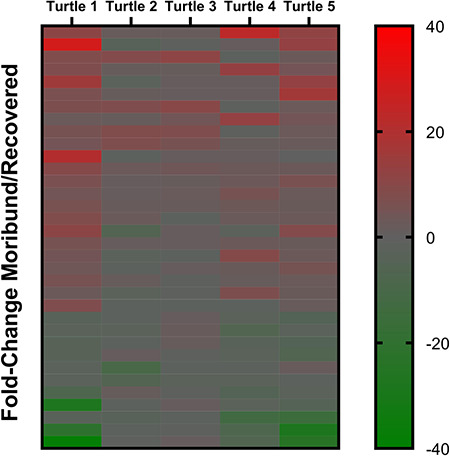
Evaluating sea turtle health can be challenging due to an incomplete understanding of pathophysiologic responses in these species. Proteome characterization of clinical plasma samples can provide insights into disease progression and prospective biomarker targets. A TMT-10-plex-LC-MS/MS platform was used to characterize the plasma proteome of five, juvenile, green turtles () and compare qualitative and quantitative protein changes during moribund and recovered states. The 10 plasma samples yielded a total of 670 unique proteins. Using ≥1.2-fold change in protein abundance as a benchmark for physiologic upregulation or downregulation, 233 (34.8%) were differentially regulated in at least one turtle between moribund and recovered states. Forty-six proteins (6.9%) were differentially regulated in all five turtles with two proteins (0.3%) demonstrating a statistically significant change. A principle component analysis showed protein abundance loosely clustered between moribund samples or recovered samples and for turtles that presented with trauma ( = 3) or as intestinal floaters ( = 2). Gene Ontology terms demonstrated that moribund samples were represented by a higher number of proteins associated with blood coagulation, adaptive immune responses and acute phase response, while recovered turtle samples included a relatively higher number of proteins associated with metabolic processes and response to nutrients. Abundance levels of 48 proteins (7.2%) in moribund samples significantly correlated with total protein, albumin and/or globulin levels quantified by biochemical analysis. Differentially regulated proteins identified with immunologic and physiologic functions are discussed for their possible role in the green turtle pathophysiologic response and for their potential use as diagnostic biomarkers. These findings enhance our ability to interpret sea turtle health and further progress conservation, research and rehabilitation programs for these ecologically important species.
由于对这些物种的病理生理反应了解不全面,评估海龟健康状况具有挑战性。临床血浆样本的蛋白质组特征分析可以为疾病进展和潜在生物标志物靶点提供见解。使用TMT-10重LC-MS/MS平台对五只幼年绿海龟的血浆蛋白质组进行特征分析,并比较濒死状态和恢复状态下蛋白质的定性和定量变化。10份血浆样本共产生670种独特蛋白质。以蛋白质丰度变化≥1.2倍作为生理上调或下调的基准,在至少一只海龟的濒死状态和恢复状态之间,有233种(34.8%)蛋白质受到差异调节。在所有五只海龟中,有46种蛋白质(6.9%)受到差异调节,其中两种蛋白质(0.3%)表现出统计学上的显著变化。主成分分析表明,濒死样本或恢复样本以及出现创伤的海龟(n = 3)或肠道漂浮物的海龟(n = 2)之间,蛋白质丰度大致聚类。基因本体术语表明,濒死样本中与血液凝固、适应性免疫反应和急性期反应相关的蛋白质数量较多,而恢复状态的海龟样本中与代谢过程和对营养物质反应相关的蛋白质数量相对较多。濒死样本中48种蛋白质(7.2%)的丰度水平与生化分析定量的总蛋白、白蛋白和/或球蛋白水平显著相关。讨论了具有免疫和生理功能的差异调节蛋白质在绿海龟病理生理反应中的可能作用及其作为诊断生物标志物的潜在用途。这些发现增强了我们解读海龟健康状况的能力,并进一步推动了针对这些具有重要生态意义物种的保护、研究和康复计划。