Bondarenko Stanislav, Filipenko Volodymyr, Karpinsky Michael, Karpinska Olena, Ivanov Gennadiy, Maltseva Valentyna, Badnaoui Ahmed Amine, Schwarzkopf Ran
Department of Joint Pathology, Sytenko Institute of Spine and Joint Pathology, Kharkiv 61124, Ukraine.
Department of Biomechanics, Sytenko Institute of Spine and Joint Pathology, Kharkiv 61124, Ukraine.
World J Orthop. 2021 Apr 18;12(4):214-222. doi: 10.5312/wjo.v12.i4.214.
Today, biological fixation of uncemented press-fit acetabular components plays an important role in total hip arthroplasty. Long-term stable fixation of these implants depends on the osseointegration of the acetabular cup bone tissue into the acetabular cup implant, and their ability to withstand functional loads.
To compare the strength of bone-implant osseointegration of four types of porous metal implants in normal and osteoporotic bone in rabbits.
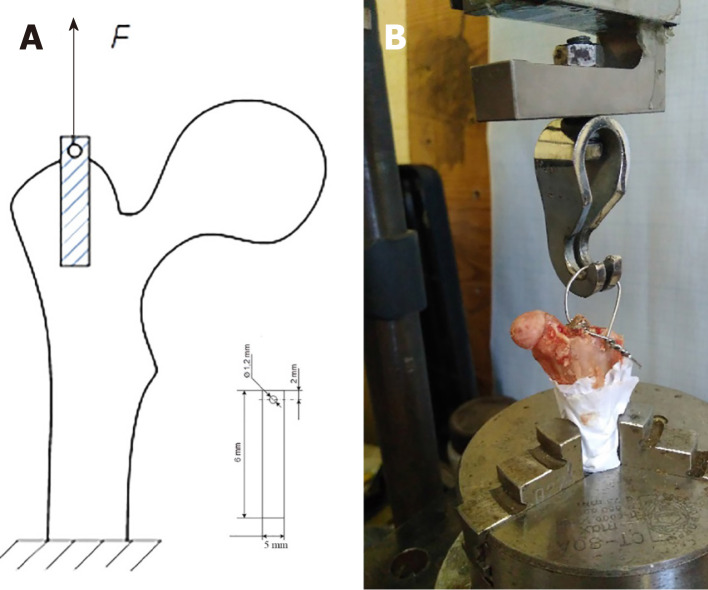
The study was performed in 50 female California rabbits divided into non-ovariectomized (non-OVX) and ovariectomized groups (OVX) at 6 mo of age. Rabbits were sacrificed 8 wk after the implantation of four biomaterials [TTM, CONCELOC, Zimmer Biomet's Trabecular Metal (TANTALUM), and ATLANT] in a 5-mm diameter defect created in the left femur. A biomechanical evaluation of the femur was carried out by testing implant breakout force. The force was gradually increased until complete detachment of the implant from the bone occurred.
The breakout force needed for implant detachment was significantly higher in the non-OVX group, compared with the OVX group for all implants (TANTALUM, 194.7 ± 6.1 N 181.3 ± 2.8 N; = 0.005; CONCELOC, 190.8 ± 3.6 N 180.9 ± 6.6 N; = 0.019; TTM, 186.3 ± 1.8 N 172.0 N ± 11.0 N; = 0.043; and ATLANT, 104.9 ± 7.0 N 78.9 N ± 4.5 N; = 0.001). In the OVX group, The breakout forces in TANTALUM, TTM, and CONCELOC did not differ significantly ( = 0.066). The breakout force for ATLANT in the OVX group was lower by a factor of 2.3 compared with TANTALUM and CONCELOC, and by 2.2 compared with TTM ( = 0.001). In the non-OVX group, the breakout force for ATLANT was significantly different from all other implants, with a reduction in fixation strength by a factor of 1.9 ( = 0.001).
TANTALUM, TTM, and CONCELOC had equal bone-implant osseointegration in healthy and in osteoporotic bone. ATLANT had significantly decreased osseointegration ( = 0.001) in healthy and in osteoporotic bone.
如今,非骨水泥压配型髋臼组件的生物固定在全髋关节置换术中起着重要作用。这些植入物的长期稳定固定取决于髋臼杯骨组织与髋臼杯植入物的骨整合,以及它们承受功能负荷的能力。
比较四种多孔金属植入物在兔正常骨和骨质疏松骨中的骨-植入物骨整合强度。
该研究在50只6月龄雌性加利福尼亚兔中进行,分为未去卵巢(非OVX)组和去卵巢(OVX)组。在左股骨制造一个5毫米直径的缺损并植入四种生物材料[TTM、CONCELOC、齐默生物公司的小梁金属(钽)和ATLANT]8周后处死兔子。通过测试植入物拔出力对股骨进行生物力学评估。逐渐增加力,直到植入物与骨完全分离。
与OVX组相比,所有植入物(钽,194.7±6.1牛对181.3±2.8牛;P = 0.005;CONCELOC,190.8±3.6牛对180.9±6.6牛;P = 0.019;TTM,186.3±1.8牛对172.0牛±11.0牛;P = 0.043;以及ATLANT,104.9±7.0牛对78.9牛±4.5牛;P = 0.001)在非OVX组中植入物分离所需的拔出力显著更高。在OVX组中,钽、TTM和CONCELOC的拔出力无显著差异(P = 0.066)。OVX组中ATLANT的拔出力比钽和CONCELOC低2.3倍,比TTM低2.2倍(P = 0.001)。在非OVX组中,ATLANT的拔出力与所有其他植入物显著不同,固定强度降低了1.9倍(P = 0.001)。
钽、TTM和CONCELOC在健康骨和骨质疏松骨中具有同等的骨-植入物骨整合。ATLANT在健康骨和骨质疏松骨中的骨整合显著降低(P = 0.001)。