Bush Christopher, Gagnier Joel J, Carpenter James, Bedi Asheesh, Miller Bruce
Department of Orthopaedic Surgery, University of Michigan, Ann Arbor, MI 48106, United States.
World J Orthop. 2021 Apr 18;12(4):223-233. doi: 10.5312/wjo.v12.i4.223.
Previous studies have shown that non-surgical management can be an effective treatment strategy for many patients with rotator cuff tears. Despite the prevalence of rotator cuff disease, few studies have examined the patient and tear related factors that predict outcomes of nonsurgical management in this cohort of patients.
To identify factors that are associated with changes in patient reported outcomes over time in individuals with full-thickness rotator cuff tears treated without surgery.
A cohort of 59 patients who underwent non-surgical management of full thickness rotator cuff tears with a minimum of 1-year follow-up were identified from our institutional registry. Patient demographics, comorbidities and tear characteristics were collected at initial presentation. Outcome measures were collected at baseline and at each clinical follow-up, which included Western Ontario Rotator Cuff (WORC) index, American Shoulder and Elbow Surgeons score, Visual Analog Scale for pain and Single Assessment Numerical Evaluation. Multi- and univariate regression analyses were used to determine the impact of each patient and tear related variable on final WORC scores and change in WORC scores throughout the study.
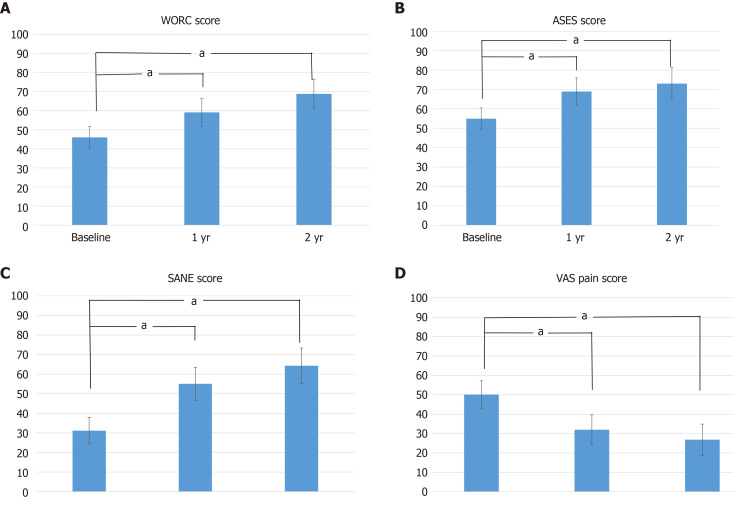
In this non-surgical cohort, all patient-reported outcome measures significantly improved compared to baseline at 1 and 2-year follow-up. There was no significant difference in outcomes between 1 and 2 years. The average improvement surpassed the published minimal clinically important differences values for WORC, American Shoulder and Elbow Surgeons, Visual Analog Scale pain and Single Assessment Numerical Evaluation scores. Regression analysis identified female gender (β = - 19.88, = 0.003), smoking (β = -29.98, = 0.014) and significant subscapularis fatty infiltration (β = -15.35, = 0.024) as predictors of less favorable WORC scores at 1 year, and female gender (β = -19.09, = 0.015) alone as a predictor of lower WORC scores at 2 years. Patients with symptom duration greater than 1 year at presentation reported less improvement in WORC scores at 1-year follow-up (β = -14.63, = 0.052) and patients with traumatic tears reported greater improvements in WORC scores at 2-year follow-up (β = 17.37, = 0.031).
Patients with full thickness rotator cuff tears can achieve and maintain clinically meaningful benefit from non-surgical management through 2-year follow-up. Female patients, smokers, and those with significant subscapularis fatty infiltration tend to have lower overall WORC scores at 1-year follow-up, and females also have lower WORC scores at 2-year follow-up. Patients presenting with symptoms greater than 1 year had less clinical improvement at 1-year follow-up, and those with traumatic tears had greater clinical improvement at 2-year follow-up.
既往研究表明,非手术治疗对于许多肩袖撕裂患者而言是一种有效的治疗策略。尽管肩袖疾病很常见,但很少有研究探讨在这类患者中预测非手术治疗效果的患者及撕裂相关因素。
确定在未接受手术治疗的全层肩袖撕裂患者中,与患者报告的随时间变化的结局相关的因素。
从我们机构的登记系统中识别出59例接受全层肩袖撕裂非手术治疗且随访至少1年的患者队列。在初次就诊时收集患者的人口统计学资料、合并症和撕裂特征。在基线和每次临床随访时收集结局指标,包括西 Ontario 肩袖(WORC)指数、美国肩肘外科医师评分、疼痛视觉模拟量表和单一评估数值评定法。采用多因素和单因素回归分析来确定每个患者及撕裂相关变量对最终 WORC 评分以及整个研究期间 WORC 评分变化的影响。
在这个非手术队列中,与基线相比,所有患者报告的结局指标在1年和2年随访时均有显著改善。1年和2年的结局之间无显著差异。平均改善超过了已发表的 WORC、美国肩肘外科医师、视觉模拟量表疼痛和单一评估数值评定法评分的最小临床重要差异值。回归分析确定,女性(β = -19.88, P = 0.003)、吸烟(β = -29.98, P = 0.014)和显著的肩胛下肌脂肪浸润(β = -15.35, P = 0.024)是1年时 WORC 评分较差的预测因素,而仅女性(β = -19.09, P = 0.015)是2年时 WORC 评分较低的预测因素。就诊时症状持续时间大于1年的患者在1年随访时 WORC 评分改善较少(β = -14.63, P = 0.052),而创伤性撕裂患者在2年随访时 WORC 评分改善更大(β = 17.37, P = 0.031)。
全层肩袖撕裂患者通过2年随访可从非手术治疗中获得并维持具有临床意义的益处。女性患者、吸烟者以及肩胛下肌有显著脂肪浸润者在1年随访时总体 WORC 评分往往较低,女性在2年随访时 WORC 评分也较低。症状出现超过1年的患者在1年随访时临床改善较少,而创伤性撕裂患者在2年随访时临床改善更大。