Ilyichev A A, Orlova L A, Sharabrin S V, Karpenko L I
State Research Center of Virology and Biotechnology "Vector", Koltsovo, Novosibirsk region, Russia.
Vavilovskii Zhurnal Genet Selektsii. 2020 Nov;24(7):802-807. doi: 10.18699/VJ20.676.
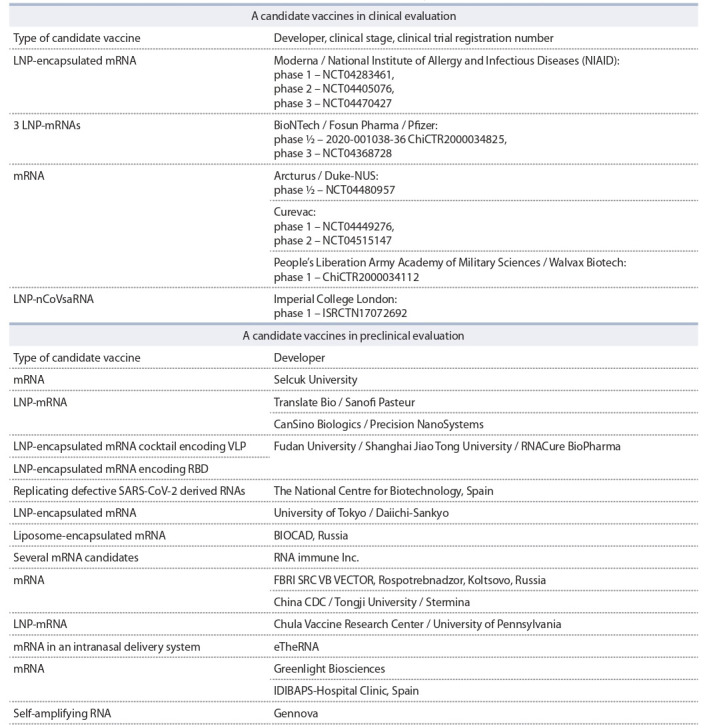
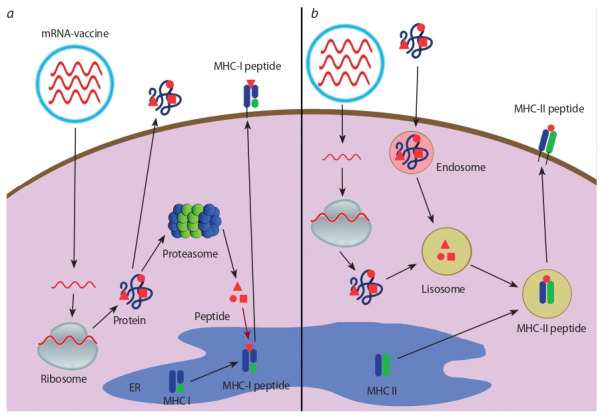
After the genome sequence of SARS-CoV-2 (Severe acute respiratory syndrome-related coronavirus 2) was published and the number of infected people began to increase rapidly, many global companies began to develop a vaccine. Almost all known approaches to vaccine design were applied for this purpose, including inactivated viruses, mRNA and DNA-vaccines, vaccines based on various viral vectors, synthetically generated peptides and recombinant proteins produced in cells of insects and mammals. This review considers one of the promising vaccine platforms based on messenger RNA. Until recent years, mRNA-vaccination was out of practical implementation due to high sensitivity to nuclease degradation and consequent instability of drugs based on mRNA. Latest technological advances significantly mitigated the problems of low immunogenicity, instability, and difficulties in RNA-vaccine delivery. It is worth noting that mRNA-vaccines can efficiently activate both components of the immune system, i. e. T-cell and humoral responses. The essential advantage of mRNAvaccines includes fast, inexpensive, scalable and uniform production providing a large output of desirable products in vitro. Synthesis and purification processes significantly simplify the process technology of mRNA drugs with injectable purity. Thus, mRNA production via in vitro transcription is more advantageous as compared with DNA-vaccines since it is a chemical process without the use of cells. mRNA techniques make it possible to pass all the phases of vaccine development much faster in comparison with the production of vaccines based on inactivated viruses or recombinant proteins. This property is critically important when designing vaccines against viral pathogens as the main problem of disease control includes a time gap between an epidemic and vaccine development. This paper discusses studies on the development of vaccines against coronaviruses including SARS-CoV-2 with special attention to the mRNA technique.
严重急性呼吸综合征冠状病毒2(SARS-CoV-2)的基因组序列公布后,感染人数开始迅速增加,许多全球公司开始研发疫苗。几乎所有已知的疫苗设计方法都被用于此目的,包括灭活病毒、mRNA和DNA疫苗、基于各种病毒载体的疫苗、合成生成的肽以及在昆虫和哺乳动物细胞中产生的重组蛋白。本综述探讨了基于信使核糖核酸(mRNA)的一种有前景的疫苗平台。直到近年来,由于对核酸酶降解高度敏感以及由此导致的基于mRNA的药物不稳定,mRNA疫苗接种一直无法实际应用。最新的技术进步显著缓解了低免疫原性、不稳定性以及RNA疫苗递送困难等问题。值得注意的是,mRNA疫苗能够有效激活免疫系统的两个组成部分,即T细胞和体液反应。mRNA疫苗的主要优势包括快速、廉价、可扩展且均匀的生产,能够在体外大量产出所需产品。合成和纯化过程显著简化了具有注射级纯度的mRNA药物的工艺技术。因此,与DNA疫苗相比,通过体外转录生产mRNA更具优势,因为这是一个不使用细胞的化学过程。与基于灭活病毒或重组蛋白的疫苗生产相比,mRNA技术能够使疫苗研发的所有阶段都更快完成。在设计针对病毒病原体的疫苗时,这一特性至关重要,因为疾病控制的主要问题包括疫情与疫苗研发之间的时间差。本文讨论了针对包括SARS-CoV-2在内的冠状病毒疫苗研发的研究,特别关注mRNA技术。