
速度相关而非去趋势的步态变异性在多个坡度下随更灵敏的自我调节跑步机控制器而增加。
Speed-related but not detrended gait variability increases with more sensitive self-paced treadmill controllers at multiple slopes.
机构信息
Department of Mechanical and Aerospace Engineering, University of Central Florida, Orlando, Florida, United States of America.
Disability, Aging, and Technology Cluster, University of Central Florida, Orlando, Florida, United States of America.
出版信息
PLoS One. 2021 May 7;16(5):e0251229. doi: 10.1371/journal.pone.0251229. eCollection 2021.
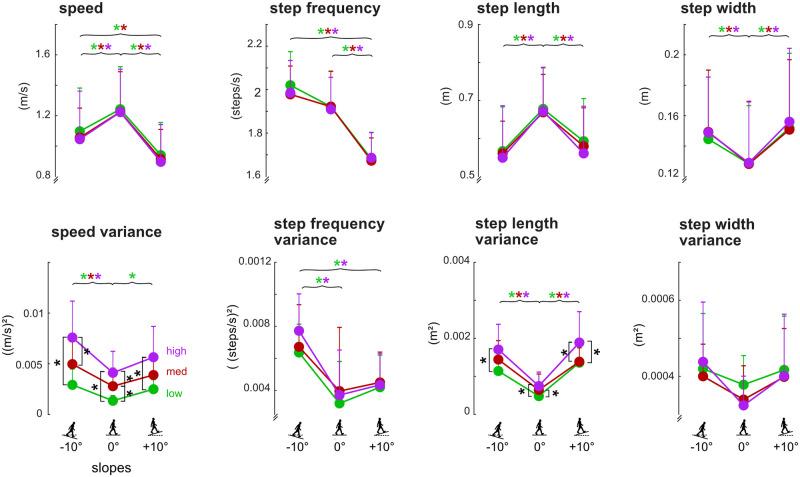
Self-paced treadmills are being used more frequently to study humans walking with their self-selected gaits on a range of slopes. There are multiple options to purchase a treadmill with a built-in controller, or implement a custom written self-paced controller, which raises questions about how self-paced controller affect treadmill speed and gait biomechanics on multiple slopes. This study investigated how different self-paced treadmill controller sensitivities affected gait parameters and variability on decline, level, and incline slopes. We hypothesized that increasing self-paced controller sensitivity would increase gait variability on each slope. We also hypothesized that detrended variability could help mitigate differences in variability that arise from differences in speed fluctuations created by the self-paced controllers. Ten young adults walked on a self-paced treadmill using three controller sensitivities (low, medium, and high) and fixed speeds at three slopes (decline, -10°; level, 0°; incline, +10°). Within each slope, average walking speeds and spatiotemporal gait parameters were similar regardless of self-paced controller sensitivity. With higher controller sensitivities on each slope, speed fluctuations, speed variance, and step length variance increased whereas step frequency variance and step width variance were unaffected. Detrended variance was not affected by controller sensitivity suggesting that detrending variability helps mitigate differences associated with treadmill speed fluctuations. Speed-trend step length variances, however, increased with more sensitive controllers. Further, detrended step length variances were similar for self-paced and fixed speed walking, whereas self-paced walking included substantial speed-trend step length variance not present in fixed speed walking. In addition, regardless of the self-paced controller, subjects walked fastest on the level slope with the longest steps, narrowest steps, and least variance. Overall, our findings suggest that separating gait variability into speed-trend and detrended variability could be beneficial for interpreting gait variability among multiple self-paced treadmill studies and when comparing self-paced walking with fixed speed walking.
自定步速跑步机越来越多地被用于研究人类在不同坡度下以自身选择的步态行走。有多种选择可以购买内置控制器的跑步机,或者实施自定义编写的自定步速控制器,这就提出了关于自定步速控制器如何影响不同坡度下跑步机速度和步态生物力学的问题。本研究调查了不同的自定步速跑步机控制器灵敏度如何影响下坡、平地和上坡时的步态参数和变异性。我们假设增加自定步速控制器的灵敏度会增加每个坡度的步态变异性。我们还假设去趋势变异性可以帮助减轻由于自定步速控制器产生的速度波动差异而引起的变异性差异。十名年轻人在自定步速跑步机上使用三种控制器灵敏度(低、中、高)和三种坡度(下坡、-10°;平地、0°;上坡、+10°)下的固定速度行走。在每个坡度内,平均行走速度和时空步态参数都相似,而与自定步速控制器的灵敏度无关。在每个坡度上,随着控制器灵敏度的提高,速度波动、速度方差和步长方差增加,而步频方差和步宽方差不受影响。去趋势方差不受控制器灵敏度的影响,这表明去趋势变异性有助于减轻与跑步机速度波动相关的差异。然而,速度趋势步长方差随着更敏感的控制器而增加。此外,去趋势步长方差在自定步速和固定速度行走中相似,而自定步速行走包括在固定速度行走中不存在的大量速度趋势步长变异性。此外,无论使用何种自定步速控制器,受试者在平地坡度上行走速度最快,步长最长,步宽最窄,变异性最小。总的来说,我们的发现表明,将步态变异性分为速度趋势和去趋势变异性可能有助于解释多个自定步速跑步机研究中的步态变异性,以及在比较自定步速行走和固定速度行走时。




 Zotero 插件