
英格兰剑桥中世纪的痛风和‘足痛风’。
Gout and 'Podagra' in medieval Cambridge, England.
机构信息
McDonald Institute for Archaeological Research, University of Cambridge, Cambridge, UK; Department of Archaeology, University of Aberdeen, Aberdeen, UK.
Department of Archaeology, University of Cambridge, Cambridge, UK.
出版信息
Int J Paleopathol. 2021 Jun;33:170-181. doi: 10.1016/j.ijpp.2021.04.007. Epub 2021 May 4.
OBJECTIVE
To estimate the prevalence rate of gout and to explore the social factors that contributed to its development in the various sub-populations in medieval Cambridge.
MATERIALS
177 adult individuals from four medieval cemeteries located in and around Cambridge, UK.
METHODS
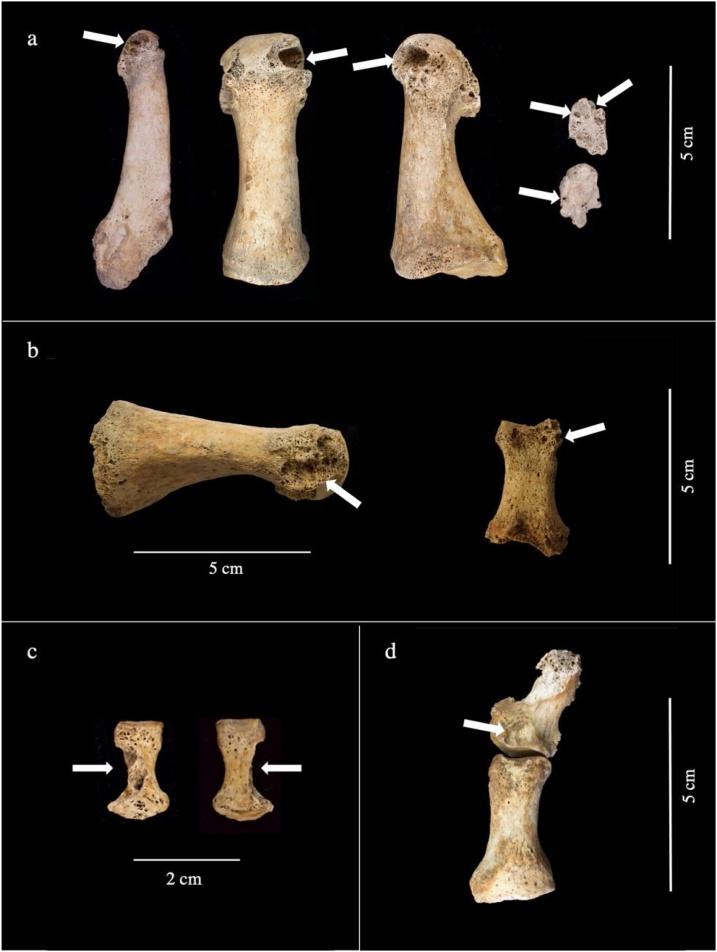
Lesions were assessed macroscopically and radiographically. Elements with lytic lesions were described and imaged using micro-computed tomography (μCT) to determine their morphology.
RESULTS
Gout was identified in 3 % of the population. Individuals buried in the friary had highest prevalence (14 %), with low prevalence rates in the Hospital (3 %) and town parish cemetery (2 %), with no cases in the rural parish cemetery. Gout was more prevalent during the 14th-15th centuries than the 10th-13th centuries.
CONCLUSION
The high prevalence rate of gout in the friary is at least partly explained by the consumption of alcohol and purine-rich diets by the friars and the wealthy townsfolk. Medieval medical texts from Cambridge show that gout (known as podagra) was sometimes treated with medications made from the root of the autumn crocus. This root contains colchicine, which is a medicine that is still used to treat gout today.
SIGNIFICANCE
This is one of the first studies to assess the epidemiology of gout in medieval England and suggests that gout varied with social status.
LIMITATIONS
Our sample size precludes statistical analysis.
SUGGESTIONS FOR FURTHER RESEARCH
Additional studies that assess the epidemiology of gout in medieval Europe is needed in order to be able to fully contextualize these findings.
目的
评估中世纪剑桥不同人群中痛风的患病率,并探讨导致其发病的社会因素。
材料
英国剑桥市及其周边四个中世纪墓地的 177 名成年个体。
方法
通过肉眼观察和 X 射线对病变进行评估。使用微计算机断层扫描(μCT)对具有溶骨性病变的元素进行描述和成像,以确定其形态。
结果
在该人群中,痛风的检出率为 3%。在修道士墓地中,痛风的患病率最高(14%),而在医院(3%)和城镇教区墓地(2%)中,其患病率较低,在农村教区墓地中则未发现痛风病例。痛风在 14 至 15 世纪比 10 至 13 世纪更为常见。
结论
修道士墓地中痛风的高患病率至少部分可以归因于修道士和富裕市民对酒精和富含嘌呤的饮食的摄入。来自剑桥的中世纪医学文献表明,痛风(俗称痛风足)有时可以通过使用秋水仙根制成的药物进行治疗。该根含有秋水仙碱,这是一种至今仍用于治疗痛风的药物。
意义
这是首次评估中世纪英格兰痛风流行病学的研究之一,表明痛风与社会地位有关。
局限性
由于样本量有限,我们的研究无法进行统计学分析。
进一步研究建议
需要进一步研究评估中世纪欧洲痛风的流行病学,以便能够充分了解这些发现的背景。


 Zotero 插件