Department of Biomedical Informatics, Harvard Medical School, Boston, Massachusetts 02115, USA.
Division of Genetics, Department of Medicine, Brigham and Women's Hospital and Harvard Medical School, Boston, Massachusetts 02115, USA.
Genome Res. 2021 Jun;31(6):935-946. doi: 10.1101/gr.275263.121. Epub 2021 May 7.
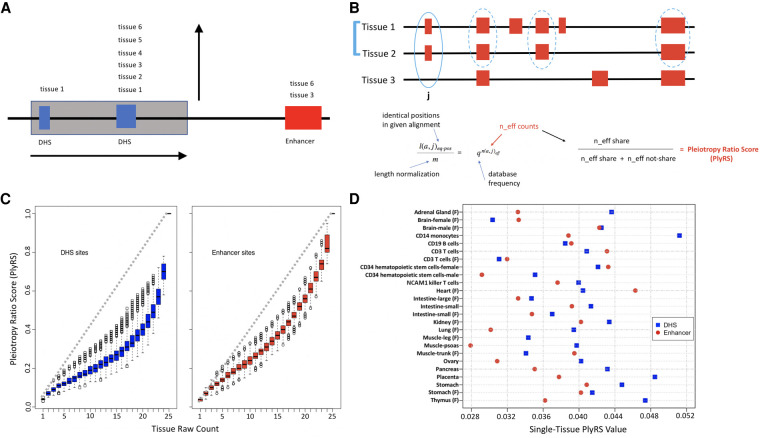
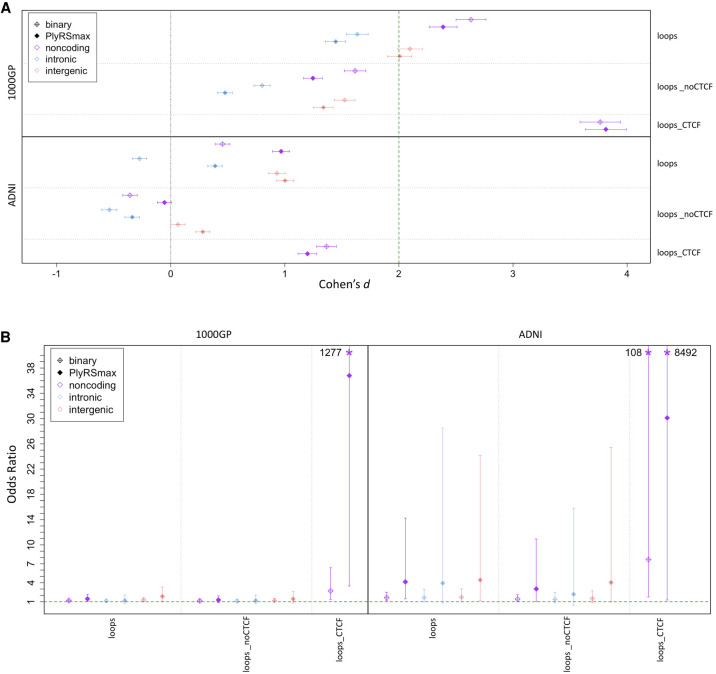
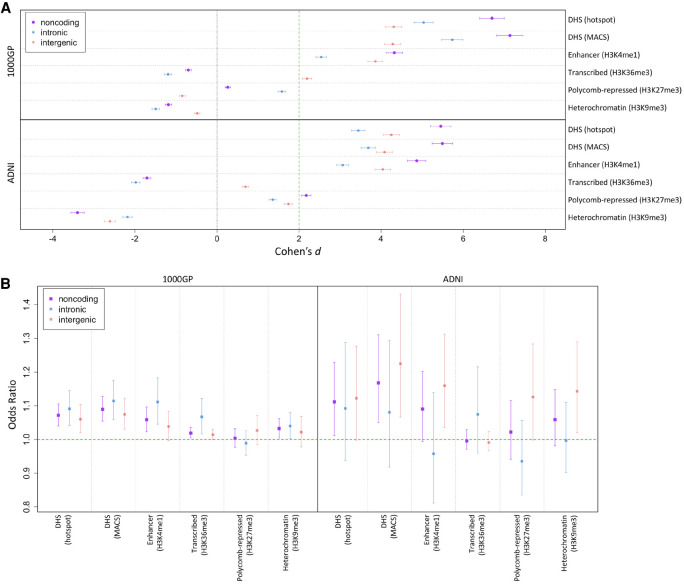
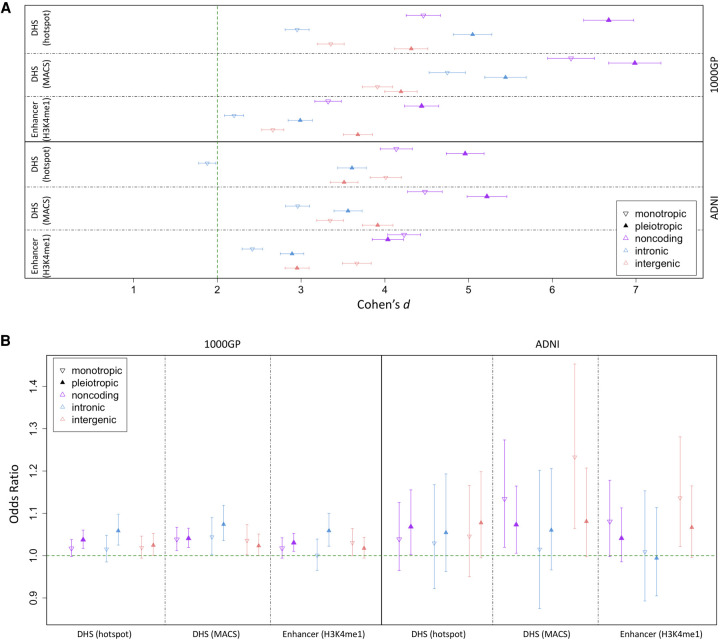
Genomic deletions provide a powerful loss-of-function model in noncoding regions to assess the role of purifying selection on genetic variation. Regulatory element function is characterized by nonuniform tissue and cell type activity, necessarily linking the study of fitness consequences from regulatory variants to their corresponding cellular activity. We generated a callset of deletions from genomes in the Alzheimer's Disease Neuroimaging Initiative (ADNI) and used deletions from The 1000 Genomes Project Consortium (1000GP) in order to examine whether purifying selection preserves noncoding sites of chromatin accessibility marked by DNase I hypersensitivity (DHS), histone modification (enhancer, transcribed, Polycomb-repressed, heterochromatin), and chromatin loop anchors. To examine this in a cellular activity-aware manner, we developed a statistical method, pleiotropy ratio score (PlyRS), which calculates a correlation-adjusted count of "cellular pleiotropy" for each noncoding base pair by analyzing shared regulatory annotations across tissues and cell types. By comparing real deletion PlyRS values to simulations in a length-matched framework and by using genomic covariates in analyses, we found that purifying selection acts to preserve both DHS and enhancer noncoding sites. However, we did not find evidence of purifying selection for noncoding transcribed, Polycomb-repressed, or heterochromatin sites beyond that of the noncoding background. Additionally, we found evidence that purifying selection is acting on chromatin loop integrity by preserving colocalized CTCF binding sites. At regions of DHS, enhancer, and CTCF within chromatin loop anchors, we found evidence that both sites of activity specific to a particular tissue or cell type and sites of cellularly pleiotropic activity are preserved by selection.
基因组缺失为研究非编码区的功能提供了一种强大的功能丧失模型,以评估纯化选择对遗传变异的作用。调控元件的功能特征是组织和细胞类型活性不均匀,必然将调控变异的适应性后果研究与其相应的细胞活性联系起来。我们从阿尔茨海默病神经影像学倡议(ADNI)的基因组中生成了一个缺失调用集,并使用 1000 基因组项目联盟(1000GP)的缺失来检查纯化选择是否保留染色质可及性标记的非编码位点(DNase I 超敏反应(DHS)、组蛋白修饰(增强子、转录、多梳抑制、异染色质)和染色质环锚点)。为了以细胞活性感知的方式检查这一点,我们开发了一种统计方法,多效性比得分(PlyRS),该方法通过分析跨组织和细胞类型的共享调控注释,计算每个非编码碱基对的“细胞多效性”的相关性调整计数。通过将真实删除 PlyRS 值与长度匹配框架中的模拟值进行比较,并在分析中使用基因组协变量,我们发现纯化选择作用于保留 DHS 和增强子非编码位点。然而,我们没有发现除非编码背景之外,非编码转录、多梳抑制或异染色质位点的纯化选择证据。此外,我们发现纯化选择通过保留共定位 CTCF 结合位点来作用于染色质环完整性的证据。在染色质环锚定的 DHS、增强子和 CTCF 区域,我们发现证据表明,特定组织或细胞类型特有的活性位点和细胞多效性活性位点都受到选择的保护。