Yen Hsu-Heng, Su Pei-Yuan, Liu I-L Ing, Zeng Ya-Huei, Huang Siou-Ping, Hsu Yu-Chun, Hsu Po-Ke, Chen Yang-Yuan
Division of Gastroenterology, Department of Internal Medicine, Changhua Christian Hospital, No. 135 Nanhsiao Street, Changhua, Taiwan.
General Education Center, Chienkuo Technology University, Changhua, Taiwan.
BMC Gastroenterol. 2021 May 8;21(1):209. doi: 10.1186/s12876-021-01792-8.
Hepatitis C virus (HCV) is one of the major causes of chronic liver disease, cirrhosis, and liver cancer. Most of the infected people have no clinical symptoms. The current strategy for HCV elimination includes test and treatment. In this study, we aimed to evaluate the campaign for retrieving patients who were lost to follow-up, for subsequent re-evaluation.
From January 2020 to October 2020, patients who had prior tests for positive anti-HCV antibody in 2010-2018 in our hospital were enrolled for our patient callback campaign. Patients who had unknown HCV RNA status or no documented successful antiviral therapy history were selected for anti-HCV therapy re-evaluation. To facilitate patient referral in the hospital, we developed an electronic reminding system and called the candidate patients via telephone during the study period.
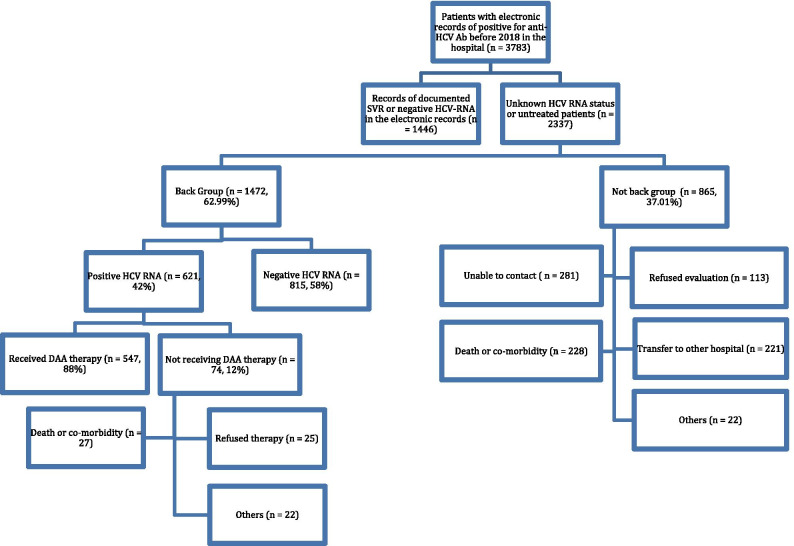
Through the hospital electronic system, 3783 patients with positive anti-HCV antibody documentation were identified. Among them, 1446 (38.22%) had tested negative for HCV RNA or had anti-HCV therapy, thereby excluded. Of the 2337 eligible patients, 1472 (62.99%) were successfully contacted and called back during the study period for subsequent HCV RNA testing and therapy. We found that 42.19% of the patients had positive HCV RNA and 88% received subsequent anti-HCV therapy.
A significant number of patients with positive HCV serology were lost for HCV confirmatory test or therapy in the hospital. Therefore, this targeted HCV callback approach in the hospital is feasible and effective in achieving microelimination.
丙型肝炎病毒(HCV)是慢性肝病、肝硬化和肝癌的主要病因之一。大多数感染者没有临床症状。当前消除HCV的策略包括检测和治疗。在本研究中,我们旨在评估召回失访患者以便后续重新评估的活动。
2020年1月至2020年10月,纳入2010 - 2018年在我院抗-HCV抗体检测呈阳性的患者参与患者召回活动。选择HCV RNA状态未知或无抗病毒治疗成功记录的患者进行抗-HCV治疗重新评估。为便于在医院内转诊患者,我们开发了一个电子提醒系统,并在研究期间通过电话联系候选患者。
通过医院电子系统,识别出3783例抗-HCV抗体记录阳性的患者。其中,1446例(38.22%)HCV RNA检测呈阴性或已接受抗-HCV治疗,因此被排除。在2337例符合条件的患者中,1472例(62.99%)在研究期间成功联系并召回,以便后续进行HCV RNA检测和治疗。我们发现42.19%的患者HCV RNA呈阳性,88%的患者接受了后续抗-HCV治疗。
大量HCV血清学阳性患者在医院中未进行HCV确诊检测或治疗。因此,这种在医院内针对性的HCV召回方法在实现微观消除方面是可行且有效的。