
杜洛克猪全基因组CNV区域检测及其与生长和脂肪性状的潜在关联
Genome-wide detection of CNV regions and their potential association with growth and fatness traits in Duroc pigs.
作者信息
Qiu Yibin, Ding Rongrong, Zhuang Zhanwei, Wu Jie, Yang Ming, Zhou Shenping, Ye Yong, Geng Qian, Xu Zheng, Huang Sixiu, Cai Gengyuan, Wu Zhenfang, Yang Jie
机构信息
College of Animal Science and National Engineering Research Center for Breeding Swine Industry, South China Agricultural University, Guangzhou, Guangdong, 510642, People's Republic of China.
Guangdong Wens Breeding Swine Technology Co., Ltd., Yunfu, Guangdong, 527400, People's Republic of China.
出版信息
BMC Genomics. 2021 May 8;22(1):332. doi: 10.1186/s12864-021-07654-7.
BACKGROUND
In the process of pig breeding, the average daily gain (ADG), days to 100 kg (AGE), and backfat thickness (BFT) are directly related to growth rate and fatness. However, the genetic mechanisms involved are not well understood. Copy number variation (CNV), an important source of genetic diversity, can affect a variety of complex traits and diseases and has gradually been thrust into the limelight. In this study, we reported the genome-wide CNVs of Duroc pigs using SNP genotyping data from 6627 animals. We also performed a copy number variation region (CNVR)-based genome-wide association studies (GWAS) for growth and fatness traits in two Duroc populations.
RESULTS
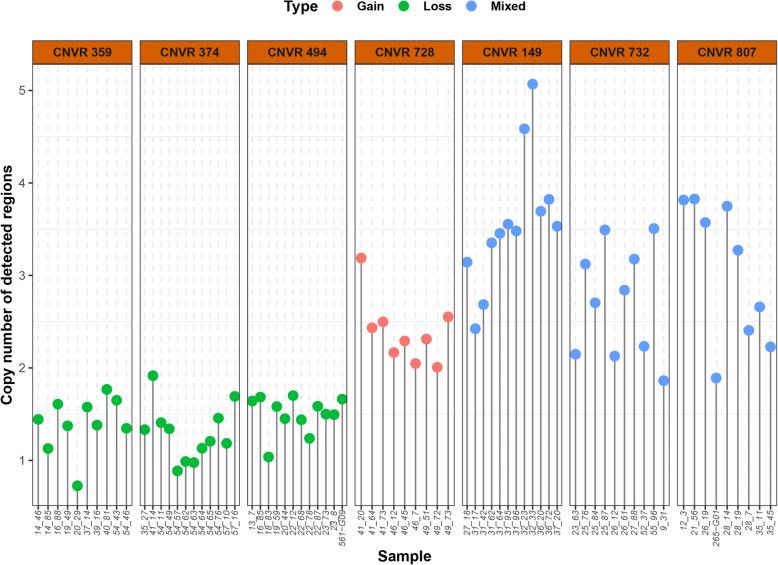
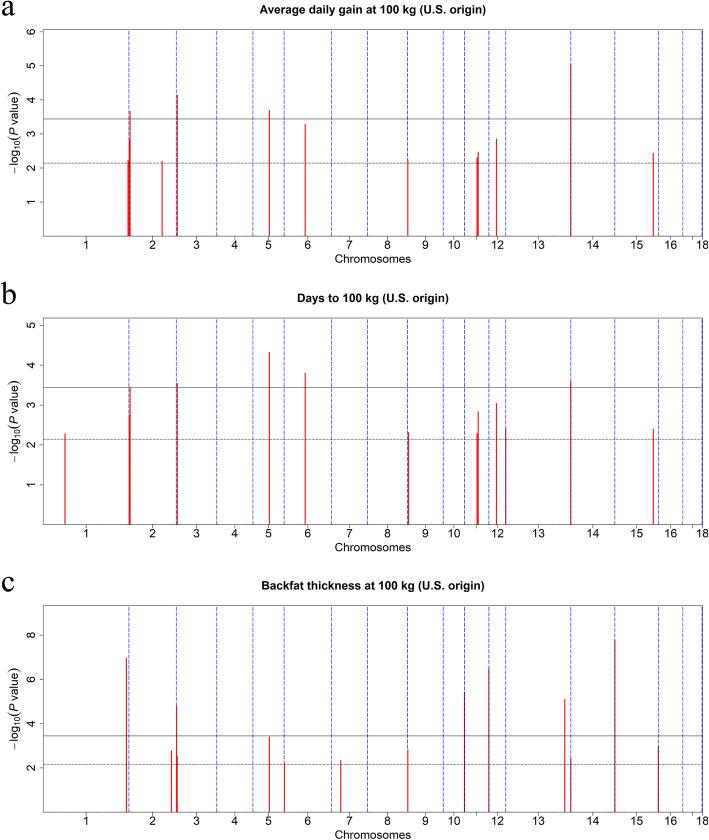
Our study identified 953 nonredundant CNVRs in U.S. and Canadian Duroc pigs, covering 246.89 Mb (~ 10.90%) of the pig autosomal genome. Of these, 802 CNVRs were in U.S. Duroc pigs with 499 CNVRs were in Canadian Duroc pigs, indicating 348 CNVRs were shared by the two populations. Experimentally, 77.8% of nine randomly selected CNVRs were validated through quantitative PCR (qPCR). We also identified 35 CNVRs with significant association with growth and fatness traits using CNVR-based GWAS. Ten of these CNVRs were associated with both ADG and AGE traits in U.S. Duroc pigs. Notably, four CNVRs showed significant associations with ADG, AGE, and BFT, indicating that these CNVRs may play a pleiotropic role in regulating pig growth and fat deposition. In Canadian Duroc pigs, nine CNVRs were significantly associated with both ADG and AGE traits. Further bioinformatic analysis identified a subset of potential candidate genes, including PDGFA, GPER1, PNPLA2 and BSCL2.
CONCLUSIONS
The present study provides a necessary supplement to the CNV map of the Duroc genome through large-scale population genotyping. In addition, the CNVR-based GWAS results provide a meaningful way to elucidate the genetic mechanisms underlying complex traits. The identified CNVRs can be used as molecular markers for genetic improvement in the molecular-guided breeding of modern commercial pigs.
背景
在猪的育种过程中,平均日增重(ADG)、达100千克体重日龄(AGE)和背膘厚度(BFT)直接关系到生长速度和脂肪含量。然而,其中涉及的遗传机制尚不清楚。拷贝数变异(CNV)作为遗传多样性的一个重要来源,能够影响多种复杂性状和疾病,已逐渐受到关注。在本研究中,我们利用6627头动物的单核苷酸多态性(SNP)基因分型数据报告了杜洛克猪的全基因组CNV情况。我们还在两个杜洛克猪群体中基于拷贝数变异区域(CNVR)进行了全基因组关联研究(GWAS),以探究生长和脂肪性状。
结果
我们的研究在美国和加拿大杜洛克猪中鉴定出953个非冗余CNVR,覆盖猪常染色体基因组的246.89 Mb(约10.90%)。其中,802个CNVR存在于美国杜洛克猪中,499个CNVR存在于加拿大杜洛克猪中,表明两个群体共有348个CNVR。实验上,通过定量PCR(qPCR)验证了随机选择的9个CNVR中的77.8%。我们还利用基于CNVR的GWAS鉴定出35个与生长和脂肪性状显著相关的CNVR。其中10个CNVR与美国杜洛克猪的ADG和AGE性状均相关。值得注意的是,4个CNVR与ADG、AGE和BFT均表现出显著关联,这表明这些CNVR可能在调节猪的生长和脂肪沉积中发挥多效性作用。在加拿大杜洛克猪中,9个CNVR与ADG和AGE性状均显著相关。进一步的生物信息学分析确定了一组潜在的候选基因,包括PDGFA、GPER1、PNPLA2和BSCL2。
结论
本研究通过大规模群体基因分型为杜洛克基因组的CNV图谱提供了必要补充。此外,基于CNVR的GWAS结果为阐明复杂性状的遗传机制提供了有意义的途径。所鉴定出的CNVR可作为现代商业猪分子辅助育种中遗传改良的分子标记。



 Zotero 插件