College of Animal Science and National Engineering Research Center for Breeding Swine Industry, South China Agricultural University, Guangzhou, Guangdong, 510642, People's Republic of China.
Department of animal science, Michigan State University, East Lansing, MI, USA.
BMC Genomics. 2020 May 7;21(1):344. doi: 10.1186/s12864-020-6742-6.
More teats are necessary for sows to nurse larger litters to provide immunity and nutrient for piglets prior to weaning. Previous studies have reported the strong effect of an insertion mutation in the Vertebrae Development Associated (VRTN) gene on Sus scrofa chromosome 7 (SSC7) that increased the number of thoracic vertebrae and teat number in pigs. We used genome-wide association studies (GWAS) to map genetic markers and genes associated with teat number in two Duroc pig populations with different genetic backgrounds. A single marker method and several multi-locus methods were utilized. A meta-analysis that combined the effects and P-values of 34,681 single nucleotide polymorphisms (SNPs) that were common in the results of single marker GWAS of American and Canadian Duroc pigs was conducted. We also performed association tests between the VRTN insertion and teat number in the same populations.
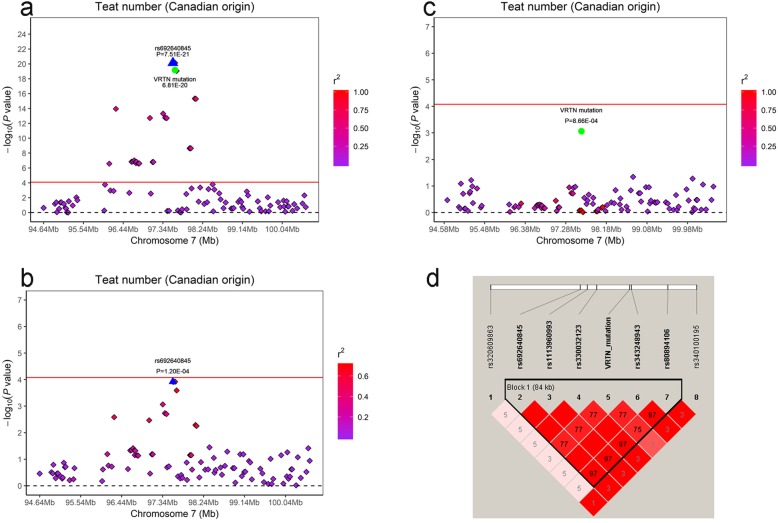
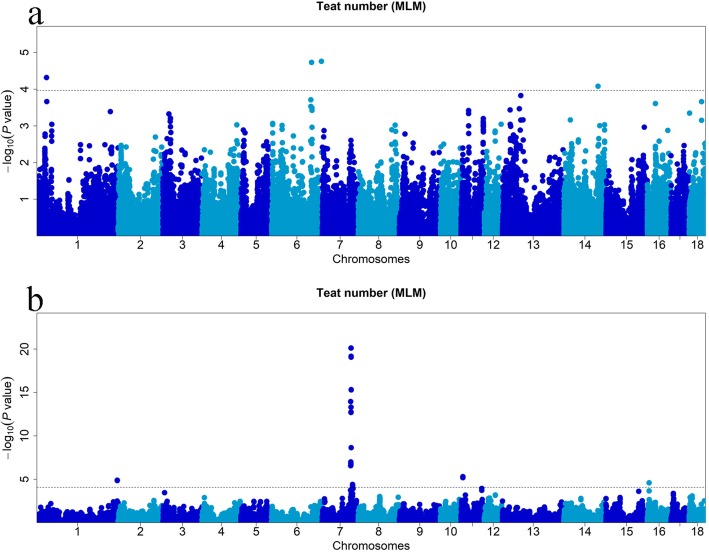
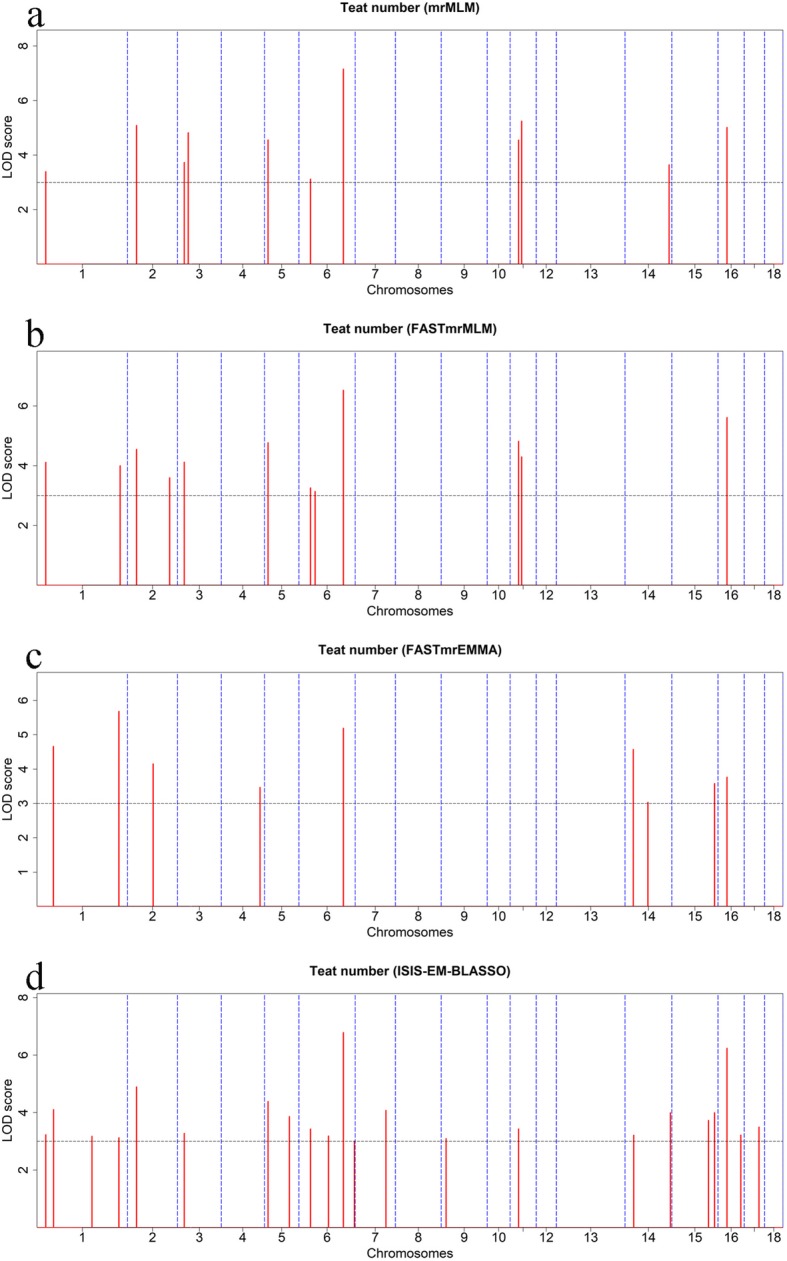
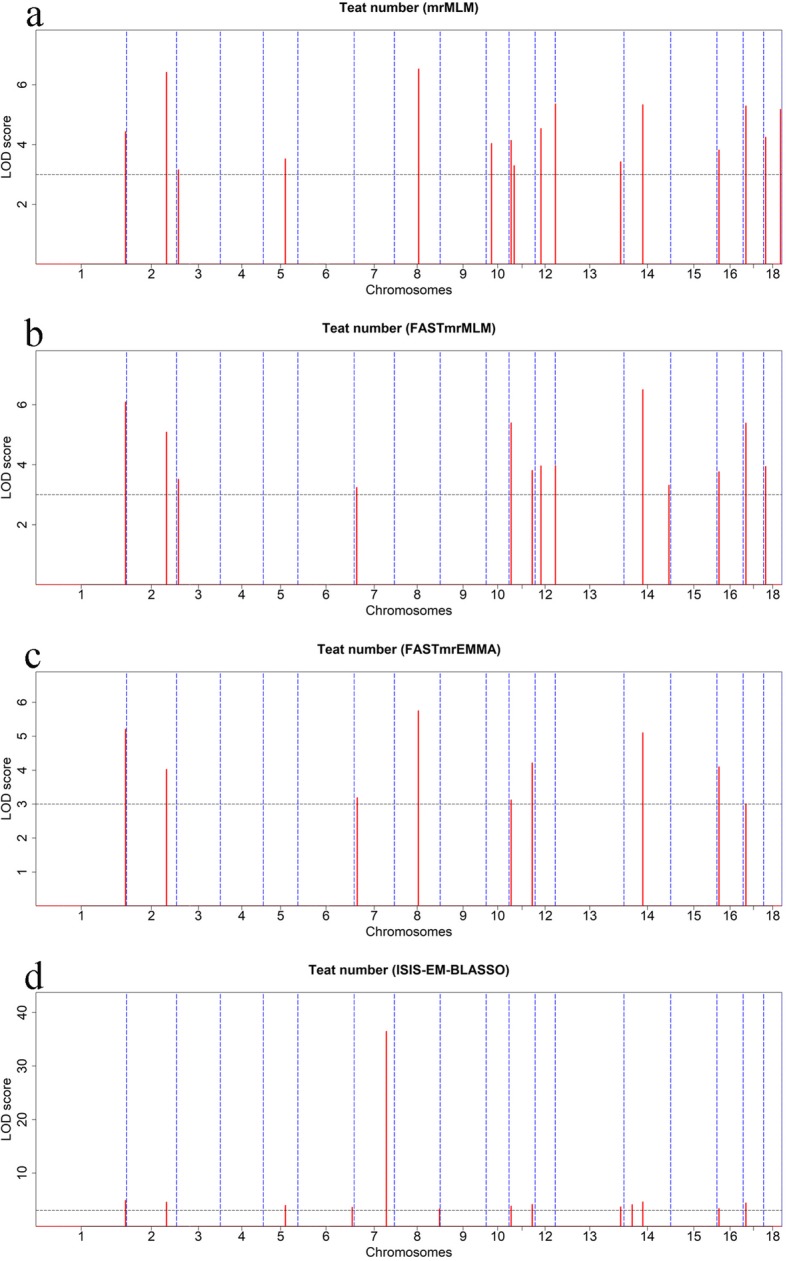
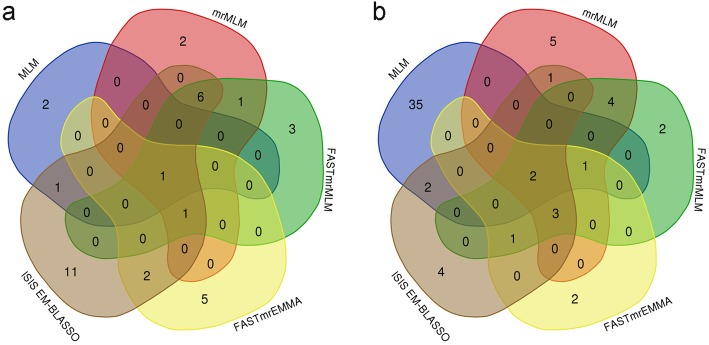
A total of 97 SNPs were found to be associated with teat number. Among these, six, eight and seven SNPs were consistently detected with two, three and four multi-locus methods, respectively. Seven SNPs were concordantly identified between single marker and multi-locus methods. Moreover, 26 SNPs were newly found by multi-locus methods to be associated with teat number. Notably, we detected one consistent quantitative trait locus (QTL) on SSC7 for teat number using single-locus and meta-analysis of GWAS and the top SNP (rs692640845) explained 8.68% phenotypic variance of teat number in the Canadian Duroc pigs. The associations between the VRTN insertion and teat number in two Duroc pig populations were substantially weaker. Further analysis revealed that the effect of VRTN on teat number may be mediated by its LD with the true causal mutation.
Our study suggested that VRTN insertion may not be a strong or the only candidate causal mutation for the QTL on SSC7 for teat number in the analyzed Duroc pig populations. The combination of single-locus and multi-locus GWAS detected additional SNPs that were absent using only one model. The identified SNPs will be useful for the genetic improvement of teat number in pigs by assigning higher weights to associated SNPs in genomic selection.
为了在断奶前为仔猪提供免疫力和营养,母猪需要更多的乳头来喂养更大的窝。先前的研究报告称,在猪的第 7 号染色体(SSC7)上,椎骨发育相关(VRTN)基因中的一个插入突变对增加胸椎和乳头数量有很强的影响。我们使用全基因组关联研究(GWAS)来定位与两个遗传背景不同的杜洛克猪群体的乳头数量相关的遗传标记和基因。使用单一标记方法和几种多基因座方法。对美国和加拿大杜洛克猪的单一标记 GWAS 结果中常见的 34681 个单核苷酸多态性(SNP)的效应和 P 值进行了荟萃分析。我们还在相同群体中对 VRTN 插入与乳头数量之间进行了关联测试。
共发现 97 个 SNP 与乳头数量相关。其中,6、8 和 7 个 SNP 分别在两种、三种和四种多基因座方法中一致检测到。7 个 SNP 在单一标记和多基因座方法之间是一致的。此外,26 个 SNP 是通过多基因座方法新发现的与乳头数量相关的。值得注意的是,我们使用单一基因座和 GWAS 的荟萃分析检测到了一个位于 SSC7 上与乳头数量一致的数量性状基因座(QTL),并发现了一个位于加拿大杜洛克猪中的 SNP(rs692640845),它解释了 8.68%的乳头数量表型变异。在两个杜洛克猪群体中,VRTN 插入与乳头数量的关联要弱得多。进一步分析表明,VRTN 对乳头数量的影响可能是由其与真正的因果突变的 LD 介导的。
我们的研究表明,VRTN 插入可能不是分析的杜洛克猪群体中 SSC7 上与乳头数量相关的 QTL 的一个强或唯一的候选因果突变。单一基因座和多基因座 GWAS 的结合检测到了仅使用一种模型时不存在的额外 SNP。所鉴定的 SNP 将有助于通过在基因组选择中给相关 SNP 更高的权重来提高猪的乳头数量的遗传改良。