Research Center for Social Determinants of Health, Research Institute for Endocrine Sciences, Shahid Beheshti University of Medical Sciences, P.O.Box: 19395-4763, Tehran, Iran.
Students' Research Committee, Shahid Beheshti University of Medical Sciences, Tehran, Iran.
BMC Public Health. 2021 May 8;21(1):885. doi: 10.1186/s12889-021-10932-4.
Parental weight is studied as an important determinant of childhood obesity; however, obesity-related metabolic abnormalities have been less considered as determinants of childhood obesity. This study aimed to investigate the association between maternal obesity phenotypes and incidence of obesity in their offspring.
This longitudinal study was conducted within the framework of the Tehran Lipid and Glucose Study. A total of 2151 non-obese children who had complete parental information were followed for incidence of obesity over a mean of 148.7 ± 34.7 months. Obesity in children was defined using the World Health Organization criteria. Maternal body mass index (BMI) was classified into three categories: normal weight, overweight and obese. Dysmetabolic status was considered as having metabolic syndrome or diabetes. Metabolic syndrome and diabetes were defined according to the Joint Interim Statement and American diabetes association criteria, respectively. Considering maternal BMI categories and metabolic status, six obesity phenotypes were defined as followed: 1) normal weight and normal metabolic status, 2) overweight and normal metabolic status, 3) obese and normal metabolic status, 4) normal weight and dysmetabolic status, 5) overweight and dysmetabolic status, and 6) obese and dysmetabolic status. The association between maternal obesity phenotypes and incidence of obesity in children was studied using Cox proportional regression hazard model.
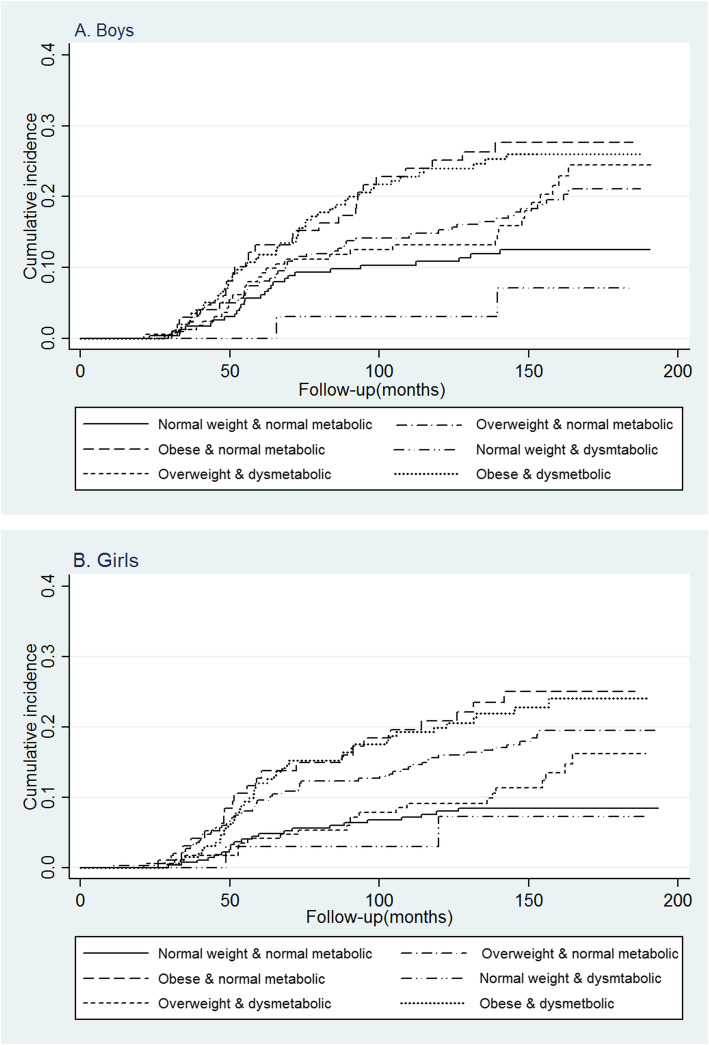
In male offspring, the risk of incidence of obesity significantly increased in those with maternal obesity phenotypes including overweight/normal metabolic: 1.75(95% CI: 1.10-2.79), obese/normal metabolic: 2.60(95%CI: 1.51-4.48), overweight/dysmetabolic: 2.34(95%CI: 1.35-4.03) and obese/dysmetabolic: 3.21(95%CI: 1.94-5.03) compared to the normal weight/normal metabolic phenotype. Similarly, in girls, the risk of incidence of obesity significantly increased in offspring with maternal obesity phenotypes including overweight/normal metabolic: 2.39(95%CI: 1.46-3.90), obese/normal metabolic: 3.55(95%CI: 1.94-6.46), overweight/dysmetabolic: 1.92(95%CI: 1.04-3.52) and obese/dysmetabolic: 3.89(95%CI: 2.28-6.64) compared to normal weight/normal metabolic phenotype. However, maternal normal weight/dysmetabolic phenotype did not significantly change the risk of obesity in both male and female offspring.
Except for normal weight/dysmetabolic phenotype, all maternal obesity phenotypes had significant prognostic values for incidence of offspring obesity with the highest risk for obese/dysmetabolic phenotype. This study provides valuable findings for identifying the first line target groups for planning interventions to prevent childhood obesity.
父母的体重被认为是儿童肥胖的一个重要决定因素;然而,与肥胖相关的代谢异常作为儿童肥胖的决定因素却较少被考虑。本研究旨在探讨母体肥胖表型与后代肥胖的发生之间的关系。
本纵向研究是在德黑兰血脂和血糖研究的框架内进行的。共有 2151 名非肥胖儿童,他们的父母信息完整,随访肥胖的发生率超过平均 148.7±34.7 个月。根据世界卫生组织的标准,将儿童肥胖定义为肥胖。母亲的身体质量指数(BMI)分为三类:正常体重、超重和肥胖。代谢状态异常被认为是代谢综合征或糖尿病。代谢综合征和糖尿病分别根据联合临时声明和美国糖尿病协会的标准进行定义。考虑到母亲的 BMI 类别和代谢状态,定义了六种肥胖表型如下:1)正常体重和正常代谢状态,2)超重和正常代谢状态,3)肥胖和正常代谢状态,4)正常体重和代谢异常状态,5)超重和代谢异常状态,6)肥胖和代谢异常状态。使用 Cox 比例风险回归风险模型研究母体肥胖表型与儿童肥胖的发生之间的关系。
在男性后代中,与正常体重/正常代谢表型相比,具有母体肥胖表型(包括超重/正常代谢:1.75(95%CI:1.10-2.79)、肥胖/正常代谢:2.60(95%CI:1.51-4.48)、超重/代谢异常:2.34(95%CI:1.35-4.03)和肥胖/代谢异常:3.21(95%CI:1.94-5.03)的后代肥胖的发生风险显著增加。同样,在女孩中,与正常体重/正常代谢表型相比,具有母体肥胖表型(包括超重/正常代谢:2.39(95%CI:1.46-3.90)、肥胖/正常代谢:3.55(95%CI:1.94-6.46)、超重/代谢异常:1.92(95%CI:1.04-3.52)和肥胖/代谢异常:3.89(95%CI:2.28-6.64)的后代肥胖的发生风险显著增加。然而,母亲正常体重/代谢异常表型并未显著改变男女后代肥胖的风险。
除正常体重/代谢异常表型外,母体肥胖的所有表型对后代肥胖的发生均具有显著的预后价值,肥胖/代谢异常表型的风险最高。本研究为确定预防儿童肥胖的干预措施的一线目标人群提供了有价值的发现。