Zhong Haoyan, Poeran Jashvant, Liu Jiabin, Wilson Lauren A, Memtsoudis Stavros G
Department of Anesthesiology, Critical Care & Pain Management, Hospital for Special Surgery, New York, NY, USA.
Institute for Healthcare Delivery Science, Department of Population Health Science & Policy, Icahn School of Medicine at Mount Sinai, New York, NY, USA.
Br J Anaesth. 2021 Jul;127(1):15-22. doi: 10.1016/j.bja.2021.04.003. Epub 2021 Apr 15.
The COVID-19 pandemic has impacted healthcare in various vulnerable patient subpopulations. However, data are lacking on the impact of COVID-19 on hip fractures, seen mainly in older patients. Using national claims data, we aimed to describe the epidemiology during the first COVID-19 wave in the USA.
We compared patients admitted for hip fractures during March and April of 2020 with those admitted in 2019 in terms of patient and healthcare characteristics, COVID-19 diagnosis, and outcomes. An additional comparison was made between COVID-19-positive and -negative patients. Outcomes included length of hospital stay (LOS), admission to an ICU, ICU LOS, use of mechanical ventilation, 30-day readmission, discharge disposition, and a composite variable of postoperative complications.
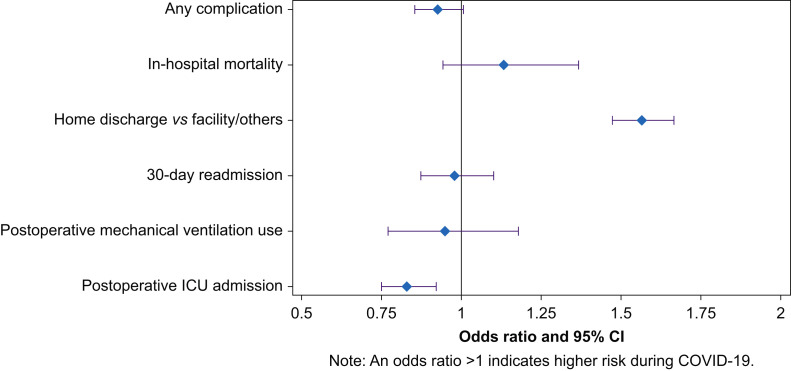
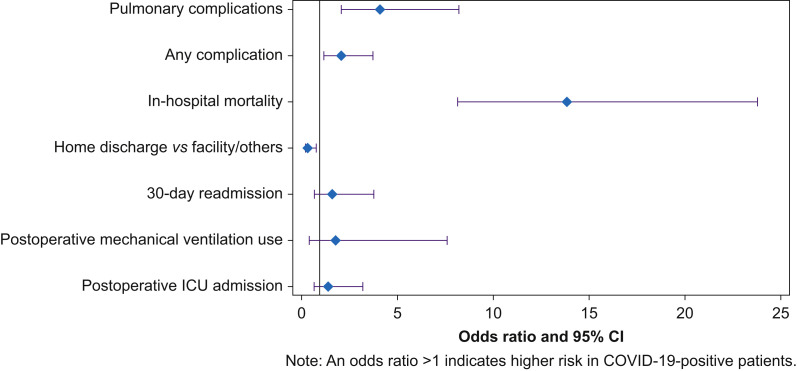
Overall, 16 068 hip fractures were observed in 2019 compared with 7498 in 2020. Patients with hip fractures in 2020 (compared with 2019) experienced earlier hospital discharge and were less likely to be admitted to ICU, but more likely to be admitted to home. Amongst 83 patients with hip fractures with concomitant COVID-19 diagnosis, we specifically observed more non-surgical treatments, almost doubled LOS, a more than 10-fold increased mortality rate, and higher complication rates compared with COVID-19-negative patients.
The COVID-19 pandemic significantly impacted not only volume of hip fractures, but also patterns in care and outcomes. These results may inform policymakers in future outbreaks and how this may affect vulnerable patient populations, such as those experiencing a hip fracture.
新冠疫情对各类脆弱患者亚群体的医疗保健产生了影响。然而,关于新冠疫情对主要见于老年患者的髋部骨折的影响,目前缺乏相关数据。利用全国索赔数据,我们旨在描述美国新冠疫情第一波期间的流行病学情况。
我们比较了2020年3月和4月因髋部骨折入院的患者与2019年入院患者在患者和医疗保健特征、新冠诊断及预后方面的情况。还对新冠阳性和阴性患者进行了额外比较。预后指标包括住院时间(LOS)、入住重症监护病房(ICU)、ICU住院时间、使用机械通气、30天再入院率、出院处置情况以及术后并发症的综合变量。
总体而言,2019年观察到16068例髋部骨折,2020年为7498例。2020年髋部骨折患者(与2019年相比)出院更早,入住ICU的可能性更小,但入住家中的可能性更大。在83例伴有新冠诊断的髋部骨折患者中,我们特别观察到与新冠阴性患者相比,非手术治疗更多、住院时间几乎翻倍、死亡率增加10倍以上以及并发症发生率更高。
新冠疫情不仅对髋部骨折的数量产生了重大影响,还对护理模式和预后产生了影响。这些结果可能为政策制定者在未来疫情爆发时以及疫情如何影响脆弱患者群体(如髋部骨折患者)提供参考。