Agbo Friday Joseph, Oyelere Solomon Sunday, Suhonen Jarkko, Laine Teemu H
School of Computing, University of Eastern Finland, P.O. Box 111, FIN-80101 Joensuu, Finland.
Department of Computer Science, Electrical and Space Engineering, Luleå University of Technology, SE-93177 Skellefteå, Sweden.
Educ Inf Technol (Dordr). 2021;26(5):5815-5849. doi: 10.1007/s10639-021-10515-1. Epub 2021 May 5.
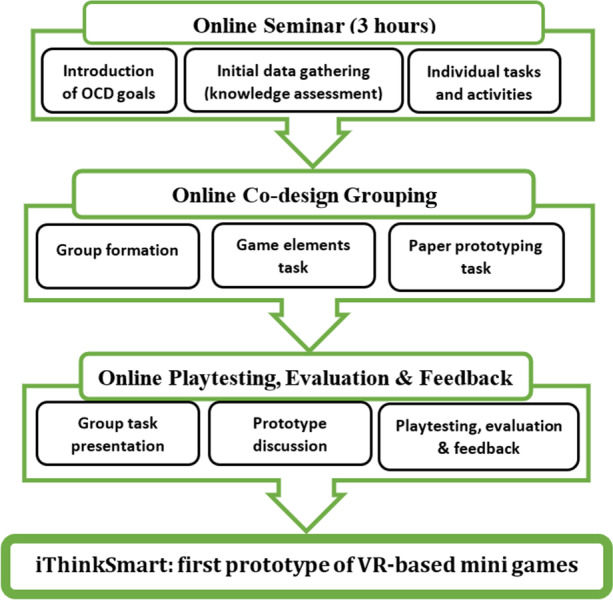
Understanding the principles of computational thinking (CT), e.g., problem abstraction, decomposition, and recursion, is vital for computer science (CS) students. Unfortunately, these concepts can be difficult for novice students to understand. One way students can develop CT skills is to involve them in the design of an application to teach CT. This study focuses on co-designing mini games to support teaching and learning CT principles and concepts in an online environment. Online co-design (OCD) of mini games enhances students' understanding of problem-solving through a rigorous process of designing contextual educational games to aid their own learning. Given the current COVID-19 pandemic, where face-to-face co-designing between researchers and stakeholders could be difficult, OCD is a suitable option. CS students in a Nigerian higher education institution were recruited to co-design mini games with researchers. Mixed research methods comprising qualitative and quantitative strategies were employed in this study. Findings show that the participants gained relevant knowledge, for example, how to (i) create game scenarios and game elements related to CT, (ii) connect contextual storyline to mini games, (iii) collaborate in a group to create contextual low-fidelity mini game prototypes, and (iv) peer review each other's mini game concepts. In addition, students were motivated toward designing educational mini games in their future studies. This study also demonstrates how to conduct OCD with students, presents lesson learned, and provides recommendations based on the authors' experience.
理解计算思维(CT)的原理,例如问题抽象、分解和递归,对计算机科学(CS)专业的学生至关重要。不幸的是,这些概念对于新手学生来说可能很难理解。学生培养CT技能的一种方法是让他们参与设计一个用于教授CT的应用程序。本研究重点是共同设计小游戏,以支持在线环境中CT原理和概念的教学与学习。小游戏的在线共同设计(OCD)通过设计情境教育游戏以帮助自身学习的严格过程,增强了学生对解决问题的理解。鉴于当前的新冠疫情,研究人员与利益相关者之间进行面对面的共同设计可能会很困难,OCD是一个合适的选择。尼日利亚一所高等教育机构的计算机科学专业学生被招募来与研究人员共同设计小游戏。本研究采用了包括定性和定量策略的混合研究方法。研究结果表明,参与者获得了相关知识,例如如何(i)创建与CT相关的游戏场景和游戏元素,(ii)将情境故事情节与小游戏联系起来,(iii)在小组中合作创建情境低保真度小游戏原型,以及(iv)相互 peer review彼此的小游戏概念。此外,学生们在未来的学习中受到激励去设计教育性小游戏。本研究还展示了如何与学生进行OCD,介绍了经验教训,并根据作者的经验提供了建议。