Bartley Nicci, Napier Christine E, Butt Zoe, Schlub Timothy E, Best Megan C, Biesecker Barbara B, Ballinger Mandy L, Butow Phyllis
Psycho-Oncology Co-operative Research Group, Faculty of Science, School of Psychology, The University of Sydney, Sydney, NSW, Australia.
Cancer Theme, Garvan Institute of Medical Research, Sydney, NSW, Australia.
Front Psychol. 2021 Apr 22;12:647502. doi: 10.3389/fpsyg.2021.647502. eCollection 2021.
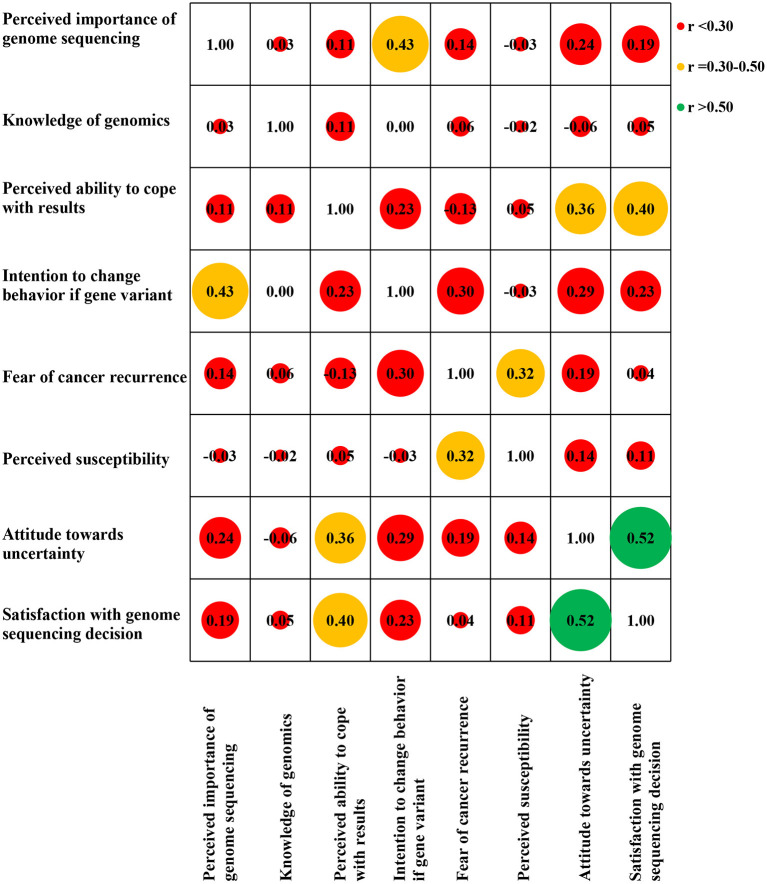
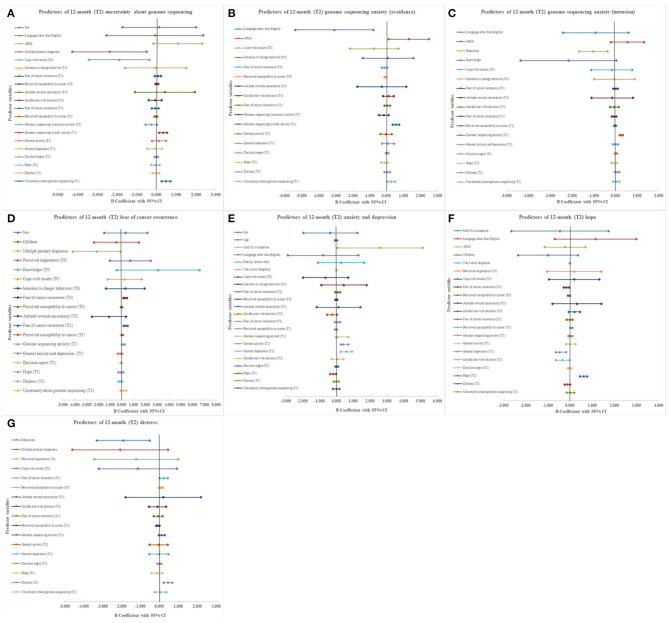
There is limited knowledge about cancer patients' experiences of uncertainty while waiting for genome sequencing results, and whether prolonged uncertainty contributes to psychological factors in this context. To investigate uncertainty in patients with a cancer of likely hereditary origin while waiting for genome sequencing results, we collected questionnaire and interview data at baseline, and at three and 12 months follow up (prior to receiving results). Participants ( = 353) had negative attitudes towards uncertainty ( = 4.03, SD 0.68) at baseline, and low levels of uncertainty at three ( = 8.23, SD 7.37) and 12 months ( = 7.95, SD 7.64). Uncertainty about genome sequencing did not change significantly over time [(210) = 0.660, = 0.510]. Greater perceived susceptibility for cancer [(348) = 0.14, < .01], fear of cancer recurrence [(348) = 0.19, < .01], perceived importance of genome sequencing [(350) = 0.24, < .01], intention to change behavior if a gene variant indicating risk is found [(349) = 0.29, < .01], perceived ability to cope with results [(349) = 0.36, < .01], and satisfaction with decision to have genome sequencing [(350) = 0.52, < .01] were significantly correlated with negative attitudes towards uncertainty at baseline. Multiple primary cancer diagnoses [B = -2.364 [-4.238, -0.491], = 0.014], lower perceived ability to cope with results [B = -0.1.881 [-3.403, -0.359], = 0.016] at baseline, greater anxiety about genome sequencing (avoidance) [B = 0.347 [0.148, 0.546], = 0.0012] at 3 months, and greater perceived uncertainty about genome sequencing [B = 0.494 [0.267, 0.721] = 0.000] at 3 months significantly predicted greater perceived uncertainty about genome sequencing at 12 months. Greater perceived uncertainty about genome sequencing at 3 months significantly predicted greater anxiety (avoidance) about genome sequencing at 12 months [B = 0.291 [0.072, 0.509], = 0.009]. Semi-structured interviews revealed that while participants were motivated to pursue genome sequencing as a strategy to reduce their illness and risk uncertainty, genome sequencing generated additional practical, scientific and personal uncertainties. Some uncertainties were consistently discussed over the 12 months, while others emerged over time. Similarly, some uncertainty coping strategies were consistent over time, while others emerged while patients waited for their genome sequencing results. This study demonstrates the complexity of uncertainty generated by genome sequencing for cancer patients and provides further support for the inter-relationship between uncertainty and anxiety. Helping patients manage their uncertainty may ameliorate psychological morbidity.
对于癌症患者在等待基因测序结果期间的不确定性体验,以及在这种情况下长期的不确定性是否会导致心理因素,我们所知有限。为了调查可能具有遗传起源的癌症患者在等待基因测序结果期间的不确定性,我们在基线、3个月和12个月随访(在收到结果之前)时收集了问卷和访谈数据。参与者(n = 353)在基线时对不确定性持消极态度(M = 4.03,标准差0.68),在3个月(M = 8.23,标准差7.37)和12个月(M = 7.95,标准差7.64)时不确定性水平较低。基因测序的不确定性随时间没有显著变化[F(2,10) = 0.660,p = 0.510]。更高的癌症易感性感知[F(348) = 0.14,p <.01]、对癌症复发的恐惧[F(348) = 0.19,p <.01]、基因测序的感知重要性[F(350) = 0.24,p <.01]、如果发现表明风险的基因变异就改变行为的意图[F(349) = 0.29,p <.01]、应对结果的感知能力[F(349) = 0.36,p <.01]以及对进行基因测序决定的满意度[F(350) = 0.52,p <.01]与基线时对不确定性的消极态度显著相关。多重原发性癌症诊断[B = -2.364 [-4.238, -0.491],p = 0.014]、基线时较低的应对结果感知能力[B = -0.1881 [-3.403, -0.359],p = 0.016]、3个月时对基因测序更大的焦虑(回避)[B = 0.347 [0.148, 0.546],p = 0.0012]以及3个月时对基因测序更大的感知不确定性[B = 0.494 [0.267, 0.721],p = 0.000]显著预测了12个月时对基因测序更大的感知不确定性。3个月时对基因测序更大的感知不确定性显著预测了12个月时对基因测序更大的焦虑(回避)[B = 0.291 [0.072, 0.509],p = 0.009]。半结构化访谈显示,虽然参与者积极进行基因测序以减少疾病和风险不确定性,但基因测序产生了额外的实际、科学和个人方面的不确定性。一些不确定性在12个月期间一直被讨论,而其他一些则随着时间出现。同样,一些不确定性应对策略随着时间保持一致,而其他一些则在患者等待基因测序结果时出现。本研究证明了基因测序给癌症患者带来的不确定性的复杂性,并为不确定性与焦虑之间的相互关系提供了进一步支持。帮助患者管理他们的不确定性可能会改善心理疾病。