Department of Physiological Sciences, Stellenbosch University, Stellenbosch, South Africa.
Front Immunol. 2021 Apr 23;12:649465. doi: 10.3389/fimmu.2021.649465. eCollection 2021.
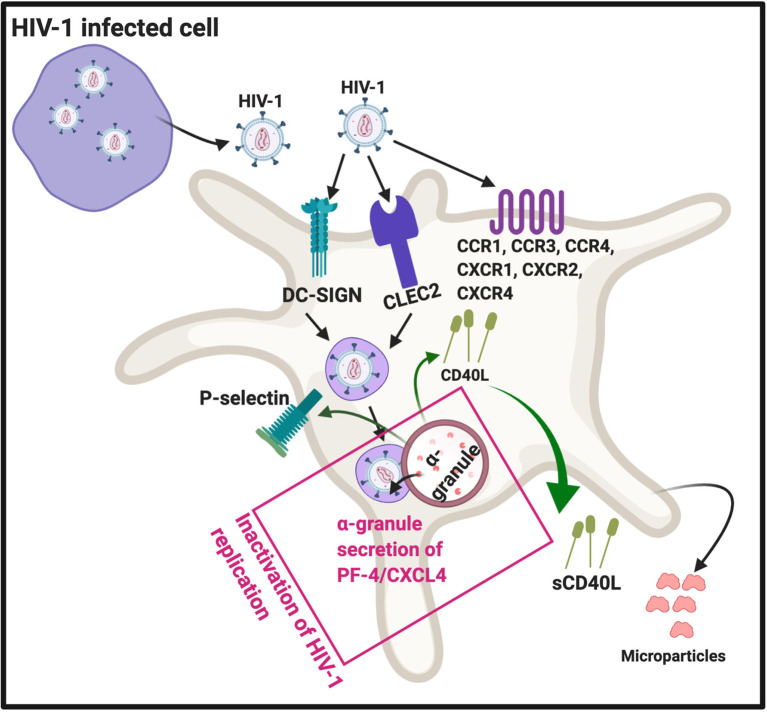
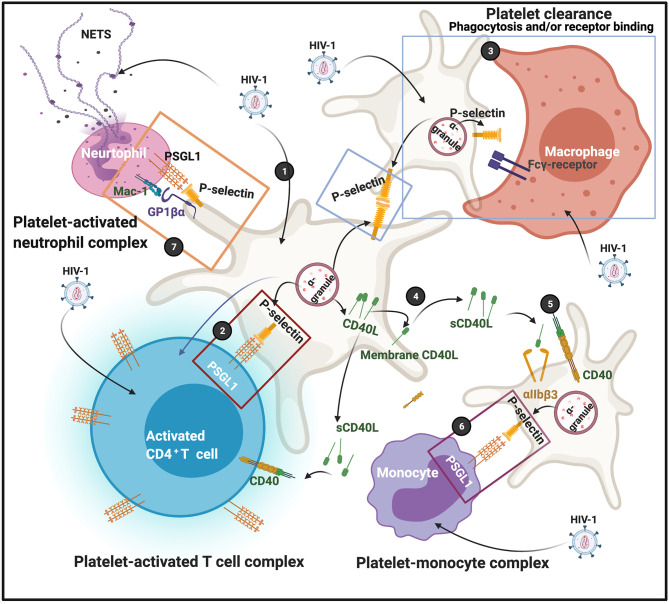
The immune and inflammatory responses of platelets to human immunodeficiency virus 1 (HIV-1) and its envelope proteins are of great significance to both the treatment of the infection, and to the comorbidities related to systemic inflammation. Platelets can interact with the HIV-1 virus itself, or with viral membrane proteins, or with dysregulated inflammatory molecules in circulation, ensuing from HIV-1 infection. Platelets can facilitate the inhibition of HIV-1 infection endogenously-produced inhibitors of HIV-1 replication, or the virus can temporarily hide from the immune system inside platelets, whereby platelets act as HIV-1 reservoirs. Platelets are therefore both guardians of the host defence system, and transient reservoirs of the virus. Such reservoirs may be of particular significance during combination antiretroviral therapy (cART) interruption, as it may drive viral persistence, and result in significant implications for treatment. Both HIV-1 envelope proteins and circulating inflammatory molecules can also initiate platelet complex formation with immune cells and erythrocytes. Complex formation cause platelet hypercoagulation and may lead to an increased thrombotic risk. Ultimately, HIV-1 infection can initiate platelet depletion and thrombocytopenia. Because of their relatively short lifespan, platelets are important signalling entities, and could be targeted more directly during HIV-1 infection and cART.
血小板对人类免疫缺陷病毒 1(HIV-1)及其包膜蛋白的免疫和炎症反应,对感染的治疗以及与全身炎症相关的合并症都具有重要意义。血小板可以与 HIV-1 病毒本身、病毒膜蛋白或由 HIV-1 感染引起的循环中失调的炎症分子相互作用。血小板可以促进 HIV-1 感染的抑制——内源性 HIV-1 复制抑制剂,或者病毒可以暂时隐藏在血小板内以逃避免疫系统,从而使血小板成为 HIV-1 的储存库。因此,血小板既是宿主防御系统的守护者,也是病毒的临时储存库。在联合抗逆转录病毒治疗(cART)中断期间,这些储存库可能具有特别重要的意义,因为它们可能导致病毒持续存在,并对治疗产生重大影响。HIV-1 包膜蛋白和循环炎症分子也可以启动血小板与免疫细胞和红细胞的复杂形成。复合物的形成导致血小板过度凝结,并可能导致血栓形成风险增加。最终,HIV-1 感染会引发血小板减少和血小板减少症。由于血小板的寿命相对较短,它们是重要的信号实体,并且在 HIV-1 感染和 cART 期间可以更直接地针对它们进行治疗。