Centre for Health and Rural Sciences, University of Cruz Alta, RS, Brazil.
Int Health. 2021 Feb 24;13(2):98-109. doi: 10.1093/inthealth/ihaa036.
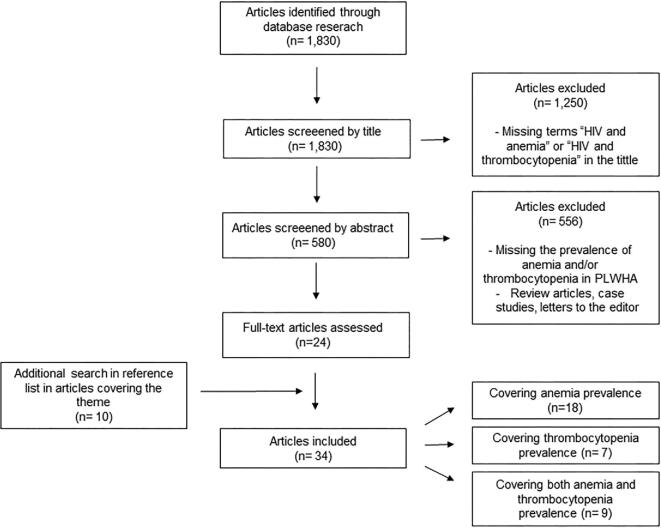
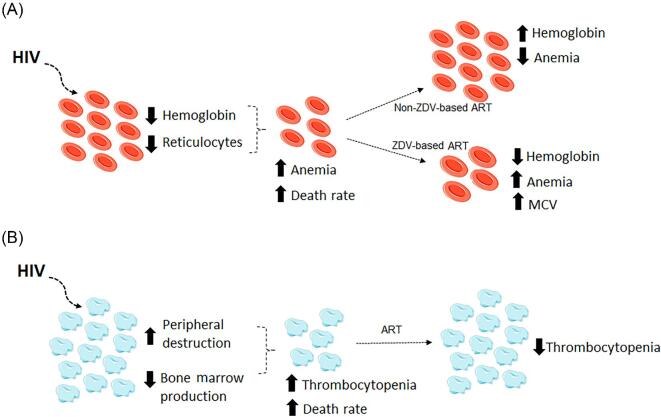
Hematologic changes are frequent complications in people living with HIV/AIDS (PLWHA). Anemia and thrombocytopenia are the most frequent multifactorial hematologic abnormalities and are associated with a low quality of life and high death rates. This study aims to describe the prevalence of anemia and thrombocytopenia in PLWHA and to identify the main clinical characteristics that aggravate these conditions in studies published in the last 10 y. A comprehensive search was performed on the PUBMED database, using the terms 'HIV infection and anemia' and 'HIV infection and thrombocytopenia'. Additional searches were made in the reference lists of articles covering the theme. The selected studies reported an overall prevalence of anemia from 7.2% to 84% and of thrombocytopenia from 4.5% to 26.2%. The prevalence of thrombocytopenia and anemia were aggravated by a CD4+ T lymphocyte count of <200 cells/μL, increased viral load and coinfections or opportunistic infections. Antiviral therapy (ART) shows a beneficial effect, reducing the frequencies of thrombocytopenia and anemia, except in a zidovudine-based ART regimen, which worsens the anemic condition. Because anemia and thrombocytopenia are treatable comorbidities associated with increased mortality among PLWHA, physicians should monitor these risk factors in order to establish better interventions and reduce morbidity and mortality in PLWHA.
血液学改变是 HIV/AIDS(艾滋病毒/艾滋病)患者常见的并发症。贫血和血小板减少症是最常见的多因素血液学异常,与生活质量降低和死亡率升高有关。本研究旨在描述过去 10 年发表的研究中 HIV/AIDS 患者贫血和血小板减少症的患病率,并确定加重这些病症的主要临床特征。我们在 PUBMED 数据库中使用“HIV 感染和贫血”和“HIV 感染和血小板减少症”等术语进行了全面检索,并对涉及该主题的文章的参考文献进行了额外检索。所选研究报告的贫血总患病率为 7.2%至 84%,血小板减少症的患病率为 4.5%至 26.2%。CD4+T 淋巴细胞计数<200 个/μL、病毒载量增加、合并感染或机会性感染会加重血小板减少症和贫血的发生。抗病毒治疗(ART)显示出有益的效果,可降低血小板减少症和贫血的发生频率,但齐多夫定为基础的 ART 方案除外,该方案会加重贫血状况。由于贫血和血小板减少症是可治疗的合并症,会增加 HIV/AIDS 患者的死亡率,因此医生应监测这些危险因素,以便进行更好的干预,降低 HIV/AIDS 患者的发病率和死亡率。