Department of Oncology, Henan Institute of Medical and Pharmaceutical Sciences, Zhengzhou University, Zhengzhou, China.
School of Basic Medical Sciences, Academy of Medical Science, Zhengzhou University, Zhengzhou, China.
Front Immunol. 2021 Apr 23;12:658922. doi: 10.3389/fimmu.2021.658922. eCollection 2021.
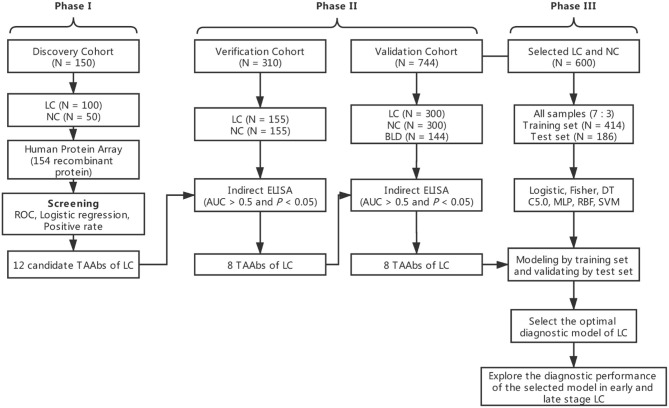
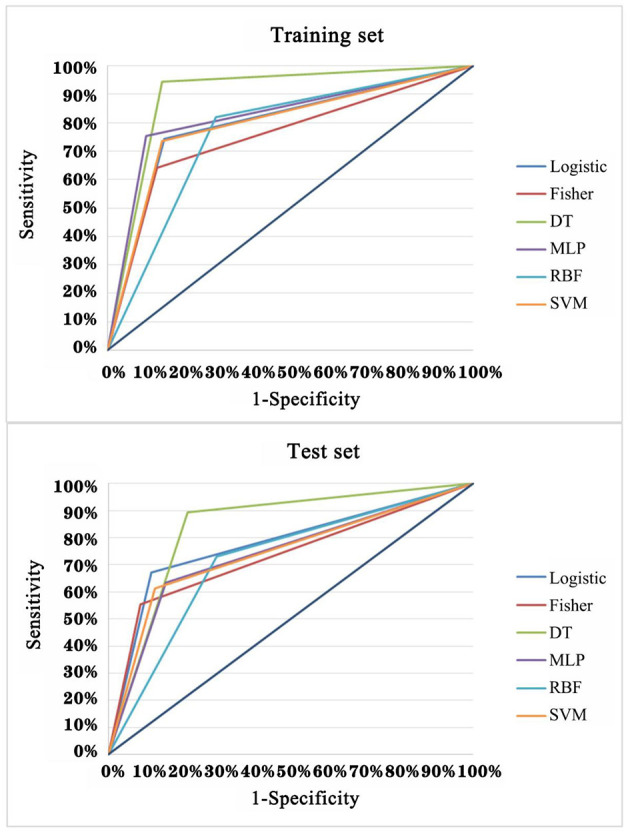
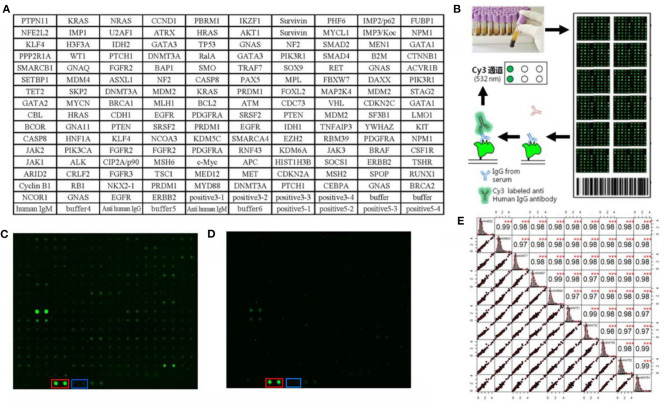
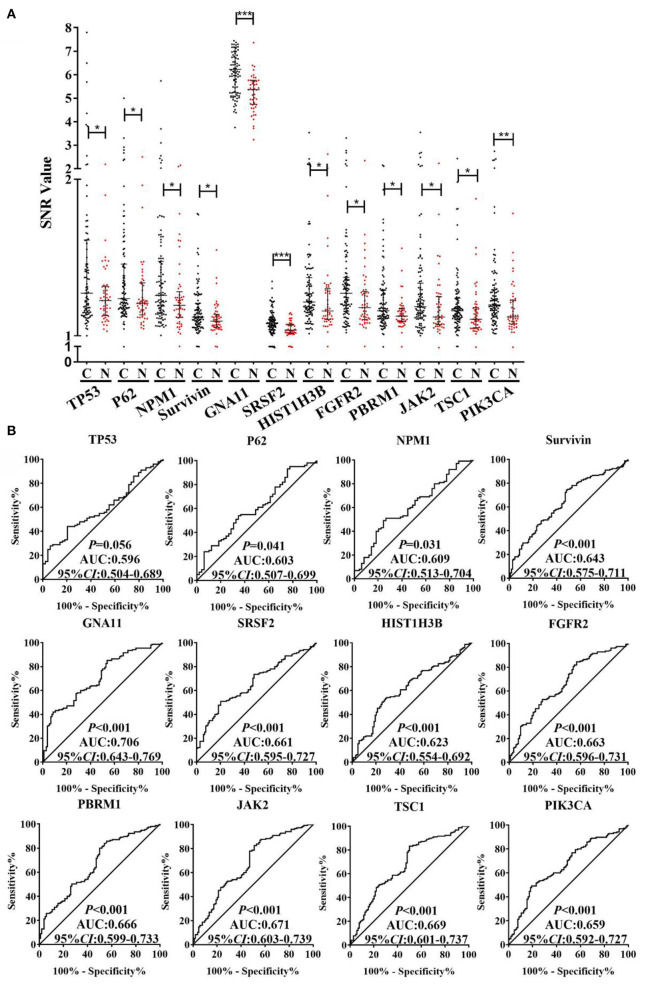
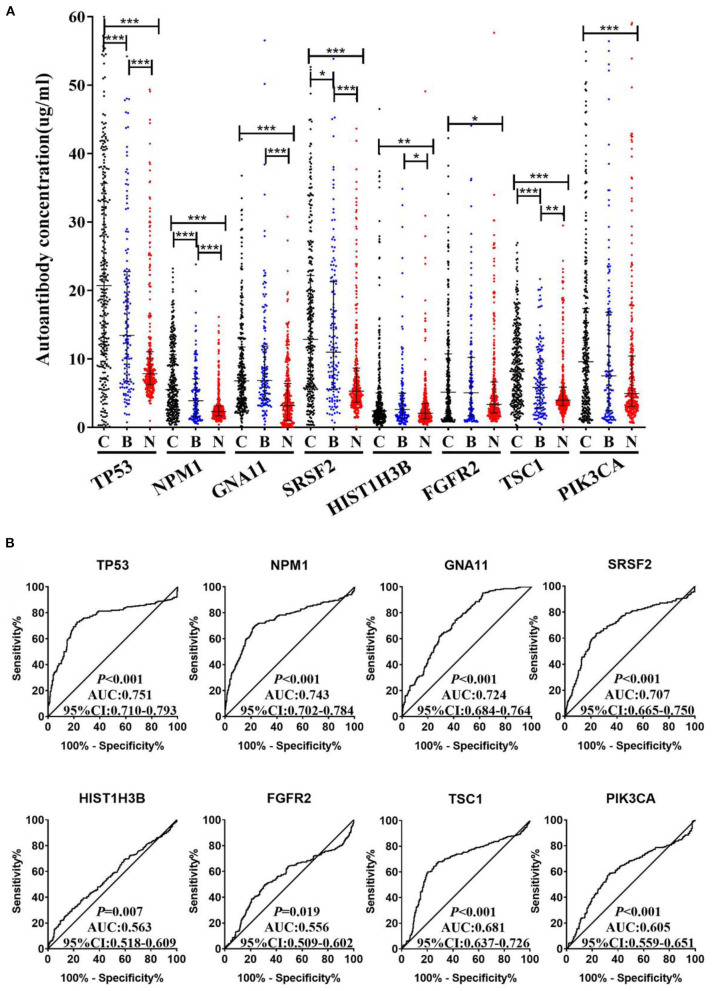
Substantial studies indicate that autoantibodies to tumor-associated antigens (TAAbs) arise in early stage of lung cancer (LC). However, since single TAAbs as non-invasive biomarkers reveal low diagnostic performances, a panel approach is needed to provide more clues for early detection of LC. In the present research, potential TAAbs were screened in 150 serum samples by focused protein array based on 154 proteins encoded by cancer driver genes. Indirect enzyme-linked immunosorbent assay (ELISA) was used to verify and validate TAAbs in two independent datasets with 1,054 participants (310 in verification cohort, 744 in validation cohort). In both verification and validation cohorts, eight TAAbs were higher in serum of LC patients compared with normal controls. Moreover, diagnostic models were built and evaluated in the training set and the test set of validation cohort by six data mining methods. In contrast to the other five models, the decision tree (DT) model containing seven TAAbs (TP53, NPM1, FGFR2, PIK3CA, GNA11, HIST1H3B, and TSC1), built in the training set, yielded the highest diagnostic value with the area under the receiver operating characteristic curve (AUC) of 0.897, the sensitivity of 94.4% and the specificity of 84.9%. The model was further assessed in the test set and exhibited an AUC of 0.838 with the sensitivity of 89.4% and the specificity of 78.2%. Interestingly, the accuracies of this model in both early and advanced stage were close to 90%, much more effective than that of single TAAbs. Protein array based on cancer driver genes is effective in screening and discovering potential TAAbs of LC. The TAAbs panel with TP53, NPM1, FGFR2, PIK3CA, GNA11, HIST1H3B, and TSC1 is excellent in early detection of LC, and they might be new target in LC immunotherapy.
大量研究表明,肿瘤相关抗原(TAAb)自身抗体出现在肺癌(LC)的早期阶段。然而,由于单一 TAAb 作为非侵入性生物标志物的诊断性能较低,因此需要采用面板方法为 LC 的早期检测提供更多线索。在本研究中,通过基于癌症驱动基因编码的 154 种蛋白质的焦点蛋白质阵列筛选了潜在的 TAAb。间接酶联免疫吸附试验(ELISA)用于在包含 1054 名参与者(验证队列 310 名,验证队列 744 名)的两个独立数据集上验证和验证 TAAb。在验证队列和验证队列中,与正常对照相比,LC 患者血清中的八种 TAAb 更高。此外,通过六种数据挖掘方法在验证队列的训练集和测试集中构建和评估了诊断模型。与其他五个模型相比,包含七个 TAAb(TP53、NPM1、FGFR2、PIK3CA、GNA11、HIST1H3B 和 TSC1)的决策树(DT)模型在训练集中构建,其曲线下面积(AUC)为 0.897,灵敏度为 94.4%,特异性为 84.9%,具有最高的诊断价值。该模型在测试集中进一步进行了评估,其 AUC 为 0.838,灵敏度为 89.4%,特异性为 78.2%。有趣的是,该模型在早期和晚期的准确率均接近 90%,比单一 TAAb 更为有效。基于癌症驱动基因的蛋白质阵列在筛选和发现 LC 的潜在 TAAb 方面非常有效。包含 TP53、NPM1、FGFR2、PIK3CA、GNA11、HIST1H3B 和 TSC1 的 TAAb 面板在 LC 的早期检测中表现出色,它们可能是 LC 免疫治疗的新靶标。