Qin Chuang, Gao Yan, Li Jiangfa, Huang Chao, He Songqing
Division of Hepatobiliary Surgery, The First Affiliated Hospital of Guangxi Medical University, Nanning, Guangxi 530021, P.R. China.
Oncol Lett. 2021 Jun;21(6):487. doi: 10.3892/ol.2021.12748. Epub 2021 Apr 22.
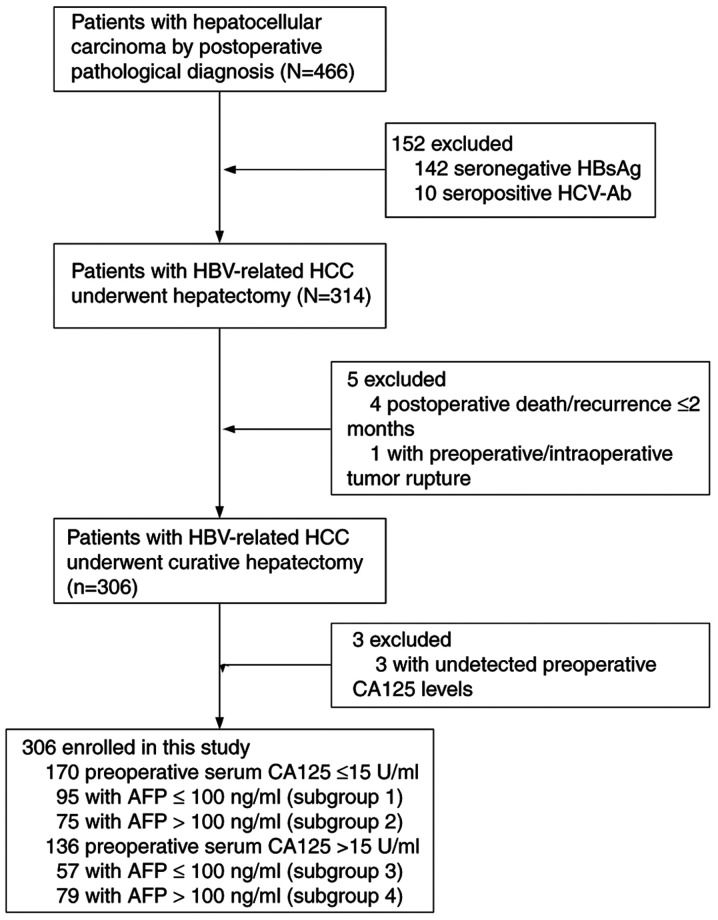
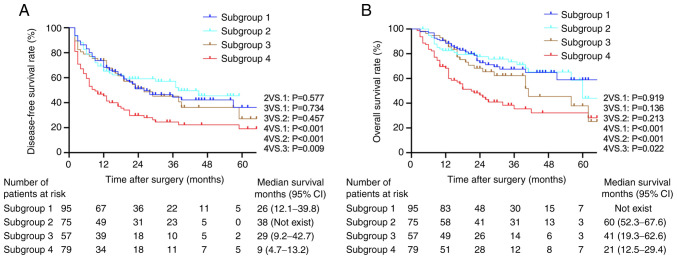
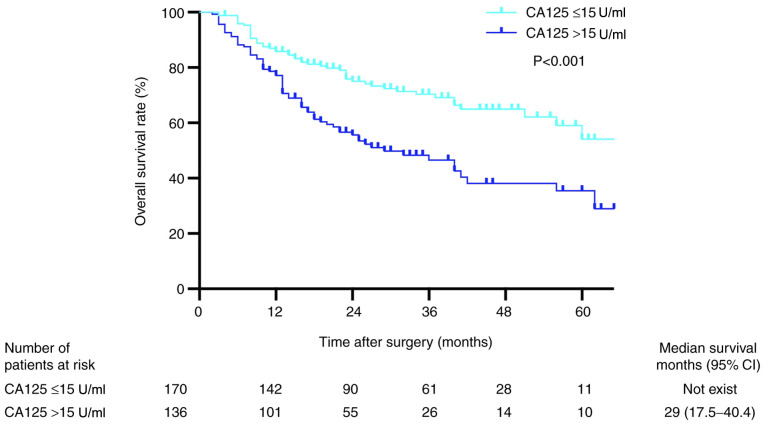
The association between the serum levels of cancer antigen 125 (CA125; also termed MUC16) and the prognosis of patients with hepatocellular carcinoma (HCC) has not been widely reported to date. The aim of the present study was to determine the association between preoperative serum CA125 levels and prognosis of patients with hepatitis B virus (HBV)-related HCC after hepatectomy. The study included 306 patients with HBV-related HCC who underwent liver resection and were classified into four subgroups based on their baseline CA125 and α-fetoprotein (AFP) levels. The perioperative clinical data were compared and analyzed. Kaplan-Meier and Cox regression analyses were performed to determine the associations between patient clinicopathological characteristics and survival. The results revealed that the median follow-up time was 35 months. Patients with low preoperative serum CA125 levels presented with improved 3-year disease-free survival (DFS) (79.3 vs. 75.7%; P=0.278) and overall survival (OS) (84.4 vs. 77.1%; P=0.001) rates compared with those among patients with high preoperative serum CA125 levels. High preoperative serum CA125 levels were a risk factor associated with short DFS and OS rates in all patients. In patients with baseline AFP levels >100 ng/ml, low preoperative serum CA125 levels were significantly associated with prolonged DFS and OS rates (log-rank test P=0.002 and P=0.005, respectively). In patients with AFP levels ≤100 ng/ml, no significant differences were observed in DFS or OS rates between the high and low preoperative serum CA125 groups. Patients with high preoperative serum CA125 and AFP levels exhibited the worst prognosis (low DFS and OS rates). In conclusion, high baseline CA125 levels may be associated with a poor prognosis in patients with HBV-related HCC.
血清癌抗原125(CA125;也称为MUC16)水平与肝细胞癌(HCC)患者预后之间的关联,迄今为止尚未有广泛报道。本研究的目的是确定术前血清CA125水平与乙型肝炎病毒(HBV)相关HCC患者肝切除术后预后之间的关联。该研究纳入了306例接受肝切除的HBV相关HCC患者,并根据其基线CA125和甲胎蛋白(AFP)水平分为四个亚组。对围手术期临床数据进行了比较和分析。进行了Kaplan-Meier和Cox回归分析,以确定患者临床病理特征与生存率之间的关联。结果显示,中位随访时间为35个月。术前血清CA125水平低的患者,其3年无病生存率(DFS)(79.3%对75.7%;P=0.278)和总生存率(OS)(84.4%对77.1%;P=0.001)较术前血清CA125水平高的患者有所改善。术前血清CA125水平高是所有患者DFS和OS率短的一个危险因素。在基线AFP水平>100 ng/ml的患者中,术前血清CA125水平低与DFS和OS率延长显著相关(对数秩检验P分别为0.002和0.005)。在AFP水平≤100 ng/ml的患者中,术前血清CA125高低组之间的DFS或OS率无显著差异。术前血清CA125和AFP水平高的患者预后最差(DFS和OS率低)。总之,高基线CA