Graw Jan A, Burchard René
Department of Anesthesiology and Operative Intensive Care Medicine CCM/CVK, Charité-Universitätsmedizin Berlin, Corporate Member of Freie Universität Berlin, Humboldt-Universität zu Berlin, Berlin Institute of Health, Berlin, Germany.
Berlin Institute of Health (BIH), Berlin, Germany.
Emerg Med Int. 2021 Apr 20;2021:5537599. doi: 10.1155/2021/5537599. eCollection 2021.
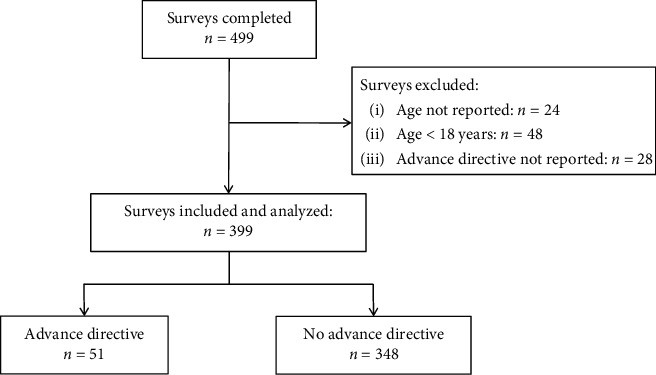
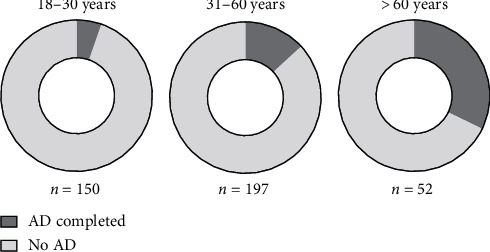
An advance directive (AD) is a written legal document in which a person can express wishes and preferences for medical treatment for the moment when that person is no longer able to make medical decisions because of a serious illness or injury. While ADs have emerged in public, it is unclear, how many adults in Germany have completed an AD, and frequencies differ among different patient cohorts and medical settings. The aim of this study was to evaluate how many patients visiting a trauma emergency room (ER) in an academic teaching hospital had completed an AD. Furthermore, patient characteristics were compared between patients who had completed an AD and those who had not completed an AD. . Patients with a traumatic injury or disease who attended the ER of an academic teaching hospital in the period from October 2015 to March 2016 ( = 499) were surveyed for completion rates of ADs. . Prior to their visit to the ER, 12.8% of the included patients possessed a completed AD. Patients with a completed AD had a higher age (median age: 54 (IQR: 34-66) vs. 35 (IQR: 25-50) < 0.001) and were less often living in an urban residential location (UR) (UR: 23.5% vs. 39.4%, =0.029). Groups did not differ between sex (=0.115), frequencies of high school graduates (=0.482), and possession of a private health insurance (=0.072), disability insurance (=0.291), or an accident insurance (=0.790). . Completion rates of ADs remain low among patients visiting an ER of an academic teaching hospital in Germany. Increasing age but not factors such as sex, educational background, or insurance status were associated with a higher frequency of completed ADs.
预先医疗指示(AD)是一份书面法律文件,个人可以在其中表达因重病或重伤而无法做出医疗决策时对医疗治疗的愿望和偏好。虽然预先医疗指示已公开出现,但德国有多少成年人完成了预先医疗指示尚不清楚,并且不同患者群体和医疗环境中的频率有所不同。本研究的目的是评估在一家学术教学医院的创伤急诊室就诊的患者中有多少人完成了预先医疗指示。此外,比较了完成预先医疗指示的患者和未完成预先医疗指示的患者的特征。对2015年10月至2016年3月期间在一家学术教学医院急诊室就诊的创伤性损伤或疾病患者(n = 499)进行了预先医疗指示完成率调查。在就诊急诊室之前,纳入的患者中有12.8%拥有已完成的预先医疗指示。完成预先医疗指示的患者年龄较大(中位年龄:54岁(四分位间距:34 - 66岁)对35岁(四分位间距:25 - 50岁),P < 0.001),并且居住在城市居民区(UR)的频率较低(UR:23.5%对39.4%,P = 0.029)。两组在性别(P = 0.115)、高中毕业生频率(P = 0.482)以及拥有私人健康保险(P = 0.072)、残疾保险(P = 0.291)或意外保险(P = 0.790)方面没有差异。在德国一家学术教学医院急诊室就诊的患者中,预先医疗指示的完成率仍然很低。年龄增加而非性别、教育背景或保险状况等因素与更高的预先医疗指示完成频率相关。