Wilson Nathaniel R, Lee Michelle T, Gill Clarence D, Serauto Canache Astrid, Donisan Teodora, Balanescu Dinu V, Song Juhee, Palaskas Nicolas, Lopez-Mattei Juan, Cilingiroglu Mehmet, Marmagkiolis Konstantinos, Iliescu Cezar A
Division of Cardiology, Department of Internal Medicine, The University of Texas Health Science Center at Houston McGovern Medical School, Houston, TX, United States.
Division of Cardiology, Department of Internal Medicine, Baylor College of Medicine, Houston, TX, United States.
Front Cardiovasc Med. 2021 Apr 21;8:638943. doi: 10.3389/fcvm.2021.638943. eCollection 2021.
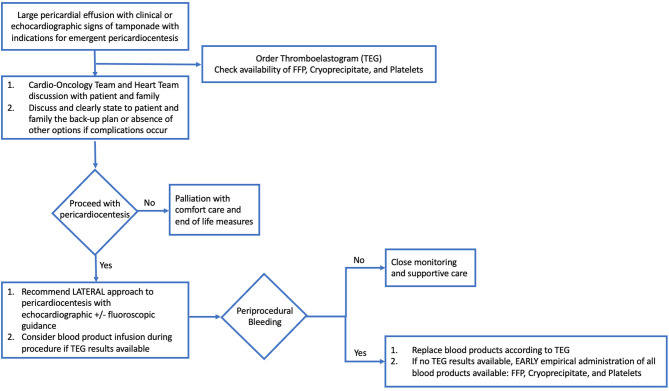
Pericardiocentesis is an important diagnostic and therapeutic tool for cancer-associated pericardial effusion. Limited safety and outcomes data exists regarding the management of malignancy-related pericardial effusion in patients with thrombocytopenia. Our study aimed to analyze prognostic factors and overall survival (OS) after pericardiocentesis in thrombocytopenic cancer patients. A retrospective review of 136 thrombocytopenic cancer patients who underwent primary percutaneous pericardiocentesis was performed. Degree of thrombocytopenia was classified by platelet count recorded on day of pericardiocentesis: 75-149 × 10 cells/μL (41%); 50-74 × 10 cells/μL (10%); 25-49 × 10 cells/μL (24%); <25 × 10 cells/μL (25%). Median OS was 2.6 months and median follow-up was 37.4 months. Kaplan-Meier survival analysis showed significant OS differences among thrombocytopenia severity groups ( = 0.023), and worse OS with platelets <100 vs. ≥100 × 10 cells/μL ( = 0.031). By univariate analysis, thrombocytopenia severity was associated with increased risk of death (HR 0.993; 95% CI 0.989-0.997; = 0.002). Poor prognostic factors for OS were advanced cancer, malignant effusion, elevated international normalized ratio (INR), quantity of platelet transfusions, and platelet transfusion resistance. However, thrombocytopenia severity became insignificant for OS ( = 0.802), after adjusting for advanced cancer and INR. For patients with malignancy-related large pericardial effusion and thrombocytopenia, pericardiocentesis is a feasible intervention and should be considered due to low complication rates. There is no absolute contraindication to pericardiocentesis in case of hemodynamic instability, even with severe thrombocytopenia.
心包穿刺术是治疗癌症相关性心包积液的重要诊断和治疗手段。关于血小板减少症患者恶性肿瘤相关性心包积液的管理,现有的安全性和预后数据有限。我们的研究旨在分析血小板减少症癌症患者心包穿刺术后的预后因素和总生存期(OS)。对136例行初次经皮心包穿刺术的血小板减少症癌症患者进行了回顾性研究。根据心包穿刺术当天记录的血小板计数对血小板减少程度进行分类:75 - 149×10⁹细胞/μL(41%);50 - 74×10⁹细胞/μL(10%);25 - 49×10⁹细胞/μL(24%);<25×10⁹细胞/μL(25%)。中位总生存期为2.6个月,中位随访时间为37.4个月。Kaplan - Meier生存分析显示血小板减少严重程度组之间的总生存期存在显著差异(P = 0.023),血小板<100×10⁹细胞/μL与≥100×10⁹细胞/μL相比总生存期更差(P = 0.031)。单因素分析显示,血小板减少严重程度与死亡风险增加相关(HR 0.993;95%CI 0.989 - 0.997;P = 0.002)。总生存期的不良预后因素包括晚期癌症、恶性积液、国际标准化比值(INR)升高、血小板输注量和血小板输注抵抗。然而,在调整晚期癌症和INR后,血小板减少严重程度对总生存期无显著影响(P = 0.802)。对于患有恶性肿瘤相关性大量心包积液和血小板减少症的患者,心包穿刺术是一种可行的干预措施,且由于并发症发生率低应予以考虑。即使存在严重血小板减少症,在血流动力学不稳定的情况下,心包穿刺术也没有绝对禁忌证。