Wang Yihan, Zhou Yingmin, Ali Malik Ahsan, Zhang Jiaman, Wang Wencan, Huang Yan, Luo Bo, Zhang Heming, Qin Ziyue, Zhang Yan, Zhang Ming, Zhou Guangbin, Zeng Changjun
College of Animal Sciences and Technology and Farm Animal Genetic Resources Exploration and Innovation Key Laboratory of Sichuan Province, Sichuan Agricultural University, Chengdu, China.
China Conservation and Research Center for the Giant Panda, Chengdu, China.
Front Vet Sci. 2021 Apr 22;8:635013. doi: 10.3389/fvets.2021.635013. eCollection 2021.
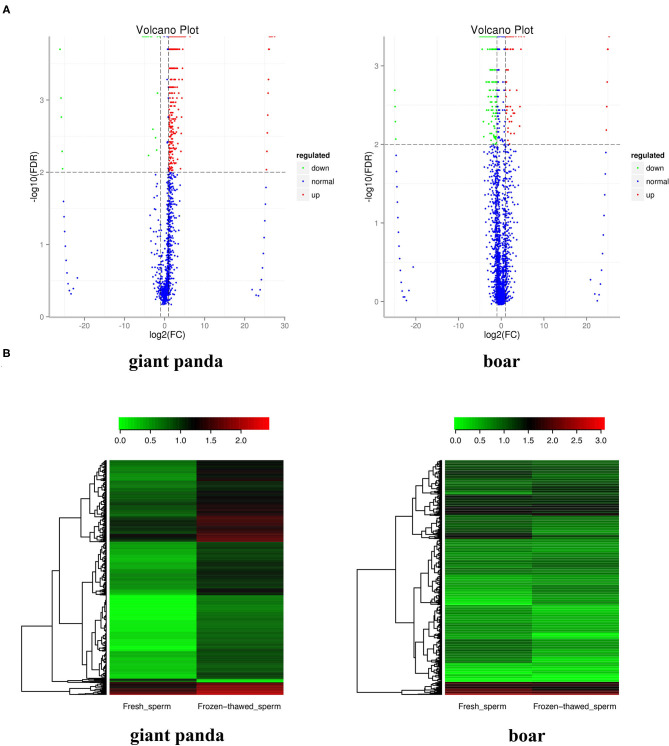
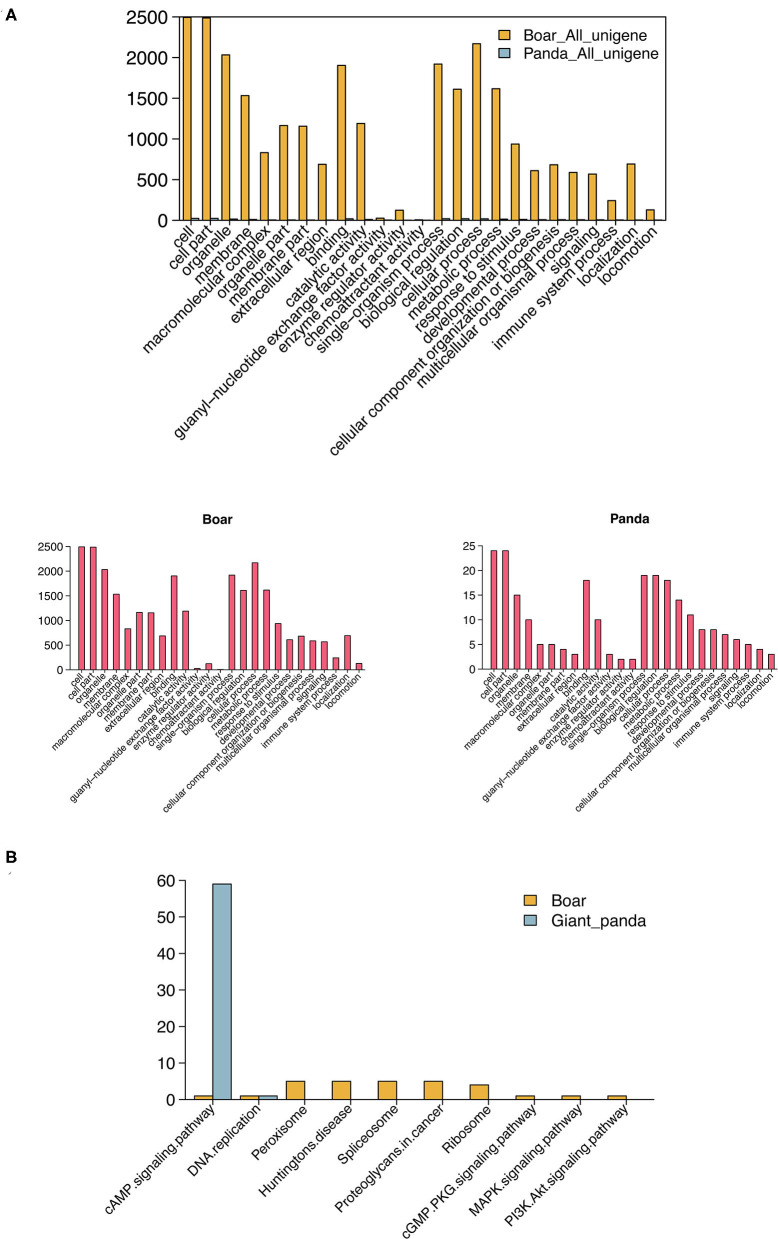
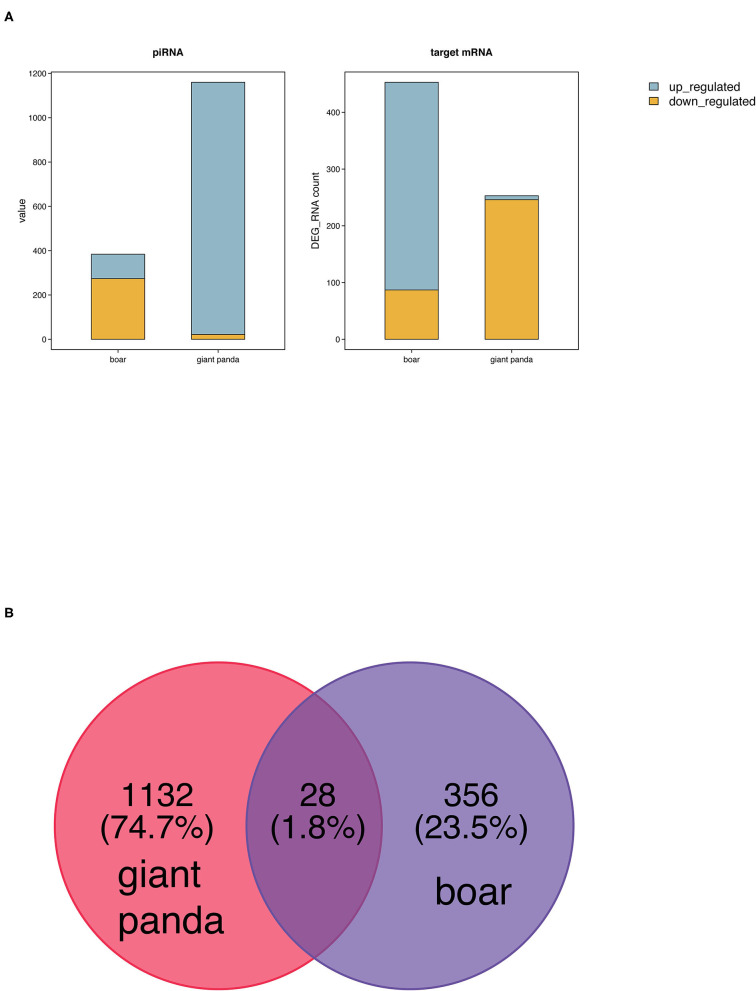
Cryopreservation induces sperm cryoinjuries, including physiological and functional changes. However, the molecular mechanisms of sperm cryoinjury and cryoresistance are still unknown. Cryoresistance or the freeze tolerance of sperm varies across species, and boar sperm is more susceptible to cold stress. Contrary to boar sperm, giant panda sperm appears to be strongly freeze-tolerant and is capable of surviving repeated cycles of freeze-thawing. In this study, differentially expressed (DE) PIWI-interacting RNAs (piRNAs) of fresh and frozen-thawed sperm with different freeze tolerance capacity from giant panda and boar were evaluated. The results showed that 1,160 (22 downregulated and 1,138 upregulated) and 384 (110 upregulated and 274 downregulated) DE piRNAs were identified in giant panda and boar sperm, respectively. Gene ontology (GO) enrichment analysis revealed that the target DE messenger RNAs (mRNAs) of DE piRNAs were mainly enriched in biological regulation, cellular, and metabolic processes in giant panda and boar sperm. Moreover, Kyoto Encyclopedia of Genes and Genomes (KEGG) analysis indicated that the target DE mRNAs of DE piRNAs were only distributed in DNA replication and the cyclic adenosine monophosphate (cAMP) signaling pathway in giant panda, but the cAMP, cyclic guanosine monophosphate (cGMP), and mitogen-activated protein kinase (MAPK) signaling pathways in boar sperm were considered as part of the olfactory transduction pathway. In conclusion, we speculated that the difference in the piRNA profiles and the DE piRNAs involved in the cAMP signaling pathway in boar and giant panda may have contributed to the different freeze tolerance capacities between giant panda and boar sperm, which helps to elucidate the molecular mechanism behind sperm cryoinjury and cryoresistance.
冷冻保存会导致精子冷冻损伤,包括生理和功能变化。然而,精子冷冻损伤和抗冻性的分子机制仍然未知。精子的抗冻性或冷冻耐受性因物种而异,猪精子对冷应激更敏感。与猪精子相反,大熊猫精子似乎具有很强的耐冻性,能够在反复的冻融循环中存活。在本研究中,评估了来自大熊猫和猪的具有不同冷冻耐受能力的新鲜和冻融精子中差异表达的(DE)PIWI相互作用RNA(piRNA)。结果显示,在大熊猫和猪精子中分别鉴定出1160个(22个下调和1138个上调)和384个(110个上调和274个下调)DE piRNA。基因本体(GO)富集分析表明,DE piRNA的靶标DE信使RNA(mRNA)主要富集在大熊猫和猪精子的生物调节、细胞和代谢过程中。此外,京都基因与基因组百科全书(KEGG)分析表明,DE piRNA的靶标DE mRNA仅分布在大熊猫的DNA复制和环磷酸腺苷(cAMP)信号通路中,但猪精子中的cAMP、环磷酸鸟苷(cGMP)和丝裂原活化蛋白激酶(MAPK)信号通路被认为是嗅觉转导通路的一部分。总之,我们推测猪和大熊猫中piRNA谱的差异以及参与cAMP信号通路的DE piRNA可能导致了大熊猫和猪精子之间不同的冷冻耐受能力,这有助于阐明精子冷冻损伤和抗冻性背后的分子机制。