Ma Yi-Hang, Tian Zhi-Sen, Liu Hao-Chuan, Zhang Bo-Yin, Zhu Yu-Hang, Meng Chun-Yang, Liu Xiang-Ji, Zhu Qing-San
Department of Spine Surgery, China-Japan Union Hospital of Jilin University, Changchun 130033, Jilin Province, China.
World J Clin Cases. 2021 Apr 26;9(12):2778-2790. doi: 10.12998/wjcc.v9.i12.2778.
As one of the most common complications of osteoporosis, osteoporotic vertebral compression fracture (OVCF) increases the risk of disability and mortality in elderly patients. Percutaneous vertebroplasty (PVP) is considered to be an effective, safe, and minimally invasive treatment for OVCFs. The recollapse of cemented vertebrae is one of the serious complications of PVP. However, the risk factors associated with recollapse after PVP remain controversial.
To identify risk factors for the recollapse of cemented vertebrae after PVP in patients with OVCFs.
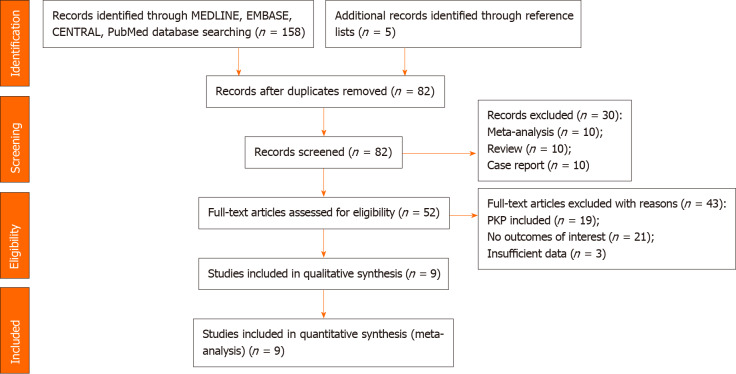
A systematic search in EMBASE, MEDLINE, the Cochrane Library, and PubMed was conducted for relevant studies from inception until March 2020. Studies investigating risk factors for the recollapse of cemented vertebrae after PVP without additional trauma were selected for analysis. Odds ratios (ORs) or standardized mean differences with 95% confidence interval (CI) were calculated and heterogeneity was assessed by both the chi-squared test and the -squared test. The methodological quality of the included studies was assessed according to the Newcastle-Ottawa Scale.
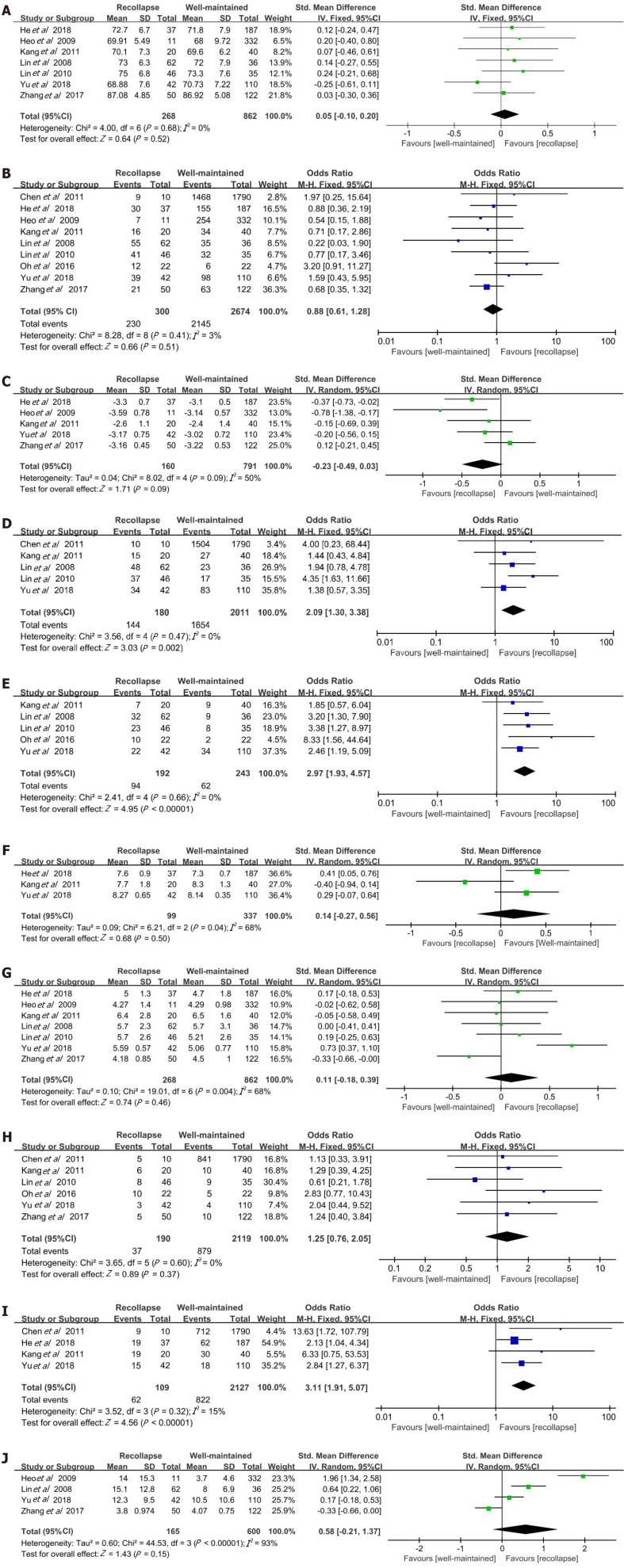
A total of nine case-control studies were included in our meta-analysis comprising 300 cases and 2674 controls. The significant risk factors for the recollapse of cemented vertebrae after PVP in OVCF patients were fractures located at the thoracolumbar junction (OR = 2.09; 95%CI: 1.30 to 3.38; = 0.002), preoperative intravertebral cleft (OR = 2.97; 95%CI: 1.93 to 4.57; < 0.00001), and solid lump distribution pattern of the cement (OR = 3.11; 95%CI: 1.91 to 5.07; < 0.00001). The analysis did not support that age, gender, lumbar bone mineral density, preoperative visual analogue scale score, injected cement volume, intradiscal cement leakage, or vertebral height restoration could increase the risk for cemented vertebra recollapse after PVP in OVCFs.
This meta-analysis suggests that thoracolumbar junction fractures, preoperative intravertebral cleft, and solid lump cement distribution pattern are associated with the recollapse of cemented vertebrae after PVP in OVCF patients.
作为骨质疏松症最常见的并发症之一,骨质疏松性椎体压缩骨折(OVCF)增加了老年患者致残和死亡的风险。经皮椎体成形术(PVP)被认为是治疗OVCF的一种有效、安全且微创的方法。骨水泥强化椎体再塌陷是PVP的严重并发症之一。然而,PVP术后再塌陷的相关危险因素仍存在争议。
确定OVCF患者PVP术后骨水泥强化椎体再塌陷的危险因素。
在EMBASE、MEDLINE、Cochrane图书馆和PubMed中进行系统检索,纳入从数据库建立至2020年3月的相关研究。选择研究PVP术后无额外创伤情况下骨水泥强化椎体再塌陷危险因素的研究进行分析。计算比值比(OR)或标准化均数差及95%置信区间(CI),并通过卡方检验和I²检验评估异质性。根据纽卡斯尔-渥太华量表评估纳入研究的方法学质量。
我们的荟萃分析共纳入9项病例对照研究,包括300例病例和2674例对照。OVCF患者PVP术后骨水泥强化椎体再塌陷的显著危险因素为胸腰段交界处骨折(OR = 2.09;95%CI:1.30至3.38;P = 0.002)、术前椎体内裂隙(OR = 2.97;95%CI:1.93至4.57;P < 0.00001)以及骨水泥的实心团块分布模式(OR = 3.11;95%CI:1.91至5.07;P < 0.00001)。分析不支持年龄、性别、腰椎骨密度、术前视觉模拟评分、注入骨水泥体积、椎间盘内骨水泥渗漏或椎体高度恢复会增加OVCF患者PVP术后骨水泥强化椎体再塌陷的风险。
这项荟萃分析表明,胸腰段交界处骨折、术前椎体内裂隙和骨水泥实心团块分布模式与OVCF患者PVP术后骨水泥强化椎体再塌陷有关。