Department of Radiology and Research Institute of Radiology, University of Ulsan College of Medicine, Asan Medical Center, 43 Olympic-ro 88, Songpa-Gu, Seoul, 05505, Korea.
Department of Convergence Medicine, Asan Medical Institute of Convergence Science and Technology, Asan Medical Center, Seoul, 05505, Korea.
Sci Rep. 2021 May 10;11(1):9912. doi: 10.1038/s41598-021-89477-w.
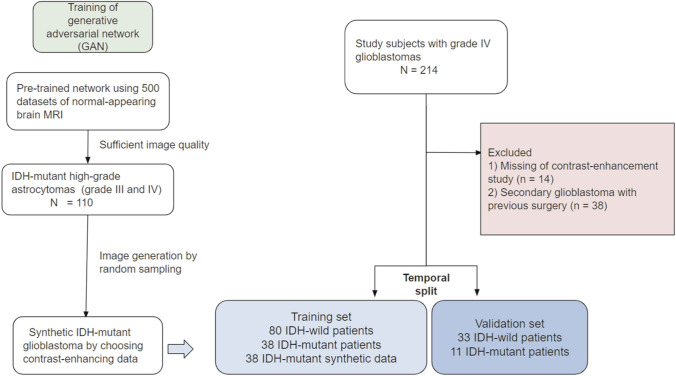
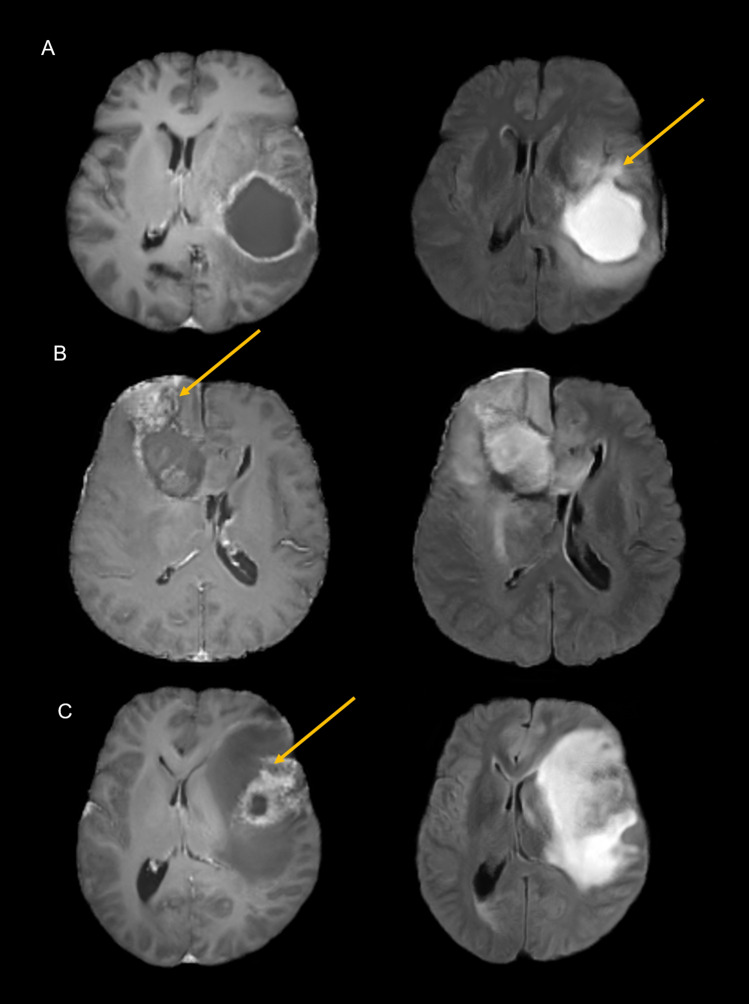
Generative adversarial network (GAN) creates synthetic images to increase data quantity, but whether GAN ensures meaningful morphologic variations is still unknown. We investigated whether GAN-based synthetic images provide sufficient morphologic variations to improve molecular-based prediction, as a rare disease of isocitrate dehydrogenase (IDH)-mutant glioblastomas. GAN was initially trained on 500 normal brains and 110 IDH-mutant high-grade astocytomas, and paired contrast-enhanced T1-weighted and FLAIR MRI data were generated. Diagnostic models were developed from real IDH-wild type (n = 80) with real IDH-mutant glioblastomas (n = 38), or with synthetic IDH-mutant glioblastomas, or augmented by adding both real and synthetic IDH-mutant glioblastomas. Turing tests showed synthetic data showed reality (classification rate of 55%). Both the real and synthetic data showed that a more frontal or insular location (odds ratio [OR] 1.34 vs. 1.52; P = 0.04) and distinct non-enhancing tumor margins (OR 2.68 vs. 3.88; P < 0.001), which become significant predictors of IDH-mutation. In an independent validation set, diagnostic accuracy was higher for the augmented model (90.9% [40/44] and 93.2% [41/44] for each reader, respectively) than for the real model (84.1% [37/44] and 86.4% [38/44] for each reader, respectively). The GAN-based synthetic images yield morphologically variable, realistic-seeming IDH-mutant glioblastomas. GAN will be useful to create a realistic training set in terms of morphologic variations and quality, thereby improving diagnostic performance in a clinical model.
生成对抗网络(GAN)生成合成图像以增加数据量,但 GAN 是否能确保有意义的形态变化尚不清楚。我们研究了基于 GAN 的合成图像是否能提供足够的形态变化,从而改善基于分子的预测,这是一种罕见的异柠檬酸脱氢酶(IDH)突变型胶质母细胞瘤。GAN 最初在 500 个正常大脑和 110 个 IDH 突变高级星形细胞瘤上进行了训练,并生成了配对的对比增强 T1 加权和 FLAIR MRI 数据。诊断模型是从真实的 IDH 野生型(n=80)和真实的 IDH 突变型胶质母细胞瘤(n=38)中开发的,或者是从合成的 IDH 突变型胶质母细胞瘤中开发的,或者是通过添加真实和合成的 IDH 突变型胶质母细胞瘤来增强的。图灵测试表明,合成数据具有真实性(分类率为 55%)。真实和合成数据均表明,肿瘤位置更靠前或更靠岛(优势比[OR]为 1.34 比 1.52;P=0.04)和明显的非增强肿瘤边界(OR 为 2.68 比 3.88;P<0.001),这些都是 IDH 突变的重要预测因素。在独立验证集中,增强模型的诊断准确性更高(两位读者的准确率分别为 90.9%[40/44]和 93.2%[41/44]),高于真实模型(两位读者的准确率分别为 84.1%[37/44]和 86.4%[38/44])。基于 GAN 的合成图像产生了形态变化多样、看起来真实的 IDH 突变型胶质母细胞瘤。GAN 将有助于创建具有形态变化和质量的逼真训练集,从而提高临床模型中的诊断性能。