Immunology, Instituto Nacional de Cardiología Ignacio Chávez, Juan Badiano 1, Sección XVI, 14080, Tlalpan, Mexico City, Mexico.
Health Care, Universidad Autónoma Metropolitana Xochimilco, Mexico City, Mexico.
Inflamm Res. 2021 Jun;70(6):731-742. doi: 10.1007/s00011-021-01466-x. Epub 2021 May 10.
To investigate whether a simplified inflammation-based risk scoring system comprising three readily available biomarkers (albumin, C-reactive protein, and leukocytes) may predict major adverse outcomes in patients with COVID-19.
Upon admission to the emergency room, the inflammation-based risk scoring system was applied and patients were classified as having mild, moderate, or severe inflammation. In-hospital occurrence of thrombosis, need for mechanical ventilation, and death were recorded.
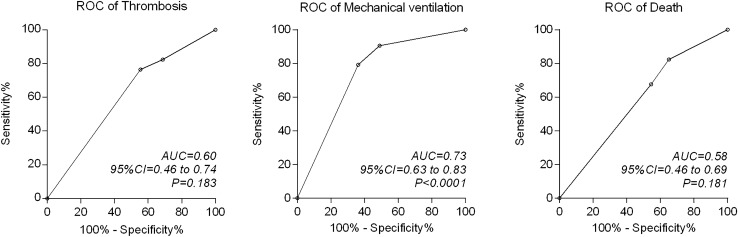
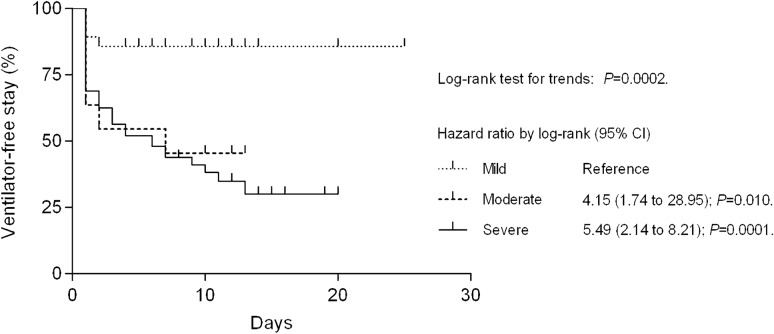
One-hundred patients (55 ± 13 years; 71% men) were included and classified as having mild (29%), moderate (12%), or severe (59%) inflammation. The need for mechanical ventilation differed among patients in each group (16%, 50%, and 71%, respectively; P < 0.0001), yielding a 4.1-fold increased risk of requiring mechanical ventilation in patients with moderate inflammation and 5.4 for those with severe inflammation. On the contrary, there were no differences for the occurrence of thrombosis (10%, 8%, and 22%, respectively; P = 0.142) or death (21%, 42%, and 39%, respectively; P = 0.106). In the multivariate analysis, only severe inflammation (hazard ratio [HR] = 4.1), D-dimer > 574 ng/mL (HR = 3.0), and troponin I ≥ 6.7 ng/mL (HR = 2.4) at hospital admission were independent predictors of the need for mechanical ventilation.
The inflammation-based risk scoring system predicts the need for mechanical ventilation in patients with severe COVID-19.
研究一种由三种易于获得的生物标志物(白蛋白、C 反应蛋白和白细胞)组成的简化炎症基础风险评分系统是否可预测 COVID-19 患者的主要不良结局。
在急诊室就诊时,应用炎症基础风险评分系统将患者分为轻度、中度或重度炎症。记录住院期间血栓形成、需要机械通气和死亡的发生情况。
共纳入 100 例患者(55±13 岁;71%为男性),并分为轻度(29%)、中度(12%)或重度(59%)炎症。每组患者的机械通气需求不同(分别为 16%、50%和 71%;P<0.0001),中度炎症患者需要机械通气的风险增加 4.1 倍,重度炎症患者增加 5.4 倍。相反,各组患者血栓形成的发生率(分别为 10%、8%和 22%;P=0.142)或死亡率(分别为 21%、42%和 39%;P=0.106)无差异。多变量分析显示,只有重度炎症(危险比 [HR]=4.1)、D-二聚体>574ng/mL(HR=3.0)和肌钙蛋白 I≥6.7ng/mL(HR=2.4)在入院时是需要机械通气的独立预测因素。
炎症基础风险评分系统可预测重度 COVID-19 患者需要机械通气。