Leiden University Medical Centre, Leiden, The Netherlands.
Erasmus Medical Center, Rotterdam, The Netherlands.
Arthritis Care Res (Hoboken). 2022 Oct;74(10):1713-1722. doi: 10.1002/acr.24640. Epub 2022 Jul 16.
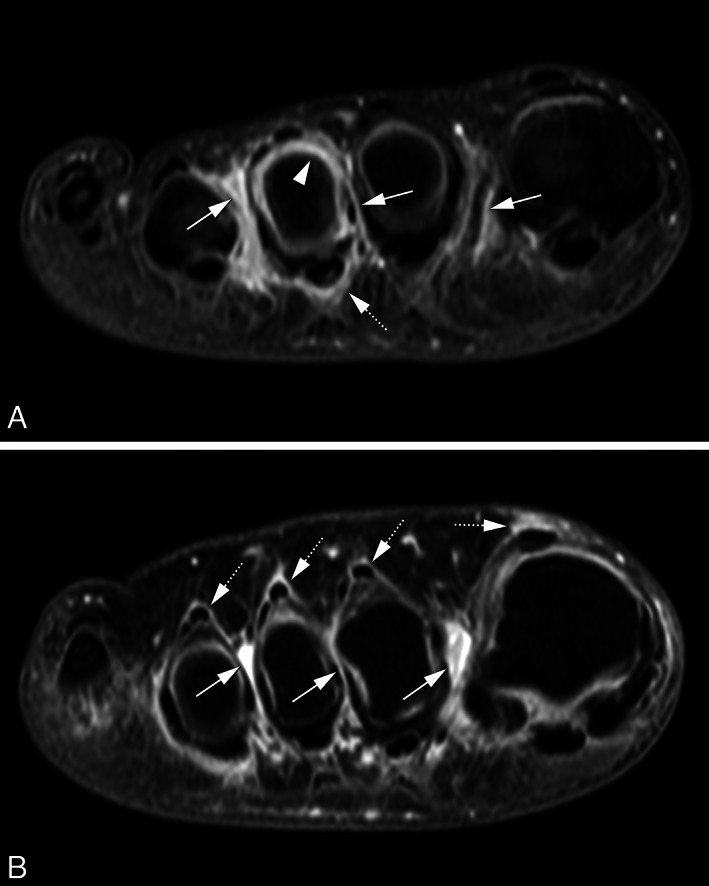
Intermetatarsal bursae in the forefeet possess a synovial lining similar to joints and tendon sheaths. Inflammation of these bursae (intermetatarsal bursitis [IMB]) was recently identified as specific for early rheumatoid arthritis (RA). The present study was undertaken to determine if IMB is indeed an RA feature by assessing the following: 1) the association with other local inflammatory measures (synovitis, tenosynovitis, and osteitis), 2) the association with clinical signs, and 3) whether it responds to disease-modifying antirheumatic drug (DMARD) therapy similarly to other local inflammatory measures.
One hundred fifty-seven consecutive early RA patients underwent unilateral contrast-enhanced 1.5T forefoot magnetic resonance imaging (MRI) at diagnosis. MRIs were evaluated for IMB presence and for synovitis, tenosynovitis, and osteitis in line with the RA MRI Scoring (RAMRIS) system (summed as RAMRIS inflammation). MRIs at 4, 12, and 24 months were evaluated for IMB presence and size in patients who had IMB at baseline and received early DMARD therapy. Logistic regression and generalized estimating equations were used. Anti-citrullinated protein antibody (ACPA) stratification was performed.
Sixty-nine percent of RA patients had ≥1 IMB. In multivariable analysis on bursa level, presence of IMB was independently associated with local presence of synovitis and tenosynovitis, with odds ratios (OR) of 1.69 (95% confidence interval [95% CI] 1.12, 2.57) and 2.83 (95% CI 1.80, 4.44), respectively, but not osteitis. On the patient level, IMB presence was most strongly associated with tenosynovitis (OR 2.92 [95% CI 1.62, 5.24]). IMB presence was associated with local joint swelling (OR 2.7 [95% CI 1.3, 5.3]) and tenderness (OR 1.7 [95% CI 1.04, 2.9]) independent of RAMRIS inflammation. During treatment, IMB size decreased between 0 and 12 months. This decrease associated with decrease in RAMRIS inflammation, which was driven by synovitis decrease. Within ACPA-positive and ACPA-negative RA, similar results were obtained.
IMB particularly accompanies inflammation of the synovial lining of joints and tendon sheaths, showed a similar treatment response after DMARD initiation, and associates with typical clinical signs. These findings suggest that IMB represents a frequently present novel RA feature of juxtaarticular synovial inflammation.
前足的跖间滑囊具有与关节和腱鞘相似的滑膜衬里。这些滑囊炎(跖间滑囊炎[IMB])的炎症最近被确定为早期类风湿关节炎(RA)的特异性。本研究旨在通过评估以下内容来确定 IMB 是否确实是 RA 的特征:1)与其他局部炎症指标(滑膜炎、腱鞘炎和骨炎)的关系,2)与临床体征的关系,以及 3)它是否像其他局部炎症指标一样对疾病修饰抗风湿药物(DMARD)治疗有反应。
157 例连续的早期 RA 患者在诊断时接受了单侧对比增强 1.5T 前足磁共振成像(MRI)检查。MRI 按照 RA MRI 评分(RAMRIS)系统评估 IMB 存在情况以及滑膜炎、腱鞘炎和骨炎(总和为 RAMRIS 炎症)。在基线时存在 IMB 并接受早期 DMARD 治疗的患者中,在第 4、12 和 24 个月评估 MRI 中 IMB 的存在和大小。使用逻辑回归和广义估计方程进行分析。进行抗瓜氨酸蛋白抗体(ACPA)分层。
69%的 RA 患者有≥1 个 IMB。在滑囊水平的多变量分析中,IMB 的存在与局部滑膜炎和腱鞘炎的存在独立相关,优势比(OR)分别为 1.69(95%置信区间[95%CI] 1.12,2.57)和 2.83(95%CI 1.80,4.44),但与骨炎无关。在患者水平上,IMB 的存在与腱鞘炎的存在最密切相关(OR 2.92[95%CI 1.62,5.24])。IMB 的存在与局部关节肿胀(OR 2.7[95%CI 1.3,5.3])和压痛(OR 1.7[95%CI 1.04,2.9])相关,独立于 RAMRIS 炎症。在治疗期间,IMB 的大小在 0 至 12 个月之间减小。这种减小与 RAMRIS 炎症的减小相关,而 RAMRIS 炎症的减小是由滑膜炎的减小驱动的。在 ACPA 阳性和 ACPA 阴性 RA 中,得到了类似的结果。
IMB 特别伴随着关节滑膜衬里和腱鞘的炎症,在 DMARD 起始后表现出相似的治疗反应,并与典型的临床体征相关。这些发现表明,IMB 代表了一种常见的新型 RA 特征,即关节旁滑膜炎症。