Department of Statistical Genetics, Osaka University Graduate School of Medicine, Suita, Japan.
Department of Neurology, Graduate School of Medicine, The University of Tokyo, Tokyo, Japan.
Mov Disord. 2021 Aug;36(8):1805-1814. doi: 10.1002/mds.28583. Epub 2021 May 11.
Despite evidence for the role of human leukocyte antigen (HLA) in the genetic predisposition to Parkinson's disease (PD), the complex haplotype structure and highly polymorphic feature of the major histocompatibility complex (MHC) region has hampered a unified insight on the genetic risk of PD. In addition, a majority of the reports focused on Europeans, lacking evidence on other populations.
The aim of this study is to elucidate the genetic features of the MHC region associated with PD risk in trans-ethnic cohorts.
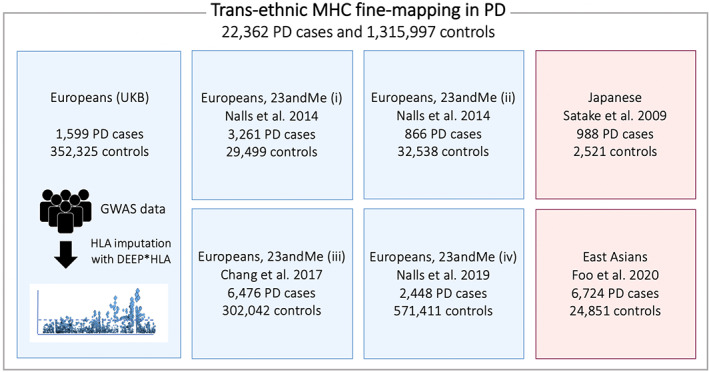
We conducted trans-ethnic fine-mapping of the MHC region for European populations (14,650 cases and 1,288,625 controls) and East Asian populations (7712 cases and 27,372 controls). We adopted a hybrid fine-mapping approach including both HLA genotype imputation of genome-wide association study (GWAS) data and direct imputation of HLA variant risk from the GWAS summary statistics.
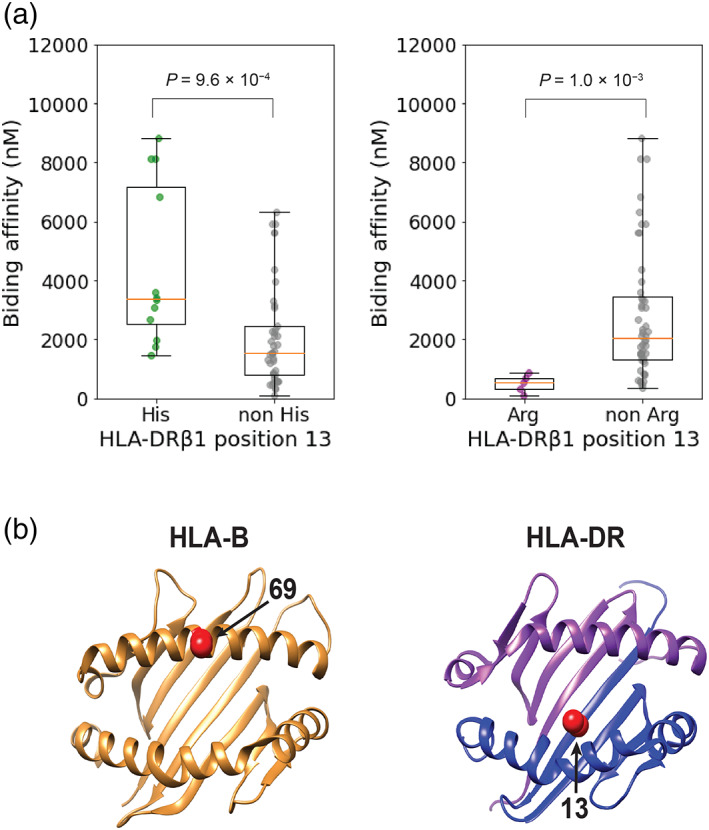
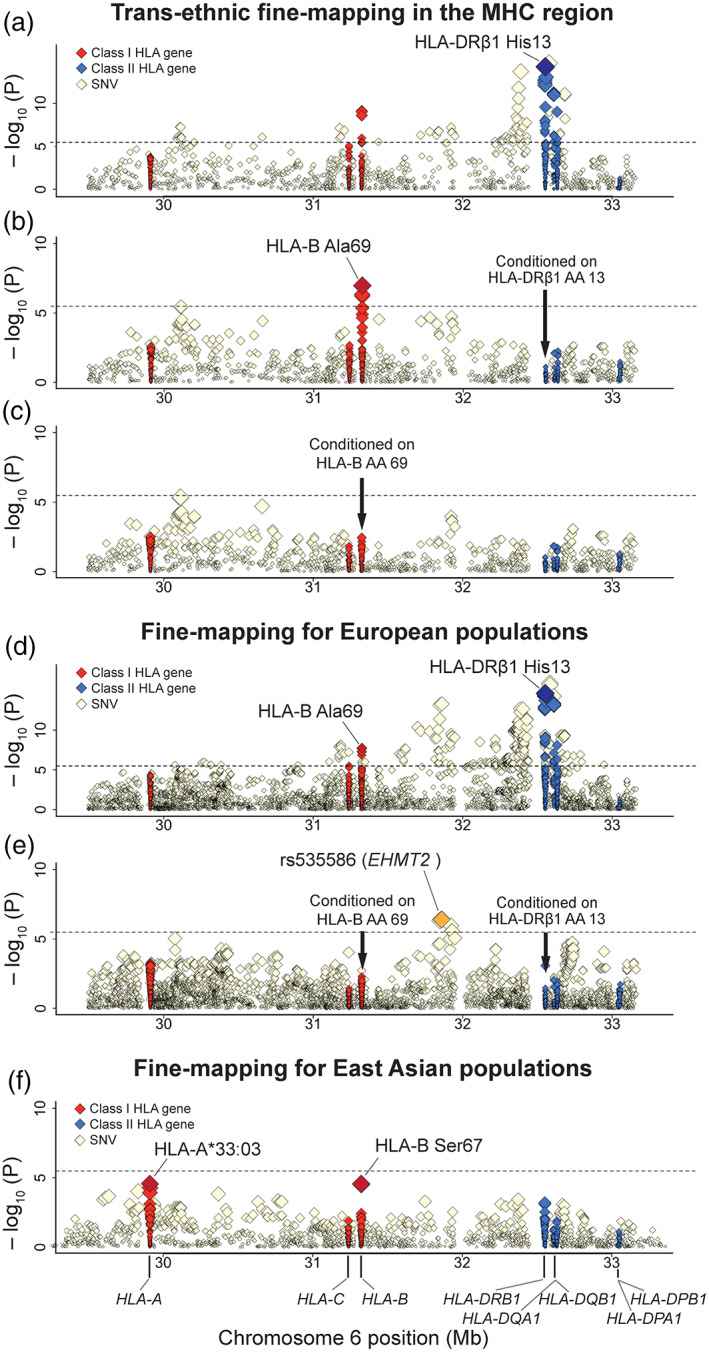
Through trans-ethnic MHC fine-mapping, we identified the strongest associations at amino acid position 13 of HLA-DRβ1 (P = 6.0 × 10 ), which explains the majority of the risk in HLA-DRB1. In silico prediction revealed that HLA-DRB1 alleles with histidine at amino acid position 13 (His13) had significantly weaker binding affinity to an α-synuclein epitope than other alleles (P = 9.6 × 10 ). Stepwise conditional analysis suggested additional independent associations at Ala69 in HLA-B (P = 1.0 × 10 ). A subanalysis in Europeans suggested additional independent associations at non-HLA genes in the class III MHC region (EHMT2; P = 2.5 × 10 ).
Our study highlights the shared and distinct genetic features of the MHC region in patients with PD across ethnicities. © 2021 The Authors. Movement Disorders published by Wiley Periodicals LLC on behalf of International Parkinson and Movement Disorder Society.
尽管人类白细胞抗原(HLA)在帕金森病(PD)的遗传易感性中发挥作用,但主要组织相容性复合体(MHC)区域的复杂单倍型结构和高度多态性特征阻碍了对 PD 遗传风险的统一认识。此外,大多数报告都集中在欧洲人群,缺乏其他人群的证据。
本研究旨在阐明与跨种族队列 PD 风险相关的 MHC 区域的遗传特征。
我们对欧洲人群(14650 例病例和 1288625 例对照)和东亚人群(7712 例病例和 27372 例对照)进行了 MHC 区域的跨种族精细定位。我们采用了一种混合精细定位方法,包括全基因组关联研究(GWAS)数据的 HLA 基因型推断和 GWAS 汇总统计数据中 HLA 变体风险的直接推断。
通过跨种族 MHC 精细定位,我们在 HLA-DRβ1 的第 13 位氨基酸处鉴定出最强的关联(P=6.0×10),这解释了 HLA-DRB1 中的大部分风险。在计算机预测中,具有第 13 位氨基酸组氨酸(His13)的 HLA-DRB1 等位基因与α-突触核蛋白表位的结合亲和力明显较弱(P=9.6×10)。逐步条件分析表明,HLA-B 中的 Ala69 处存在额外的独立关联(P=1.0×10)。在欧洲人群中的一项亚分析表明,MHC 区域的 III 类非 HLA 基因中存在额外的独立关联(EHMT2;P=2.5×10)。
我们的研究强调了跨种族 PD 患者 MHC 区域的共享和独特的遗传特征。